 As we saw in the blog post The UK’s poor productivity record, the UK’s productivity, as measured by output per hour worked, has grown much slower than in other major developed countries since the financial crisis. In fact, output per hour is lower now than in 2008. In France and Germany it is around 3 per higher than in 2008; in Japan it is nearly 6% higher; in the USA it is over 8% higher; and in Ireland it is 12% higher.
The chart below shows international comparisons of labour productivity from 2000 to 2014. (Click here for a PowerPoint of the chart.)
And it is not just labour productivity that has fallen in the UK. Total factor productivity of labour and capital combined has also fallen. This reflects the fall in business investment after the financial crisis and, more recently, meeting the demand for extra output by employing more labour rather than by investing in extra capital.
 In his first major speech since the election, the Chancellor of the Exchequer, George Osborne, told the CBI that the government was intent on tackling the problem of low and stagnant productivity. This would require investment in infrastructure, such as high-speed rail, better roads, superfast broadband and a new runway in the south east. It would require investment in education, training and research; it would involve cutting red tape for business; it would require making it easier for both parents in a family to work by cutting the cost of childcare. The details of the government’s policies would be made clear in the soon-to-be published Productivity Plan.
But how much difference can the government make? Are there intractable problems that will prove virtually impossible to overcome? How much, indeed, can a government do, however much it would like to? The articles explore the issues.
Articles
Will George Osborne’s productivity plan help make Britain a world-beater? The Guardian, Larry Elliott (24/5/15)
UK productivity has stayed stubbornly low for years. Dare we hope for better? The Guardian (24/5/15)
Joseph Stiglitz: ‘GDP per capita in the UK is lower than it was before the crisis. That is not a success’ The Observer, Anthony Andrew (24/5/15)
Osborne says low productivity key economic challenge BBC News (20/5/15)
Solving the productivity puzzle BBC News, Duncan Weldon (20/4/15)
Osborne faces up to productivity challenge BBC News, Robert Peston (20/5/15)
Osborne makes priority of boosting UK productivity Financial Times, George Parker (20/5/15)
The Bank of England is living in cloud-cuckoo land on wages Independent, David Blanchflower (18/5/14)
Cameron’s Plan Hasn’t Cracked Productivity Slump Flagged by BOE Bloomberg, Jill Ward (14/5/15)
To solve Britain’s productivity puzzle, try asking the workers The Conversation, Stephen Wood (29/6/15)
Report
Inflation Report: Chapter 3, Output and Supply Bank of England (May 2015)
Questions
- Define (a) labour productivity; (b) capital productivity; (c) total factor productivity.
- Why has the UK experienced lower productivity than other developed countries?
- Why may the UK’s lower unemployment than other countries in the post-recession period be the direct consequence of lower productivity growth?
- For what reasons might it be difficult for the government to achieve a significant increase in UK productivity?
- How might demand-side policy negatively impact on the supply-side policies that the government might adopt to increase productivity?
- How might the period up to and beyond the referendum in the UK on continuing EU membership impact on productivity?
- How might poor productivity be tackled?
 Real GDP depends on two things: output per hour worked and the number of hours worked. On the surface, the UK economy is currently doing relatively well, with growth in 2014 of 2.8%. After several years of poor economic growth following the financial crisis of 2007/8, growth of 2.8% represents a return to the long-run average for the 20 years prior to the crisis.
But growth since 2010 has been entirely due to an increase in hours worked. On the one hand, this is good, as it has meant an increase in employment. In this respect, the UK is doing better than other major economies. But productivity has not grown and on this front, the UK is doing worse than other countries.
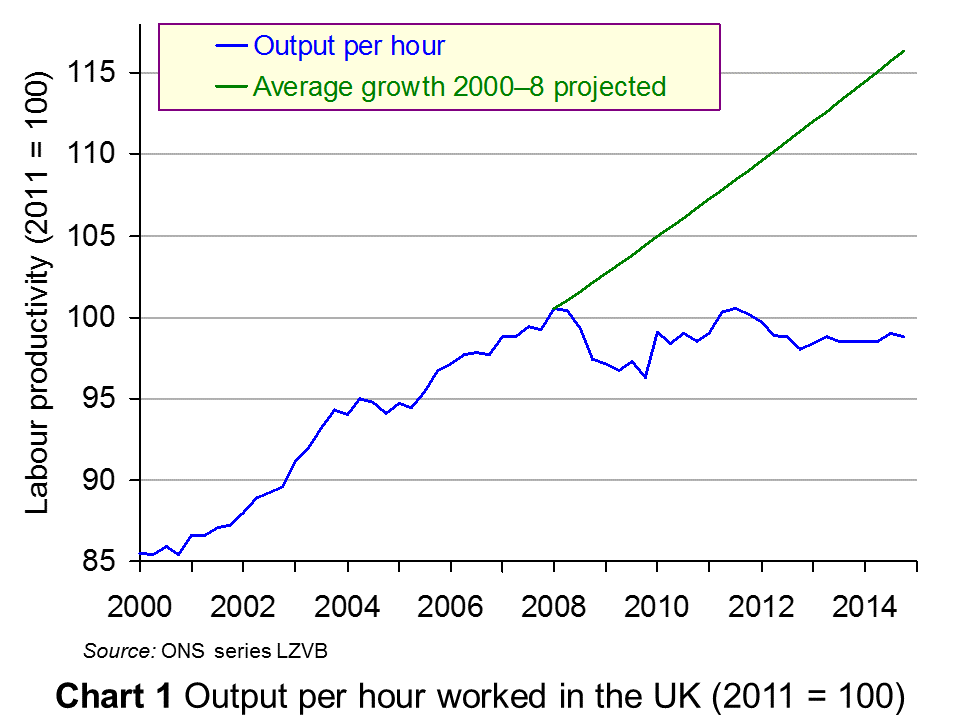 The first chart shows UK output per hour worked (click here for a PowerPoint). It is based on figures released by the ONS on 1 April 2015. Average annual growth in output per hour worked was 2.3% from 2000 to 2008. Since then, productivity growth has stalled and output per hour is now lower than at the peak in 2008.
The green line projects from 2008 what output per hour would have been if its growth had remained at 2.3%. It shows that by the end of 2014 output per hour would have been nearly 18% higher if productivity growth had been maintained.
 The second chart compares UK productivity growth with other countries (click here for a PowerPoint). Up to 2008, UK productivity was rising slightly faster than in the other five countries illustrated. Since then, it has performed worse than the other five countries, especially since 2011.
Productivity growth increases potential GDP. It also increases actual GDP if the productivity increase is not offset by a fall in hours worked. A rise in hours worked without a rise in productivity, however, even though it results in an increase in actual output, does not increase potential output. If real GDP growth is to be sustained over the long term, there must be an increase in productivity and not just in hours worked.
The articles below examines this poor productivity performance and looks at reasons why it has been so bad.
Articles
UK’s sluggish productivity worsened in late 2014 – ONS Reuters (1/4/15)
UK productivity growth is weakest since second world war, says ONS The Guardian, Larry Elliott (1/4/15)
UK productivity weakness worsening, says ONS Financial Times, Chris Giles (1/4/15)
Is the UK’s sluggish productivity a problem? Financial Times comment (1/4/15)
UK manufacturing hits eight-month high but productivity slump raises fears over sustainability of economic recovery This is Money, Camilla Canocchi (1/4/15)
Weak UK productivity unprecedented, ONS says BBC News (1/4/15)
Weep for falling productivity Robert Peston (1/4/15)
UK’s Falling Productivity Prevented A Massive Rise In Unemployment Forbes, Tim Worstall (2/4/15)
Data
Labour Productivity, Q4 2014 ONS (1/4/15)
AMECO database European Commission, Economic and Financial Affairs
Questions
- How can productivity be measured? What are the advantages and disadvantages of using specific measures?
- Draw a diagram to show the effects on equilibrium national income of (a) a productivity increase, but offset by a fall in the number of hours worked; (b) a productivity increase with hours worked remaining the same; (c) a rise in hours worked with no increase in productivity. Assume that actual output depends on aggregate demand.
- Is poor productivity growth good for employment? Explain.
- Why is productivity in the UK lower now than in 2008?
- What policies can be pursued to increase productivity in the UK?
 ‘Employment has been strong, but productivity and real wages have been flat.’ This is one of the key observations in a new OECD report on the state of the UK economy. If real incomes for the majority of people are to be raised, then labour productivity must rise.
For many years, the UK has had a lower productivity (in terms of output per hour worked) than most other developed countries, with the exception of Japan. But from 1980 to the mid 2000s, the gap was gradually narrowing. Since then, however, the gap has been widening again. This is illustrated in Chart 1, which shows countries’ productivity relative to the UK’s (with the UK set at 100). (Click here for a PowerPoint.)
Compared with the UK, GDP per hour worked in 2013 (the latest data available) was 28% higher in France, 29% higher in Germany and 30% higher in the USA. What is more, GDP per hour worked  and GDP per capita in the UK fell by 3.8% and 6.1% respectively after the financial crisis of 2007/8 (see the green and grey lines in Chart 2). And while both indicators began rising after 2009, they were still both below their 2007 levels in 2013. Average real wages also fell after 2007 but, unlike the other two indicators, kept on falling and by 2013 were 4% below their 2007 levels, as the red line in Chart 2 shows. (Click here for a PowerPoint.)
Although productivity and even real wages are rising again, the rate of increase is slow. If productivity is to rise, there must be investment. 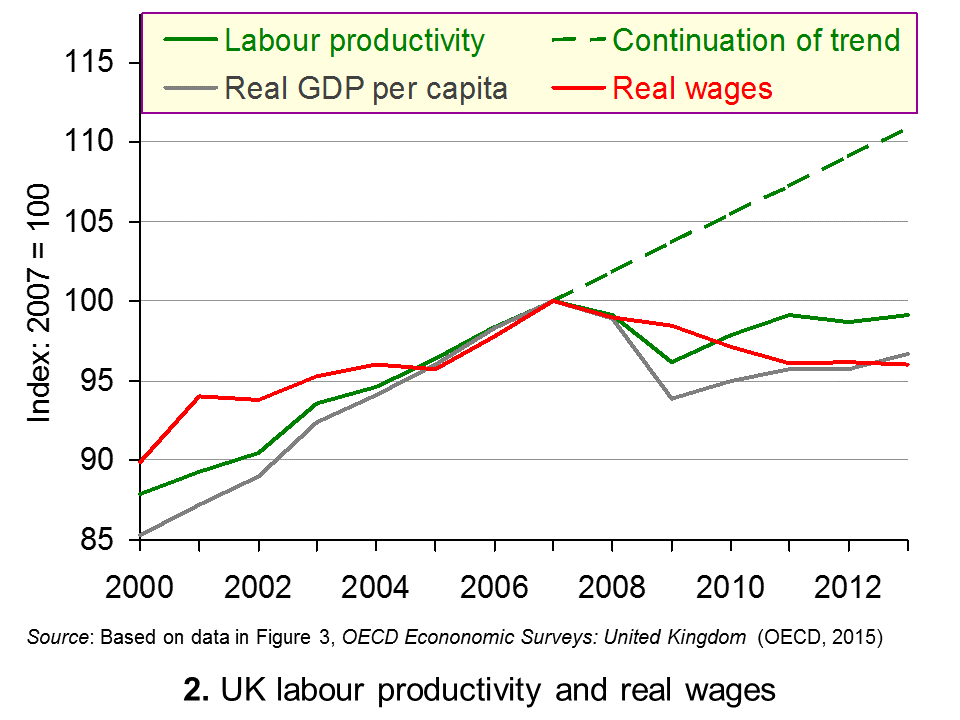 This could be in physical capital, human capital or, preferably, both. But for many years the UK has had a lower rate of investment than other countries, as Chart 3 shows. (Click here for a PowerPoint.) This chart measures investment in fixed capital as a percentage of GDP.
So how can investment be encouraged? Faster growth will encourage greater investment through the accelerator effect, but such an effect could well be short-lived as firms seek to re-equip but may be cautious about committing to increasing capacity. What is crucial here is maintaining 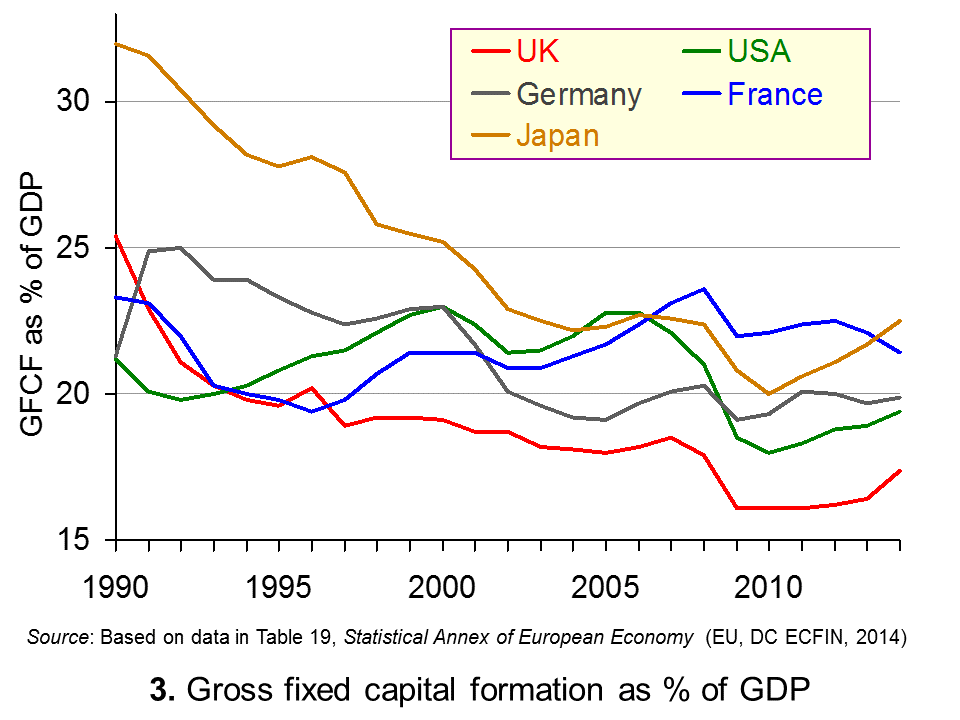 high degrees of business confidence over an extended period of time.
More fundamentally, there are structural problems that need tackling. One is the poor state of infrastructure. This is a problem not just in the UK, but in many developed countries, which cut back on public and private investment in transport, communications and energy infrastructure in an attempt to reduce government deficits after the financial crisis. Another is the low level of skills of many workers. Greater investment in training and apprenticeships would help here.
Then there is the question of access to finance. Although interest rates are very low, banks are cautious about granting long-term loans to business. Since the financial crisis banks have become much more risk averse and long-term loans, by their nature, are relatively risky. Government initiatives to provide finance to private companies may help here. For example the government has just announced a Help to Grow scheme which will provide support for 500 small firms each year through the new British Business Bank, which will provide investment loans and also grants on a match funding basis for new investment.
Articles
OECD: UK must fix productivity Economia, Oliver Griffin (25/2/15)
The UK’s productivity puzzle BBC News, Lina Yueh (24/2/15)
OECD warns UK must fix productivity problem to raise living standards The Guardian, Katie Allen (24/2/15)
Britain must boost productivity to complete post-crisis recovery, says OECD International Business Times, Ian Silvera (24/2/15)
OECD urges UK to loosen immigration controls on skilled workers Financial Times, Emily Cadman and Helen Warrell (24/2/15)
Report
OECD Economic Surveys, United Kingdom: Overview OECD (February 2015)
OECD Economic Surveys, United Kingdom: Full report OECD (February 2015)
Questions
- In what ways can productivity be measured? What are the relative merits of using the different measures?
- Why has the UK’s productivity lagged behind other industrialised countries?
- What is the relationship between income inequality and labour productivity?
- Why has UK investment been lower than in other industrialised countries?
- What are zombie firms? How does the problem of zombie firms in the UK compare with that in other countries? Explain the differences.
- What policies can be pursued to increased labour productivity?
- What difficulties are there in introducing effective policies to tackle low productivity?
- Should immigration controls be lifted to tackle the problem of a shortage of skilled workers?
 In a post last August we looked at the rising number of workers employed on ‘zero-hours’ contracts. These are contracts where there are no guaranteed minimum hours. Such contracts give employers the flexibility to employ workers as much or as little as suits the business. Sometimes it benefits workers, who might be given the flexibility to request the hours that suit them, but usually workers simply have to take the hours on offer.
Latest figures published by the Office for National Statistics show that zero-hours contracts are on the increase. In 2014 quarter 4, 697,000 workers were recorded as being on zero-hours contracts.  This represents 2.3% of people in employment. Ten years ago (2004, Q4) the figures were 108,000 or 0.4%: see chart. (Click here for a PowerPoint of the chart.)
Around one third of the 697,000 people on zero-hours contracts wanted more work if they could get it and most wanted it in their current job rather than having to move jobs. These people wanting more work can be classed as underemployed. They also include those not on a zero-hours contract who would like to work more if they could.
According to the ONS:
‘People on zero-hours contracts are more likely to be women, in full-time education or in young or older age groups when compared with other people in employment. On average, someone on a zero-hours contract usually works 25 hours a week.’ (See section 4 of the report for more details.)
As we saw in the earlier post, many public- and private-sector employers use such contracts, including many small and medium-sized enterprises and many well-known large companies, such as Sports Direct, Amazon, JD Wetherspoon and Cineworld. It gives them the flexibility to adjust the hours they employ people. It allows them to keep people in employment when demand is low. It also makes them more willing to take on staff when demand rises, as it removes the fear of being over-staffed if demand then falls back.
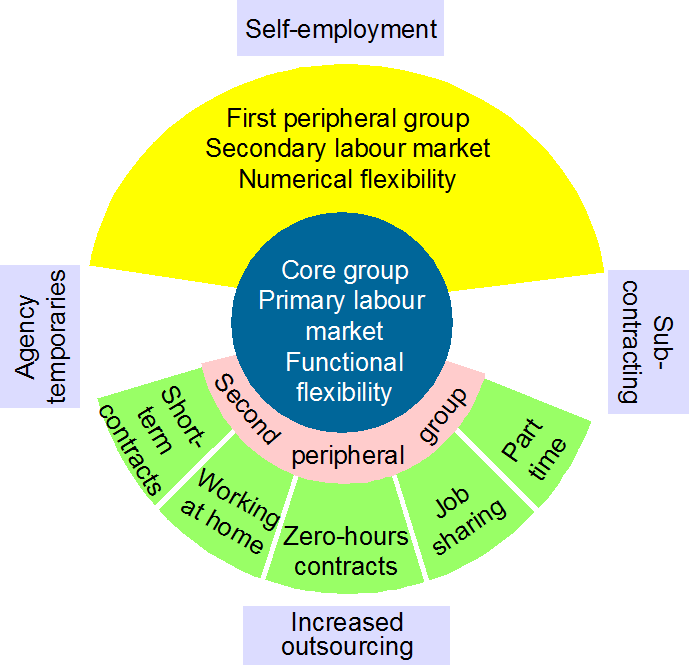 As we also saw, zero-hours contracts are not the only form of flexible working. Other examples include: ‘self-employed’ workers, contracted separately for each job they do for a company; people paid largely or wholly on commission; on-call working; part-time working, where the hours are specified in advance, but where these are periodically re-negotiated; overtime; people producing a product or service for a company (perhaps at home), where the company varies the amount paid per unit according to market conditions.
The extent of zero-hours contracts varies dramatically from one sector of the economy to another. Only 0.6% of workers in the Information, Finance and Professional sectors were on zero-hours contracts in 2014 Q4, whereas 10% in the Accommodation and Food sectors were.
The flexibility that such contracts give employers may make them more willing to keep on workers when demand is low – they can reduce workers’ hours rather than laying them off. It also may make them more willing to take on workers (or increase their hours) when demand is expanding, not having to worry about being over staffed later on.
However, many workers on such contracts find it hard to budget when their hours are not guaranteed and can vary significantly from week to week.
Articles
lmost 700,000 people in UK have zero-hours contract as main job The Guardian, Phillip Inman (25/2/15)
UK firms use 1.8m zero-hours contracts, says ONS BBC News (25/1/15)
Zero-hours contracts jump in UK Financial Times, Emily Cadman (25/2/15)
Zero-hours contracts ‘disturbingly’ hit 1.8 million in 2014 International Business Times, Ian Silvera (25/2/15)
Zero-hours contracts a reality for almost 700,000 UK workers, ONS figures show Independent, Antonia Molloy (25/1/15)
Data
Contracts with No Guaranteed Hours, Zero Hour Contracts, 2014 ONS Release (25/1/15)
Supplementary LFS data on zero hours contracts – October to December 2014 ONS dataset (25/2/15)
Analysis of Employee Contracts that do not Guarantee a Minimum Number of Hours ONS Report (25/1/15)
Questions
- Distinguish between open unemployment, disguised unemployment and underemployment?
- Distinguish between functional, numerical and financial flexibility? Which type or types of flexibility do zero-hours contracts give the firm?
- In a ‘flexible’ labour market, what forms can that flexibility take?
- Why does the Accommodation and Food sector have a relatively high proportion of people employed on zero-hours contracts?
- What are the benefits and costs to employers of using zero-hours contracts?
- If a company introduces a system of zero-hours contracts, is this in accordance with the marginal productivity theory of profit maximisation from employment?
- What are the benefits and costs to employees of working on zero-hours contracts?
- Why has the use of zero-hours contracts risen so rapidly?
- Using the ONS data, find out how the use of zero-hours contracts varies by occupation and explain why.
- Identify what forms of flexible contracts are used for staff in your university or educational establishment. Do they benefit (a) staff; (b) students?
- Consider the arguments for and against (a) banning and (b) regulating zero-hours contracts.
 What is the relationship between the degree of inequality in a country and the rate of economic growth? The traditional answer is that there is a trade off between the two. Increasing the rewards to those who are more productive or who invest encourages a growth in productivity and capital investment, which, in turn, leads to faster economic growth. Redistribution from the rich to the poor, by contrast, is argued to reduce incentives by reducing the rewards from harder work, education, training and investment. Risk taking, it is claimed, is discouraged.
Recent evidence from the OECD and the IMF, however, suggests that when income inequality rises, economic growth falls. Inequality has grown massively in many countries, with average incomes at the top of the distribution seeing particular gains, while many at the bottom have experienced actual declines in real incomes or, at best, little or no growth.  This growth in inequality can be seen in a rise in countries’ Gini coefficients. The OECD average Gini coefficient rose from 0.29 in the mid-1980s to 0.32 in 2011/12. This, claims the OECD, has led to a loss in economic growth of around 0.35 percentage points per year.
But why should a rise in inequality lead to lower economic growth? According to the OECD, the main reason is that inequality reduces the development of skills of the lower income groups and reduces social mobility.
By hindering human capital accumulation, income inequality undermines education opportunities for disadvantaged individuals, lowering social mobility and hampering skills development.
The lower educational attainment applies both to the length and quality of education: people from poorer backgrounds on average leave school or college earlier and with lower qualifications.
But if greater inequality generally results in lower economic growth, will a redistribution from rich to poor necessarily result in faster economic growth? According to the OECD:
Anti-poverty programmes will not be enough. Not only cash transfers but also increasing access to public services, such as high-quality education, training and healthcare, constitute long-term social investment to create greater equality of opportunities in the long run.
Thus redistribution policies need to be well designed and implemented and focus on raising incomes of the poor through increased opportunities to increase their productivity. Simple transfers from rich to poor via the tax and benefits system may, in fact, undermine economic growth. According to the IMF:
That equality seems to drive higher and more sustainable growth does not in itself support efforts to redistribute. In particular, inequality may impede growth at least in part because it calls forth efforts to redistribute that themselves undercut growth. In such a situation, even if inequality is bad for growth, taxes and transfers may be precisely the wrong remedy.
Articles
Inequality ‘significantly’ curbs economic growth – OECD BBC News (9/12/14)
Is inequality the enemy of growth? BBC News, Robert Peston (6/10/14)
Income inequality damages growth, OECD warns Financial Times, Chris Giles (8/10/14)
OECD finds increasing inequality lowers growth Deutsche Welle, Jasper Sky (10/12/14)
Revealed: how the wealth gap holds back economic growth The Guardian, Larry Elliott (9/12/14)
Inequality Seriously Damages Growth, IMF Seminar Hears IMF Survey Magazine (12/4/14)
Warning! Inequality May Be Hazardous to Your Growth iMFdirect, Andrew G. Berg and Jonathan D. Ostry (8/4/11)
Economic growth more likely when wealth distributed to poor instead of rich The Guardian, Stephen Koukoulas (4/6/15)
So much for trickle down: only bold reforms will tackle inequality The Guardian, Larry Elliott (21/6/15)
Videos
Record inequality between rich and poor OECD on YouTube (5/12/11)
The Price of Inequality The News School on YouTube, Joseph Stiglitz (5/10/12)
Reports and papers
FOCUS on Inequality and Growth OECD, Directorate for Employment, Labour and Social Affairs (December 2014)
Trends in Income Inequality and its Impact on Economic Growth OECD Social, Employment and Migration Working Papers, Federico Cingano (9/12/14)
An Overview of Growing Income Inequalities in OECD Countries: Main Findings OCED (2011)
Redistribution, Inequality, and Growth IMF Staff Discussion Note, Jonathan D. Ostry, Andrew Berg, and Charalambos G. Tsangarides (February 2014)
Measure to Measure Finance and Development, IMF, Jonathan D. Ostry and Andrew G. Berg (Vol. 51, No. 3, September 2014)
Data
OECD Income Distribution Database: Gini, poverty, income, Methods and Concepts OECD
The effects of taxes and benefits on household income ONS
Questions
- Explain what are meant by a Lorenz curve and a Gini coefficient? What is the relationship between the two?
- The Gini coefficient is one way of measuring inequality. What other methods are there? How suitable are they?
- Assume that the government raises taxes to finance higher benefits to the poor. Identify the income and substitution effects of the tax increases and whether the effects are to encourage or discourage work (or investment).
- Distinguish between (a) progressive, (b) regressive and (c) proportional taxes?
- How will the balance of income and substitution effects vary in each of the following cases: (a) a cut in the tax-free allowance; (b) a rise in the basic rate of income tax; (c) a rise in the top rate of income tax? How does the relative size of the two effects depend, in each case, on a person’s current income?
- Identify policy measures that would increase both equality and economic growth.
- Would a shift from direct to indirect taxes tend to increase or decrease inequality? Explain.
- By examining Tables 3, 26 and 27 in The Effects of Taxes and Benefits on Household Income, 2012/13, (a) explain the difference between original income, gross income, disposable income and post-tax income; (b) explain the differences between the Gini coefficients for each of these four categories of income in the UK.
 As we saw in the blog post The UK’s poor productivity record, the UK’s productivity, as measured by output per hour worked, has grown much slower than in other major developed countries since the financial crisis. In fact, output per hour is lower now than in 2008. In France and Germany it is around 3 per higher than in 2008; in Japan it is nearly 6% higher; in the USA it is over 8% higher; and in Ireland it is 12% higher.