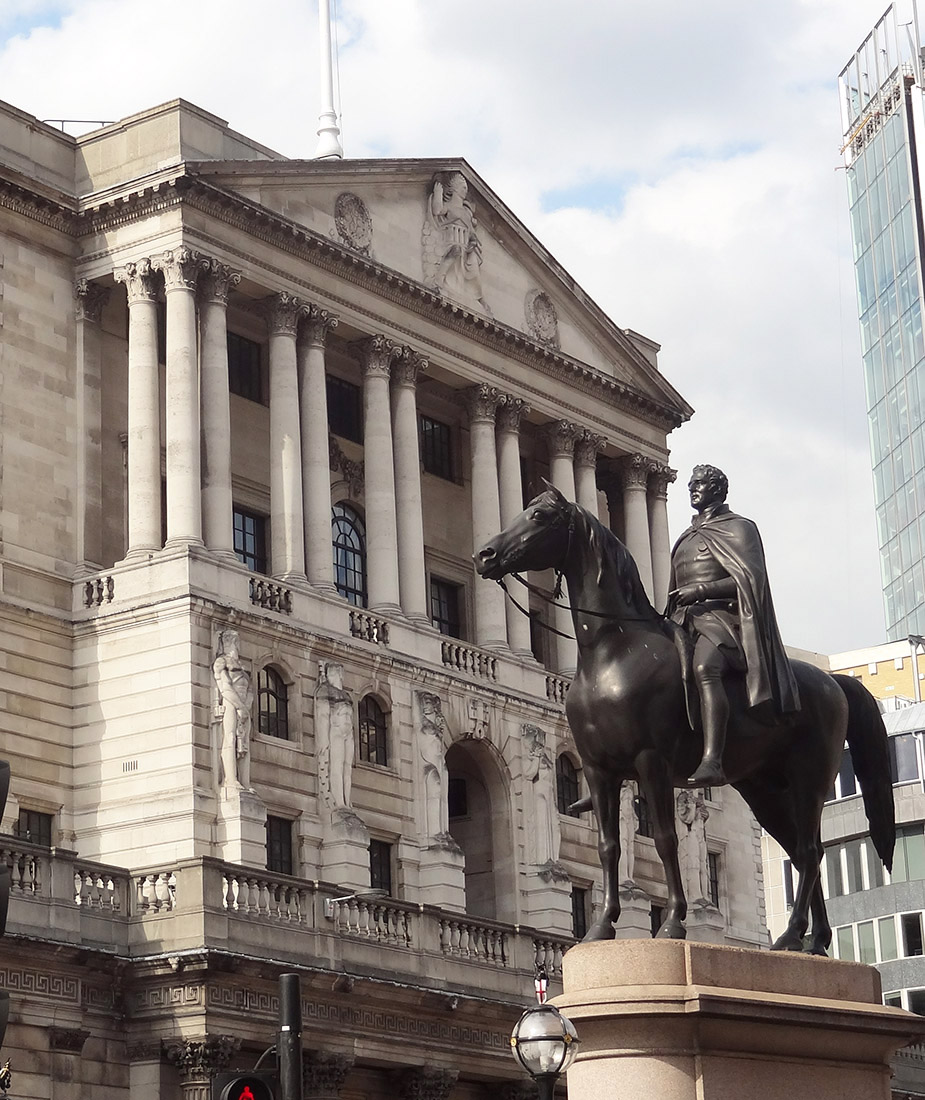
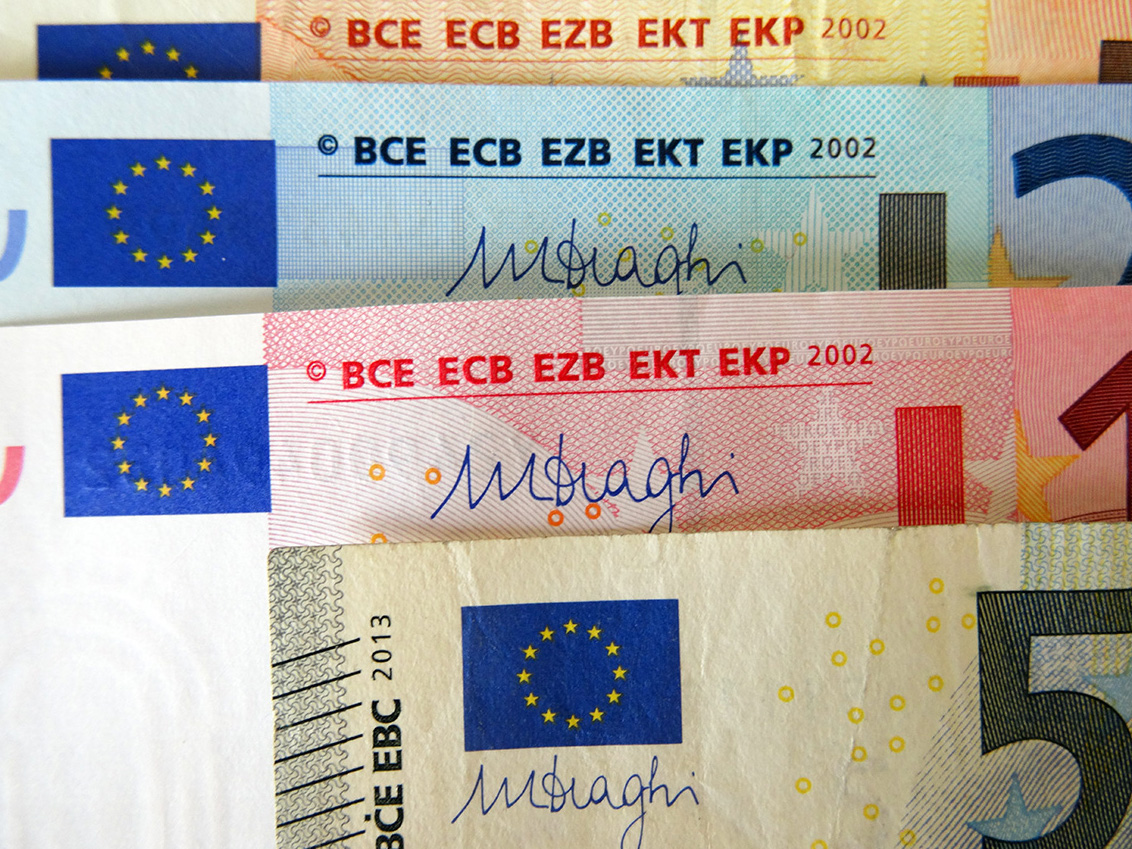
 The Brexit vote has caused shockwaves throughout European economies. But there is a potentially larger economic and political problem facing the EU and the eurozone more specifically. And that is the state of the Italian banking system and the Italian economy.
Italy is the third largest economy in the eurozone after Germany and France. Any serious economic weaknesses could have profound consequences for the rest of the eurozone and beyond.
At 135% of GDP, Italy’s public-sector debt is one the highest in the world; its banks are undercapitalised with a high proportion of bad debt; and it is still struggling to recover from the crisis of 2008–9. The Economist article elaborates:
The adult employment rate is lower than in any EU country bar Greece. The economy has been moribund for years, suffocated by over-regulation and feeble productivity. Amid stagnation and deflation, Italy’s banks are in deep trouble, burdened by some €360 billion of souring loans, the equivalent of a fifth of the country’s GDP. Collectively they have provisioned for only 45% of that amount. At best, Italy’s weak banks will throttle the country’s growth; at worst, some will go bust.
Since 2007, the economy has shrunk by 10%. And potential output has fallen too, as firms have closed. Unemployment is over 11%, with youth unemployment around 40%.
Things seem to be coming to a head. As confidence in the Italian banking system plummets, the Italian government would like to bail out the banks to try to restore confidence and encourage deposits and lending. But under new eurozone rules designed to protect taxpayers, it requires that the first line of support should be from bondholders. Such support is known as a ‘bail-in’.
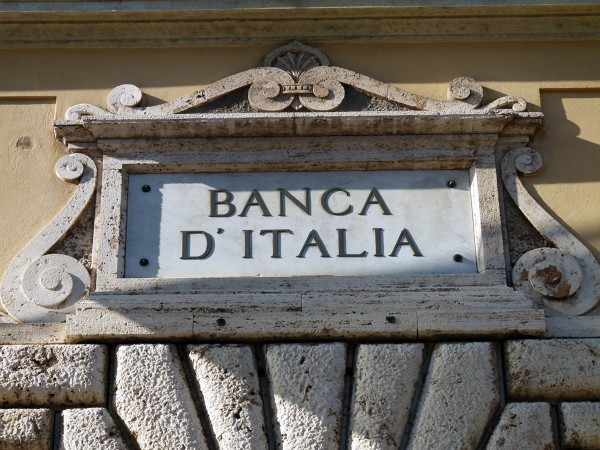 If bondholders were large institutional investors, this might not be such a problem, but a significant proportion of bank bonds in Italy are held by small investors, encouraged to do so by tax relief. Bailing in the banks by requiring bondholders to bear significant losses in the value of their bonds could undermine the savings of many Italians and cause them severe hardship, especially those who had saved for their retirement.
So what is the solution? Italian banks need recapitalising to restore confidence and prevent a more serious crisis. However, there is limited scope for bailing in, unless small investors can be protected. And eurozone rules provide little scope for government funding for the banks. These rules should be relaxed under extreme circumstances. At the same time, policy needs to focus on making Italian banking more efficient.
Meanwhile, the IMF is forecasting that Italian economic growth will be less than 1% this year and little better in 2017. Part of the problem, claims the IMF, is the Brexit vote. This has heightened financial market volatility and increasead the risks for Italy with its fragile banking system. But the problems of the Italian economy run deeper and will require various supply-side policies to tackle low productivity, corruption, public-sector inefficiency and a financial system not fit for purpose. What the mix of these policies should be – whether market based or interventionist – is not just a question of effectiveness, but of political viability and democratic support.
Articles
The Italian Job The Economist (9/7/16)
IMF warns Italy of two-decade-long recessionThe Guardian, Larry Elliott (11/7/16)
Italy economy: IMF says country has ‘two lost decades’ of growth BBC News (12/7/16)
What’s the problem with Italian banks? BBC News, Andrew Walker (10/7/16)
Why Italy’s banking crisis will shake the eurozone to its core The Telegraph, Tim Wallace Szu Ping Chan (16/8/16)
If You Thought Brexit Was Bad Wait Until The Italian Banks All Go Bust Forbes, Tim Worstall (17/7/16)
In the euro zone’s latest crisis, Italy is torn between saving the banks or saving its people Quartz, Cassie Werber (13/7/16)
Why Italy could be the next European country to face an economic crisis Vox, Timothy B. Lee (8/7/16)
Forget Brexit, Quitaly is Europe’s next worry The Guardian, Larry Elliott (26/7/16)
Report
Italy IMF Country Report No. 16/222 (July 2016)
Data
Economic Outlook OECD (June 2016) (select ‘By country’ from the left-hand panel and then choose ‘Italy’ from the pull-down menu and choose appropriate time series)
Questions
- Can changes in aggregate demand have supply-side consequences? Explain.
- Explain why there may be a downward spiral of asset sales by banks.
- How might the principle of bail-ins for undercapitalised Italian banks be pursued without being at the expense of the small saver?
- What lessons are there from Japan’s ‘three arrows’ for Italy? Does being in the eurozone constrain Italy’s ability to adopt any or all of these three categories of policy?
- Why may the Brexit vote have more serious consequences for Italy than many other European economies?
- Find out what reforms have already been adopted or are being pursued by the Italian government. How successful are they likely to be in increasing Italian growth and productivity?
- What external factors are currently (a) favourable, (b) unfavourable to improving Italian growth and productivity?
 In the blog post, Global warning, we looked at the use of unconventional macroeconomic policies to deal with the slow pace of economic growth around the world. One of the articles was by Nouriel Roubini. In the linked article below, he argues that slow economic growth may be the new global norm.
At the centre of the problem is a fall in the rate of potential economic growth. This has been caused by a lack of investment, which has slowed the pace of innovation and the growth in labour productivity.
The lack of investment, in turn, has been caused by a lack of spending by both households and governments. What is the point in investing in new capacity, argue firms, if they already have spare capacity?
Low consumer spending is partly the result of a redistribution of income from low- and middle-income households (who have a high marginal propensity to consume) to high-income households and corporations (who have a low mpc). Low spending is also the result of both consumers and governments attempting to reduce their levels of debt by cutting back spending.
Low growth leads to hysteresis – the process whereby low actual growth leads to low potential growth. The reason is that the unemployed become deskilled and the lack of investment by firms reduces the innovation that is necessary to embed new technologies.
Read Roubini’s analysis and consider the policy implications.
Article
Has the global economic growth malaise become the ‘new normal’? The Guardian, Nouriel Roubini (2/5/16)
Questions
- Explain what is meant by ‘hysteresis’ and how the concept is relevant in explaining low global economic growth.
- Why has there been a reduction in the marginal propensity to consume in recent years? What is the implication of this for the multiplier and economic recovery?
- Explain what Roubini means by ‘a painful de-leveraging process’. What are the implications of this process?
- How important are structural reforms and what forms could these take? Why has there been a reluctance for governments to institute such reforms?
- ‘Asymmetric adjustment between debtor and creditor economies has also undermined growth.’ Explain what Roubini means by this.
- Why are governments reluctant to use fiscal policy to boost both actual and potential economic growth?
- What feasible policy measures could be taken to boost actual and potential economic growth?
 In a recent post, Global Warning, we looked at concerns about the global economy. One of these was about the ineffectiveness of monetary policy to stimulate aggregate demand and to restore growth rates. Despite the use of unconventional monetary policies, such as quantitative easing and negative interest rates, and despite the fact that these policies have become the new convention, they have failed to do enough to bring sustained recovery.
The two articles below argue that the failure has been due to a flawed model of monetary policy: one that takes too little account of the behaviour of banks and the drivers of consumption and of physical investment. Negative interest rates on banks’ holdings of reserves in central banks are hardly likely to push down lending rates to businesses sufficiently to stimulate investment in new plant and machinery if firms already have overcapacity. And consumers are unlikely to borrow more for consumption if their wages are barely rising and they already have debts that they fear will be difficulty to pay off.
As Joseph Stiglitz points out:
As real interest rates have fallen, business investment has stagnated. According to the OECD, the percentage of GDP invested in a category that is mostly plant and equipment has fallen in both Europe and the US in recent years. (In the US, it fell from 8.4% in 2000 to 6.8% in 2014; in the EU, it fell from 7.5% to 5.7% over the same period.) Other data provide a similar picture.
And the unwillingness of many firms and individuals to borrow is matched by banks’ caution about lending in an uncertain economic environment. Many are more concerned about building their capital and liquidity ratios to protect themselves. In these circumstances, negative interest rates have little effect on stimulating bank lending and, by hurting their balance sheets through lower earnings on the money markets, may even encourage them to lend less
What central banks should be doing, argue both Stiglitz and Elliott, is finding ways of directly stimulating consumption and investment. Perhaps this will involve central banks “focusing on the flow of credit, which means restoring and maintaining local banks’ ability and willingness to lend to SMEs.” Perhaps it will mean using helicopter money, as we examined in the previous blog. As Larry Elliott points out:
The fact that economists at Deutsche Bank published a helpful cut-out-and-keep guide to helicopter  money last week is a straw in the wind.
As the Deutsche research makes clear, the most basic variant of helicopter money involves a central bank creating money so that it can be handed to the finance ministry to spend on tax cuts or higher public spending. There are two differences with QE. The cash goes directly to firms and individuals rather than being channelled through banks, and there is no intention of the central bank ever getting it back.
So if the model of monetary policy is indeed flawed, prepare for more unconventional measures
Articles
What’s Wrong With Negative Rates?, Project Syndicate, Joseph Stiglitz (13/4/16)
The bad smell hovering over the global economy The Guardian, Larry Elliott (17/4/16)
Questions
- What arguments does Stiglitz use to support his claim that the model of monetary policy currently being used is flawed?
- In what ways has monetary policy hurt older people and what has been the effect on their spending and on aggregate demand in general?
- Why has monetary policy encouraged investors to shift their portfolios toward riskier assets?
- Examine the argument that ultra-low interest rates may result in a rise in unemployment in the long term by affecting the relative prices of capital and labour.
- What forms might helicopter money take?
- Would the use of helicopter money necessarily result in an increase in aggregate demand? What would determine the size of any such increase?
 In a recent blog Accelerating interest in the interesting case of UK interest rates we compared the level of the official Bank Rate, which has now been at 0.5 per cent for over seven years, with a representative unsecured borrowing rate. In doing so, we found some evidence that credit conditions might be easing following the credit market disturbance of the late 2000s. Here we take the opportunity not only to review that data again one month on, but also to see whether a similar picture is true for the mortgage market.
Theories of the financial accelerator argue that the macroeconomic environment can affect commercial banks’ lending practices. One way in which this can operate is through the difference between banks’ lending rates and the official Bank Rate. We can think of such interest-rate differentials – or spreads – as a credit premium. The size of the premium may be thought to reflect lenders’ perceived risk of default by borrowers. It is argued by some economists that interest-rate differentials will fall when the economy is doing well and increase when the economy is doing less well. This is because the probability of default by borrowers is seen as smaller when the macroeconomic environment improves.
The effect of interest-rate differentials that are contingent on the macroeconomic environment is to amplify the business cycle. For example, a positive demand-side shock, such as a rise in consumer confidence, which causes the economy’s aggregate demand to rise will, in turn, lead to lower borrowing rates relative to the official Bank Rate. This financial effect further stimulates the demand for credit and, as a consequence, aggregate demand and economic activity. It is an example of what economists called the financial accelerator.
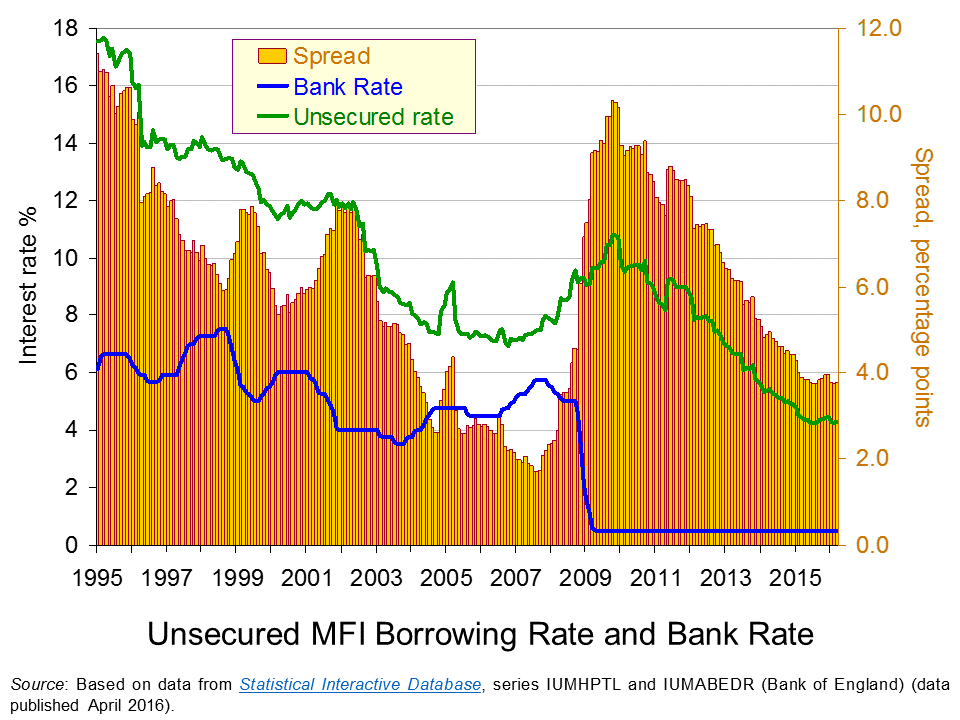 The chart shows the Bank Rate along with the average unsecured borrowing rate on loans by Monetary Financial Institutions (MFIs) of £10 000. Unlike secured borrowing, which we consider shortly, unsecured borrowing is not secured against property.
As expected, we can see that the unsecured borrowing rate is greater than the Bank Rate. In other words, there is a positive interest-rate differential. However, this differential is seen to vary. It falls sharply in the period up to the financial crisis. In early 2002 it was running at 8 percentage points. By summer 2007 the differential had fallen to only 1.7 percentage points. (Click here to download a PowerPoint of the chart.)
The period from 2002 to 2007 was characterised by consistently robust growth with the UK economy growing by about 2.7 per cent per annum over this period. This may point to economic growth can contributing to an easing of credit conditions as implied by the financial accelerator.
The story from 2008 changes very quickly as the interest-rate differential increases very sharply. In 2009, as the official Bank Rate was cut to 0.5 per cent, the unsecured borrowing rate climbed to close to 10.5 per cent. Consequently, the interest-rate differential rose to 10 percentage points. Inter-bank lending had dried up with banks concerned that banks would default on loans. The increase in interest rates on lending to the non-bank private sector was stark and evidence of a credit market disruption.
The interest-rate differential for unsecured borrowing has steadily declined since its peak at the end of 2009 as the unsecured borrowing rate has fallen. This implies that credit conditions have eased. In March 2016 our interest-rate differential for unsecured borrowing stood at 3.8 percentage points, not dissimilar to levels over the past 12 months. Interestingly, today’s differential on unsecured borrowing is lower than the 6.5 percentage point average over the period from 1997 to 2003, before the differential then went on its pre-crisis fall.
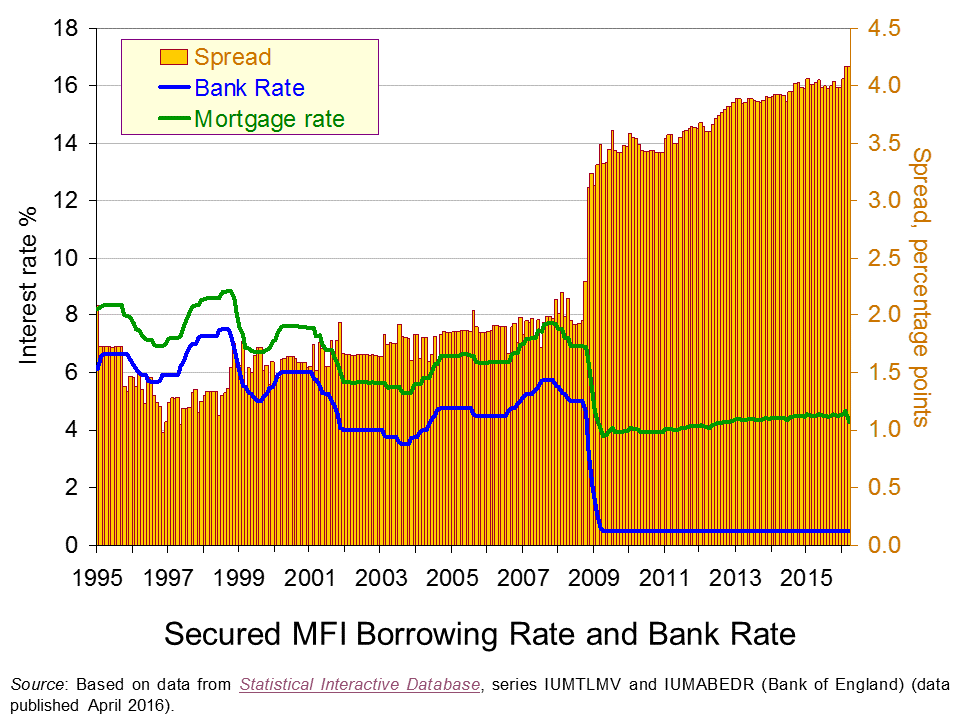 Our second chart repeats the analysis but this time for mortgages. The representative mortgage rate is the average standard variable mortgage rate.
Unlike that for unsecured borrowing, the interest-rate differential for mortgages is fairly constant up to the financial crisis. The widely report credit easing in the mortgage market appears to have operated more through amounts lent rather than through price, as evidenced by rising mortgage advance-to-income ratios. (Click here to download a PowerPoint of the chart.)
The second chart shows clear evidence of a credit market disruption from 2009. Hence, the markets for secured and unsecured lending saw credit conditions tighten with interest-rate differentials rising markedly. However, it shows that the higher interest-rate differential for secured lending following the credit market disruption remains. So while the differential has fallen sharply for unsecured lending the situation is quite different in the mortgage market. In fact, February and March 2016 saw the mortgage rate spread at 4.17 percentage points which is an historic high.
Our interest rate data show that interest-rate differentials can vary significantly over time. This is important to understand when we are thinking about the relationships between the macroeconomy and the financial system. Significantly, the data suggest that interest rates on different financial instruments can behave differently such that differences emerge in the patterns of spreads over the official Bank Rate.
The evidence on UK mortgage rates suggests that the market remains affected by the financial crisis and the credit market disruption that arose. Although the level of mortgage rates is historically low – which tends to capture many of the headlines – this masks an historically high premium over the official Bank Rate.
Articles
Bank warns EU vote may hit growth as it holds rates BBC News, (14/4/16)
Carney issues a warning as interest rates are held Belfast Telegraph, (15/4/16)
Bank Of England Leaves Interest Rates On Hold Sky News, (14/4/16)
UK banks plan to boost lending to households but not firms – BoE Reuters, (13/4/16)
Mortgage rates reach record lows as threat of Bank Rate rise evaporates Telegraph, Tara Evans (1/4/16)
Data
Bankstats (Monetary and Financial Statistics) – Latest Tables Bank of England
Statistical Interactive Database – interest and exchange rates data Bank of England
Questions
- Why would we expect banks’ borrowing rates to be higher than the official Bank Rate?
- How might banks’ credit criteria change as the macroeconomic environment changes? Explain your answer.
- As well as the macroeconomic environment, what other factors might lead to a change in the interest-rate differential between banks’ borrowing rates and the official Bank Rate?
- How would we expect a credit market disruption to affect the interest-rate differential?
- Explain how the financial accelerator affects the change in the size of the economy following a positive demand shock.
- Explain how the financial accelerator affects the change in the size of the economy following a negative demand shock.
- What is the impact of the financial accelerator of the amplitude of the business cycle?
- How might regulators intervene to minimise the effect of the financial accelerator?
- Why might explain the high interest-rate differential on mortgages that continues to persist following the financial crisis?
- Analyse the ways in which the financial system can stabilise or destabilise economies.
 Project Syndicate is an organisation which produces articles on a range of economic, political and social topics written by eminent scholars, political and business leaders, policymakers and civic activists. It then makes these available to news media in more than 150 countries. Here we look at four such articles which assess the outlook for the European and global economies and even that of capitalism itself.
The general tone is one of pessimism. Despite unconventional monetary policies, such as quantitative easing (QE) and negative nominal interest rates, the global recovery is anaemic. As the Nouriel Roubini articles states:
Unconventional monetary policies – entrenched now for almost a decade – have themselves become conventional. And, in view of persistent lacklustre growth and deflation risk in most advanced economies, monetary policymakers will have to continue their lonely fight with a new set of ‘unconventional unconventional’ monetary policies.
Perhaps this will involve supplying additional money directly to consumers and/or business in a so-called ‘helicopter drop’ of money. Perhaps it will be supplying money directly to governments to finance infrastructure projects – a policy dubbed ‘people’s quantitative easing‘. Perhaps it will involve taxing the holding of cash by banks to encourage them to lend.
 The Hans-Werner Sinn article looks at some of the consequences of the huge amount of money created through QE and continuing to be created in the eurozone. Although it has not boosted consumption and investment nearly as much as desired, it has caused bubbles in various asset markets. For example, the property market has soared in many countries:
Property markets in Austria, Germany, and Luxembourg have practically exploded throughout the crisis, as a result of banks chasing borrowers with offers of loans at near-zero interest rates, regardless of their creditworthiness.
The German property boom could be reined in with an appropriate jump in interest rates. But, given the ECB’s apparent determination to head in the opposite direction, the bubble will only grow. If it bursts, the effects could be dire for the euro.
The Jean Pisani-Ferry article widens the analysis of the eurozone’s problems. Like Roubini, he considers the possibility of a helicopter drop of money, which “would be functionally equivalent to a direct government transfer to households, financed by central banks’ permanent issuance of money”.
 Without such drastic measures he sees consumer and business pessimism (see chart) undermining recovery and making the eurozone vulnerable to global shocks, such as further weakening in China. (Click here for a PowerPoint of the chart.)
Finally, Anatole Kaletsky takes a broad historical view. He starts by saying that “All over the world today, there is a sense of the end of an era, a deep foreboding about the disintegration of previously stable societies.” He argues that the era of ‘leaving things to the market’ is coming to an end. This was an era inspired by the monetarist and supply-side revolutions of the 1960s and 1970s that led to the privatisation and deregulation policies of Reagan, Thatcher and other world leaders.
But if the market cannot cope with the complexities of today’s world, neither can governments.
If the world is too complex and unpredictable for either markets or governments to achieve social objectives, then new systems of checks and balances must be designed so that political decision-making can constrain economic incentives and vice versa. If the world is characterized by ambiguity and unpredictability, then the economic theories of the pre-crisis period – rational expectations, efficient markets, and the neutrality of money – must be revised.
… It is obvious that new technology and the integration of billions of additional workers into global markets have created opportunities that should mean greater prosperity in the decades ahead than before the crisis. Yet ‘responsible’ politicians everywhere warn citizens about a ‘new normal’ of stagnant growth. No wonder voters are up in arms.
His solution has much in common with that of Roubini and Pisani-Ferry. “Money could be printed and distributed directly to citizens. Minimum wages could be raised to reduce inequality. Governments could invest much more in infrastructure and innovation at zero cost. Bank regulation could encourage lending, instead of restricting it.”
So will there be a new era of even more unconventional monetary policy and greater regulation that encourages rather than restricts investment? Read the articles and try answering the questions.
Articles
Unconventional Monetary Policy on Stilts Project Syndicate, Nouriel Roubini (1/4/16)
Europe’s Emerging Bubbles Project Syndicate, Hans-Werner Sinn (28/3/16)
Preparing for Europe’s Next Recession Project Syndicate, Jean Pisani-Ferry (31/3/16)
When Things Fall Apart Project Syndicate, Anatole Kaletsky (31/3/16)
Questions
- Explain how a ‘helicopter drop’ of money would work in practice.
- Why has growth in the eurozone been so anaemic since the recession of 2009/10?
- What is the relationship between tightening the regulations about capital and liquidity requirements of banks and bank lending?
- Explain the policies of the different eras identified by Anatole Kaletsky.
- Would it be fair to describe the proposals for more unconventional monetary policies as ‘Keynesian’?
- If quantitative easing was used to finance government infrastructure investment, what would be the effect on the public-sector deficit and debt?
- If the inflation of asset prices is a bubble, what could cause the bubble to burst and what would be the effect on the wider economy?
 The Brexit vote has caused shockwaves throughout European economies. But there is a potentially larger economic and political problem facing the EU and the eurozone more specifically. And that is the state of the Italian banking system and the Italian economy.
 If bondholders were large institutional investors, this might not be such a problem, but a significant proportion of bank bonds in Italy are held by small investors, encouraged to do so by tax relief. Bailing in the banks by requiring bondholders to bear significant losses in the value of their bonds could undermine the savings of many Italians and cause them severe hardship, especially those who had saved for their retirement.