 In the blogs The capital adequacy of UK banks and A co-operative or a plc? we focus on how British banks continue to look to repair their balance sheets. To do so, banks need to ‘re-balance’ their balance sheets. This may involve them holding more reserves and equity capital and/or a less risky and more liquid profile of assets. The objective is to make banks more resilient to shocks and less susceptible to financial distress.
This will take time and even then the behaviour of banks ought to look like quite different from that before the financial crisis. All of this means that we will need to learn to live with new banking norms which could have fundamental consequences for economic behaviour and activity.
The increasing importance of financial institutions to economic activity is known as financialisation. It is not perhaps the nicest word, but, in one way or another, we all experience it. I am writing this blog in a coffee shop in Leicester having paid for my coffee and croissant by a debit card. I take it for granted that I can use electronic money in this way. Later I am going shopping and I will perhaps use my credit card. I take this short term credit for granted too. On walking down from Leicester railway station to the coffee shop I walked past several estate agents advertising properties for sale. The potential buyers are likely to need a mortgage. In town, there are several construction sites as Leicester’s regeneration continues. These projects need financing and such projects often depend on loans secured from financial institutions.
 We should not perhaps expect economic relationships to look as they did before the financial crisis. The chart shows how levels of net lending by financial institutions to households have dramatically fallen since the financial crisis. (Click here for PowerPoint of chart.)
Net lending measures the amount of lending by financial institutions after deducting repayments. These dramatically smaller flows of credit do matter for the economy and they do affect important macroeconomic relationships.
Consider the consumption function. The consumption function is a model of the determinants of consumer spending. It is conventional wisdom that if we measure the growth of consumer spending over any reasonably long period of time it will basically reflect the growth in disposable income. This is less true in the short run and this is largely because of the financial system. We use the financial system to borrow and to save. It allow us to smooth our consumption profile making spending rather less variable. We can save during periods when income growth is strong and borrow when income growth is weak or income levels are actually falling. All of this means that in the short term consumption is less sensitive to changes in disposable income that it would otherwise be.
 The financial crisis means new norms for the banking system and, hence, for the economy. One manifestation of this is that credit is much harder to come by. In terms of our consumption function this might mean consumption being more sensitive to income changes that it would otherwise be. In other words, consumption is potentially more volatile as a result of the financial crisis. But, the point is more general. All spending activity, whether by households or firms, is likely to be more sensitive to economic and financial conditions than before. For example, firms’ capital spending will be more sensitive to their current financial health and crucially to their flows of profits.
We can expect particular markets and sectors to be especially affected by new financial norms. An obvious example is the housing market which is very closely tied to the mortgage market. But, any market or sector that traditionally is dependent on financial institutions for finance will be affected. This may include, for example, small and medium-sized enterprises or perhaps organsiations that invest heavily in R&D. It is my view that economists are still struggling to understand what the financial crisis means for the economy, for particular sectors of the economy and for the determination of key economic relationships, such as consumer spending and capital spending. What is for sure, is that these are incredibly exciting times to study economics and to be an economist.
Data
Statistical Interactive Database Bank of England
Articles
Cut in net lending to non-financial firms raises credit worries Herald Scotland, Mark Williamson (25/5/13)
Loans to business continue to shrink despite Funding for Lending Scheme Wales Online, Chris Kelsey (3/6/13)
Factbox – Capital shortfalls for five UK banks, mutuals Standard Chartered News (20/6/13)
UK banks ordered to plug £27.1bn capital shortfall The Guardian, Jill Treanor (20/6/13)
Barclays, Co-op, Nationwide, RBS and Lloyds responsible for higher-than-expected capital shortfall of £27.1bn The Telegraph, Harry Wilson (20/6/13)
UK banks need to plug £27bn capital hole, says PRA BBC News (20/6/13)
Barclays and Nationwide forced to strengthen BBC News, Robert Peston (20/6/13)
Five Banks Must Raise $21 Billion in Fresh Capital: BOE Bloomberg, Ben Moshinsky (20/6/13)
Co-operative Bank to list on stock market in rescue deal The Guardian, Jill Treanor (17/6/13)
Troubled Co-operative Bank unveils rescue plan to plug £1.5bn hole in balance sheet Independent, Nick Goodway (17/6/13)
Co-op Bank announces plan to plug £1.5bn hole Which?(17/6/13)
The Co-operative Bank and the challenge of finding co-op capital The Guardian, Andrew Bibby (13/6/13)
Co-op Bank seeks to fill £1.5bn capital hole Sky News (17/6/13)
Central banks told to head for exit Financial Times, Claire Jones (23/6/13)
Stimulating growth threatens stability, central banks warn The Guardian (23/6/13)
BIS Press Release and Report
Making the most of borrowed time: repair and reform the only way to growth, says BIS in 83rd Annual Report BIS Press Release (23/6/13)
83rd BIS Annual Report 2012/2013 Bank for International Settlements (23/6/13)
Questions
- What is meant by equity capital?
- How can banks increase the liquidity of their assets?
- Explain how Basel III is intended to increase the financial resilence of banks.
- What do you understand by the term ‘financialisation’? Use examples to illustrate this concept.
- How might we expect the financial crisis to affect the detemination of spending by economic agents?
- Using an appropriate diagram, explain how a reduction in capital spending could affect economic activity? Would this be just a short-term effect?
- What does it mean if we describe households as consumption-smoothers? How can households smooth their spending?
 When you are next in town shopping, just keep in mind that consumer spending accounts for a little over 60 per cent of GDP. Therefore, consumption is incredibly important to the economy. How consumers behave is crucial to our short-term economic growth. The second estimate of British growth from the Office for National Statistics shows that the economy expanded by 0.3 per cent in the first three months of 2013. This follows a 0.3 per cent decline in the final quarter of 2012. Real household expenditure rose by just 0.1 per cent in Q1 2013. However, this was the sixth consecutive quarter in which the volume of purchases by households has grown.
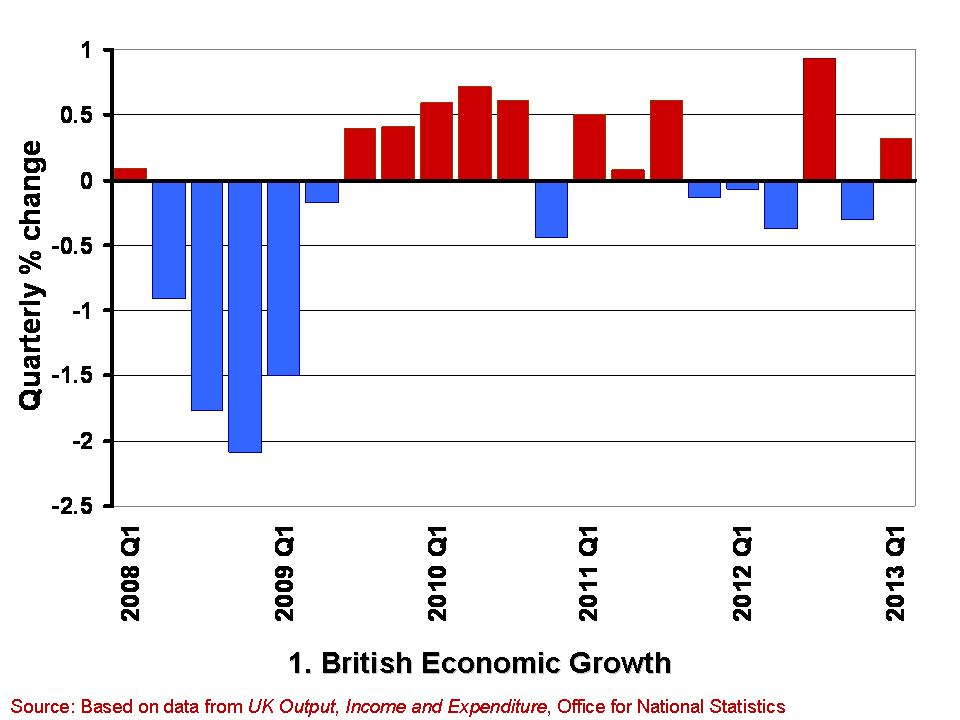 The growth in the economy is measured by changes in real GDP. Chart 1 shows the quarter-to-quarter change in real GDP since Q1 2008. (Click here to download a PowerPoint of the chart). During this period the economy is thought to have contracted in 10 of the 21 quarters shown. Furthermore, they show a double-dip recession and so two periods in close proximity where output shrank for two or more quarters. While more recent output numbers are frequently revised, which could see the double-dip recession possibly ‘statistically wiped’ from history, the period since 2008 will always been one characterised by anemic growth. The average quarterly growth rate since Q1 2008 has been -0.12 per cent.
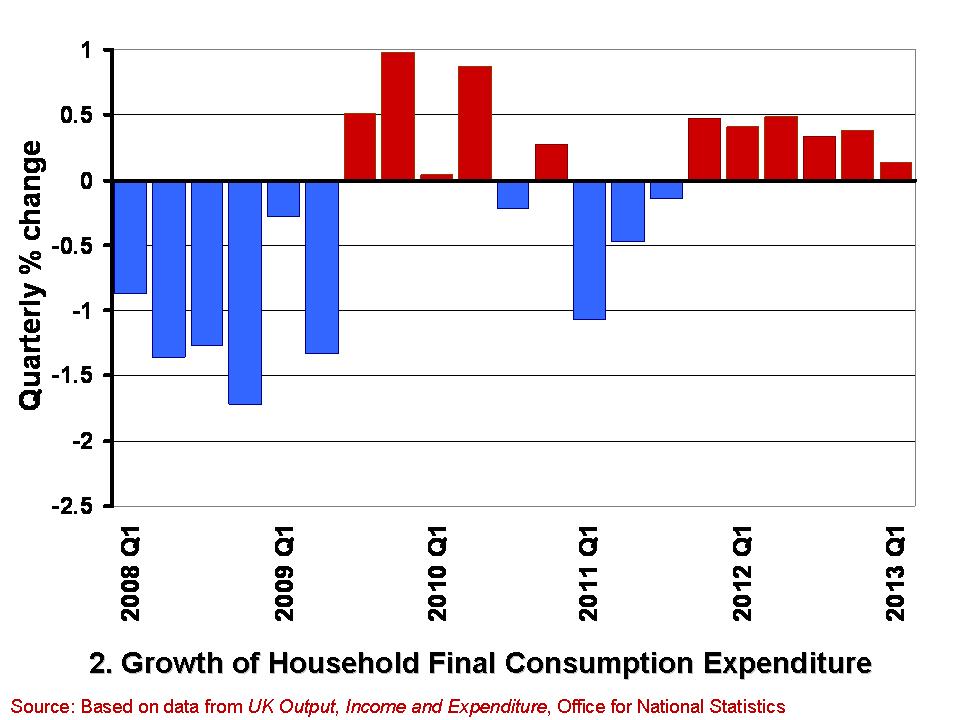 Chart 2 shows from Q1 2008 the quarterly growth in household expenditure in real terms, i.e. after stripping the effect of consumer price inflation. (Click here for a PowerPoint of the chart). Over the period, the volume of household consumption has typically fallen by 0.18 per cent per quarter. Hence, consumption has feared a little worse than the economy has a whole.
While the annualised rate of growth for the economy since Q1 2008 has averaged -0.47 per cent that for consumer spending has averaged -0.73 per cent. However, these figures disguise a recent improvement in consumer spending growth. This is because the volume of consumption has in fact grown in each of the six quarters since Q4 2011. In contrast, the economy has grown in only 2 of these quarters. It is, of course, much too early to start trumpeting consumption growth has heralding better times, not least because the 0.1 per cent growth in Q1 2013 is the weakest number since positive consumption growth resumed at the back end of 2011. Nonetheless, the figures do deserve some analysis by economists to understand what is going on.
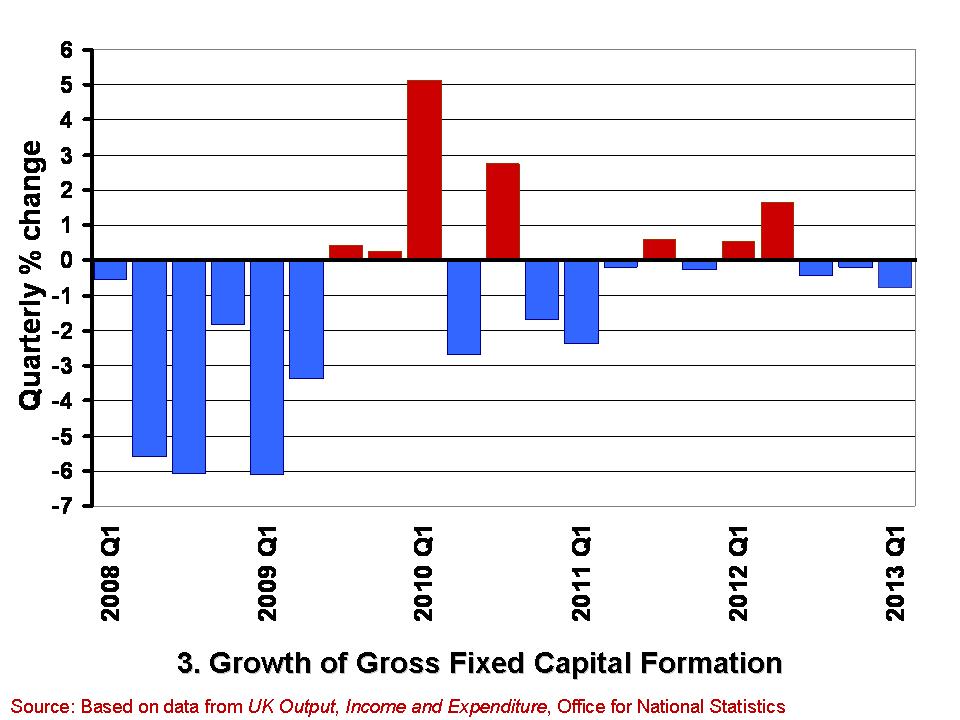 A slightly less promising note is struck by the gross fixed capital formation (GFCF) numbers. These numbers relate to the volume of investment in non-financial fixed assets, such as machinery, buildings, office space and fixtures and fittings. Chart 3 shows the quarterly growth in the volume of GFCF since Q1 2008. (Click here for a PowerPoint of the chart). The average quarterly rate of growth over this period has been -0.77 per cent. This is equivalent to an annual rate of decline of 3.9 per cent. GFCF has risen in only 7 of these quarters, declining in the remaining 14 quarters.
Worryingly, gross fixed capital formation has decreased in each of the last three quarters. While these figures may reflect continuing difficulties encountered by businesses in obtaining finance, they may also point to lingering concerns within the business community about the prospects for sustained growth. Therefore, it is important for economists to try and understand the drivers of these disappointing investment numbers and, hence, whether it is these or the slightly better consumption numbers that best hint at our short-term economic prospects.
Data
Second estimate of GDP, Q1 2013 Office for National Statistics
Second Estimate of GDP, Q1 2013 Dataset Office for National Statistics
Articles
UK GDP: concerns about underlying economy as 0.3pc growth confirmed Telegraph, Philip Aldrick (23/5/13)
UK investment fall among worst in G8 Guardian, Phillip Inman (23/5/13)
UK first-quarter growth unchanged BBC News (28/5/13)
U.K. Economy Grows 0.3% on Inventories, Consumer Spending Bloomberg, Svenja O’Donnell (23/5/13)
Surge in consumer spending kept UK out of recession The Telegraph (28/5/13)
Boost in service sector activity The Herald, Greig Cameron (28/5/13)
Hopes dashed as household spending rises by just 0.1% The Herald, Ian McConnell (24/5/13)
Questions
- Why do we typically focus on real GDP rather than nominal GDP when analysing economic growth?
- What is meant by aggregate demand? Of what importance is consumer spending to aggregate demand?
- Why might the patterns we observe in consumer spending differ from those in other components of aggregate demand?
- What factors might influence the determination of consumer spending?
- What do you understand by gross fixed capital formation? What factors might help to explain how its level is determined?
- Of what significance is gross fixed capital formation for aggregate demand and for aggregate supply?
- What is a recession? What is a double-dip recession?
- What data would you need to collect to identify a recession?
 The new Japanese government under Shinzo Abe, which took office on 26 December 2012, has been pursuing a policy of weakening the yen. Using a combination of low interest rates, quantitative easing, expansionary fiscal policy and a declared aim of depreciation, the government has succeeded in driving down the value of the yen.
Since mid-November last year, the yen has depreciated by 28% against the dollar, 30% against the euro and 21% against sterling. The effective exchange rate index has fallen by 22% (see first diagram below: click here for a PowerPoint of the diagram).
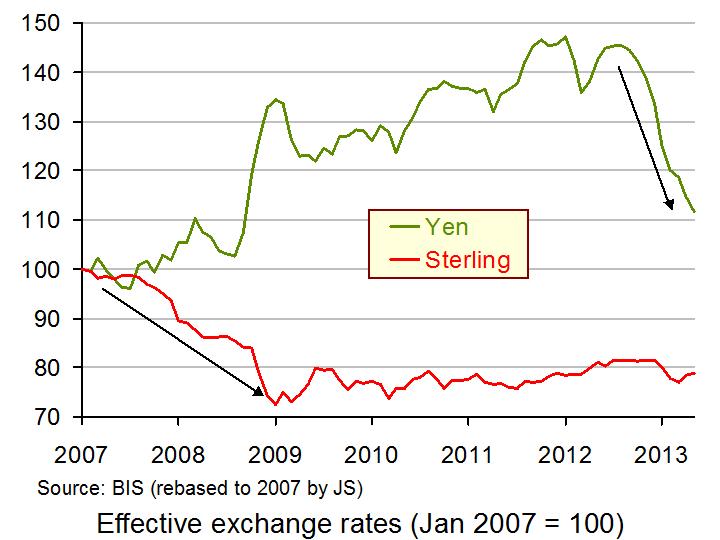 But will this depreciation succeed in stimulating the Japanese economy and will it improve the balance of trade? The hope is that the falling yen will boost export sales by making them cheaper abroad, and will reduce the demand for imports by making them more expensive in Japan. The balance of trade will thereby improve and higher exports (an injection) and lower imports (a withdrawal) will stimulate aggregate demand and economic growth.
Traditionally Japan has run balance of trade surpluses, but since July 2012, it has been running monthly deficits – the longest run of deficits since 1980. But depreciation cannot be expected to turn this position around immediately. Indeed, theory suggests that the balance of trade is likely to deteriorate before it improves. This is known as the J-curve effect and is illustrated in the second diagram below. As page 768 of Economics, 8th edition states:
 At first a devaluation or depreciation might make a current account deficit worse: the J-curve effect. The price elasticities of demand for imports and exports may be low in the short run (see Case Study 25.1 in MyEconLab). Directly after devaluation or depreciation, few extra exports may be sold, and more will have to be paid for imports that do not have immediate substitutes. There is thus an initial deterioration in the balance of trade before it eventually improves. In Figure 25.12 [the second diagram], devaluation takes place at time t1. As you can see, the diagram has a J shape.
Evidence suggests that the first part of the ‘J’ has been experienced in Japan: Japan’s balance of trade has deteriorated. But there is debate over whether the balance of trade will now start to improve. As the article by James Saft states:
But a look at the actual data shows Japanese companies, like British ones during a similar bout of currency weakness in 2008, appear to be more eager to use a newly competitive currency to pad profits through higher margins rather than higher export volumes. Thus far, Japanese exporters appear to be doing just that. Despite yen falls the price of Japanese exports in local currency has barely budged.
“Japanese companies have not actually cut the foreign currency prices of their exports. Just as with the UK exporters, the Japanese have chosen to hold foreign prices constant, maintain market share, and increase the yen value and thus the yen profit associated with yen depreciation,” UBS economist Paul Donovan writes in a note to clients.
 The extra profits earned by Japanese companies from export sales may be stockpiled or paid out in dividends rather than reinvested. And what investment does take place may be abroad rather than in Japan. The net effect may be very little stimulus to the Japanese economy.
As stated by Saft above, the UK had a similar experience in the period 2007–9, when sterling depreciated some 27% (see the second diagram). The balance of trade improved very little and UK companies generally priced goods to markets abroad rather than cutting overseas prices.
But times were different then. The world was plunging into recession. Now global markets are mildly growing or static. Nevertheless, there is a danger that the upward slope of the J-curve in Japan may be pretty flat.
Articles
Weak yen a boon for investors, not Japan Reuters, James Saft (14/5/13)
Japan’s Trade Data Suggest Even Lower Yen Needed Wall Street Journal, Nick Hastings (22/5/13)
2 Misunderstandings About Japanese Trade Seeking Alpha, Marc Chandler (22/5/13)
Japanese trade deficit widens Financial Times, Ben McLannahan (22/5/13)
Data
BIS effective exchange rate indices Bank for International Settlements
Japan’s balance of trade Trading Economics
UK Trade, March 2013 ONS
Questions
- Explain the J-curve effect.
- Why is there some doubt about whether the Japanese balance of trade will improve significantly?
- What will be the consequences for Japanese growth?
- If foreign currency prices of Japanese exports do not change, what will determine the amount that Japan exports?
- What other measures is the Japanese government taking to stimulate the economy? What will determine the size of the multiplier effects of these measures?
- Using data from the ONS plot the UK’s quarterly balance of trade figures from 2007 to the present day. Explain the pattern that emerges.
 The US dollar has been used as the international currency for the majority of international trade. Around 85% of foreign-exchange transactions are trades between US dollars and other currencies. As the first article below, from the Wall St Journal, states:
When a South Korean wine wholesaler wants to import Chilean cabernet, the Korean importer buys US dollars, not pesos, with which to pay the Chilean exporter. Indeed, the dollar is virtually the exclusive vehicle for foreign-exchange transactions between Chile and Korea, despite the fact that less than 20% of the merchandise trade of both countries is with the US.
… The dollar is the currency of denomination of half of all international debt securities. More than 60% of the foreign reserves of central banks and governments are in dollars.
But things are gradually changing as countries increasingly by-pass the dollar. Several countries have reached agreements with China to allow companies to exchange their currencies directly in so-called ‘currency swap‘ arrangements (see also). These include Japan, Australia, the UK, France/the eurozone, Argentina, Brazil, South Korea, Chile and Russia. But while these currency swap arrangements apply to current account transactions, there are still considerable controls of currency movements on China’s capital and financial accounts.
So what will be the implications for the USA and for China? What will be the impact on currency and bonds markets? The following articles explore the issues.
Why the Dollar’s Reign Is Near an End Wall Street Journal, Barry Eichengreen (1/3/11)
Beijing Continues Inexorable Push for Internationalisation of the Renminbi iNVEZZ, Alice Young (22/4/13)
RMB: Advance of the renminbi Emerging Markets, Elliot Wilson (4/5/13)
China’s new leaders to quicken yuan reform, but caution remains Reuters, Kevin Yao and Heng Xie (7/5/13)
Japan, China to launch direct yen-yuan trade on June 1 Reuters, Tetsushi Kajimoto (29/5/12)
China and Japan to start direct yen-yuan trade in June BBC News (29/5/12)
BOE Plans to Sign Yuan Currency Swap Deal With China Bloomberg, Fergal O’Brien & Svenja O’Donnell (22/2/13)
Bank of England, PBOC close to RMB/GBP swap agreement Emerging Markets (22/2/13)
China and Brazil sign $30bn currency swap agreement BBC News (27/3/13)
China, Brazil sign trade, currency deal before BRICS summit Reuters, Agnieszka Flak and Marina Lopes (26/3/13)
Direct trading to boost global use of yuan China Daily, Wei Tian (10/4/13)
Paris vies to be yuan hub China Daily, Li Xiang (19/4/13)
France plans currency swap line with China: paper Reuters (12/4/13)
Yuan Replaces the Dollar in China’s Dealings With France, Britain, Australia, as the War-Debt Continues to Destroy US Currency Al-Jazeerah (6/5/13)
China Takes Another Stab At The Dollar, Launches Currency Swap Line With France ZeroHedge, Tyler Durden (13/4/13)
Questions
- What are the ‘three pillars’ that have supported the dollar’s dominance?
- What is changing in the global economy to undermine this dominance?
- What will be the impact on the US government and US companies?
- What steps has China taken to ‘internationalise’ the renminbi (denominated in yuan)?
- Is the role of the euro likely to increase or decrease as an internationally held and used currency?
- What dangers are there for investors in holding all their wealth in dollar-denominated assets?
- Why may the increasing internationalisation of the euro and renminbi lead to less volatility between them and the dollar?
- How will the growing internationalisation of the euro and renminbi benefit eurozone and Chinese banks and internationally trading companies?
- What more does China need to do before the renminbi can be regarded as a truly global currency?
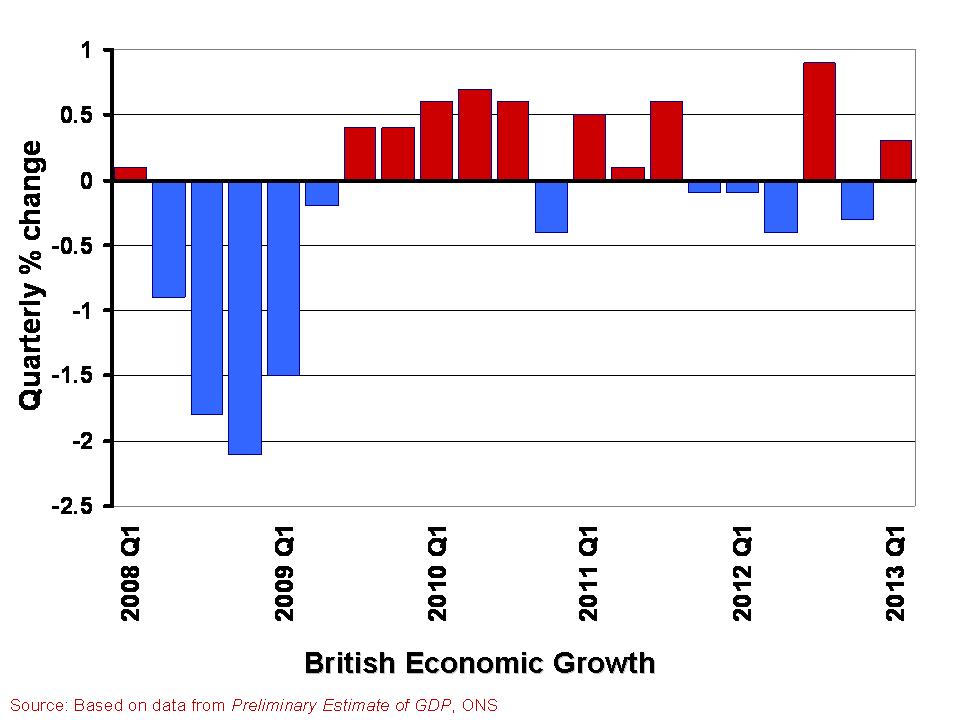 In The global economy we note the mixed picture contained within the latest British growth numbers. With the first estimate of growth for Q1 of 2013 pointing to an increase in real GDP of 0.3 per cent, the UK economy appears to have missed the ignominy of a triple dip recession. However, the overall economy remains fragile with different sectors of the economy performing quite differently.
A patchy picture is perhaps the fairest assessment. This helps to explain the quite different perceptions amongst economists, business people, journalists and the wider public about the current state of the economy. Here we consider in a little more detail the growth numbers for the UK from the latest preliminary GDP estimates. (Click here for a PowerPoint of the chart).
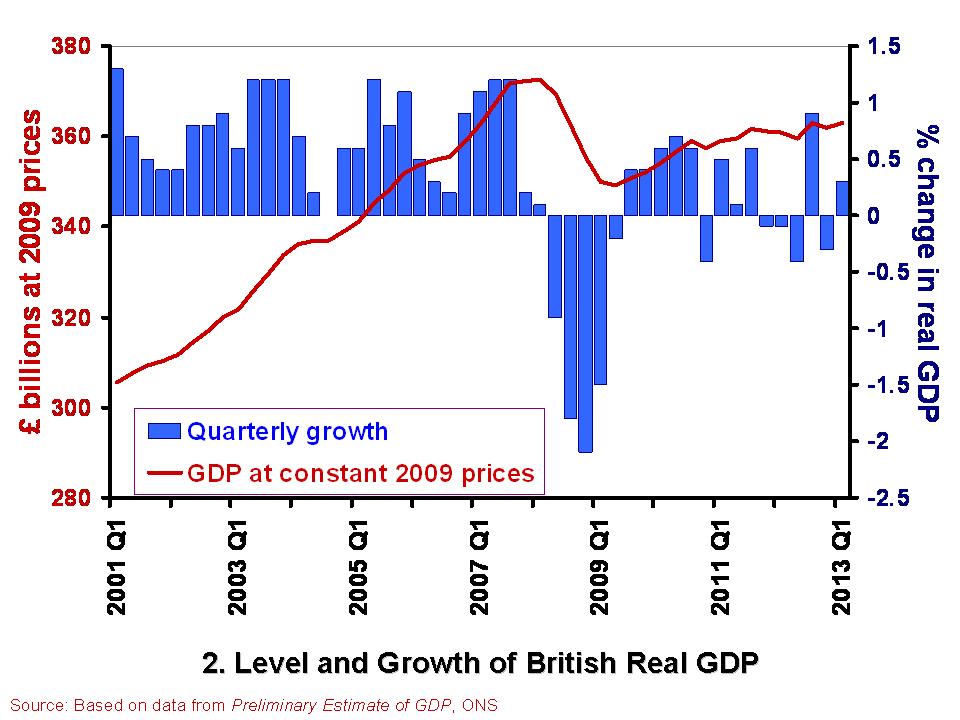 The British economy is thought to have grown by 0.3 per cent in the first quarter of 2013. This follows a contraction of 0.3 per cent in the final quarter of 2012. Compared with the first quarter of 2012, the output of the British economy was 0.6 per cent higher. However, as Chart 2 helps to show, the British economy has some way to go before it returns to the levels seen prior to the financial crisis. Real GDP peaked in the first quarter of 2008 when GDP at 2009 prices was estimated at £372.7 billion. In the first quarter of 2013, GDP at constant 2009 prices is estimated at £362.9 billion. This means that the economy is still 2.6 per cent smaller than its 2008-peak. Click here for a PowerPoint of the chart.
The patchy nature of British growth is illustrated nicely by the contrasting rates of growth across the different industrial sectors in the first quarter of the year. While service sector output rose by 0.6 per cent, output across the production industries rose by only 0.2 per cent and agricultural output declined by 3.7 per cent. Within the production industries, mining and quarrying output rose by 3.2 per cent, but manufacturing output shrunk by 0.3 per cent and construction output shrunk by 2.5 per cent.
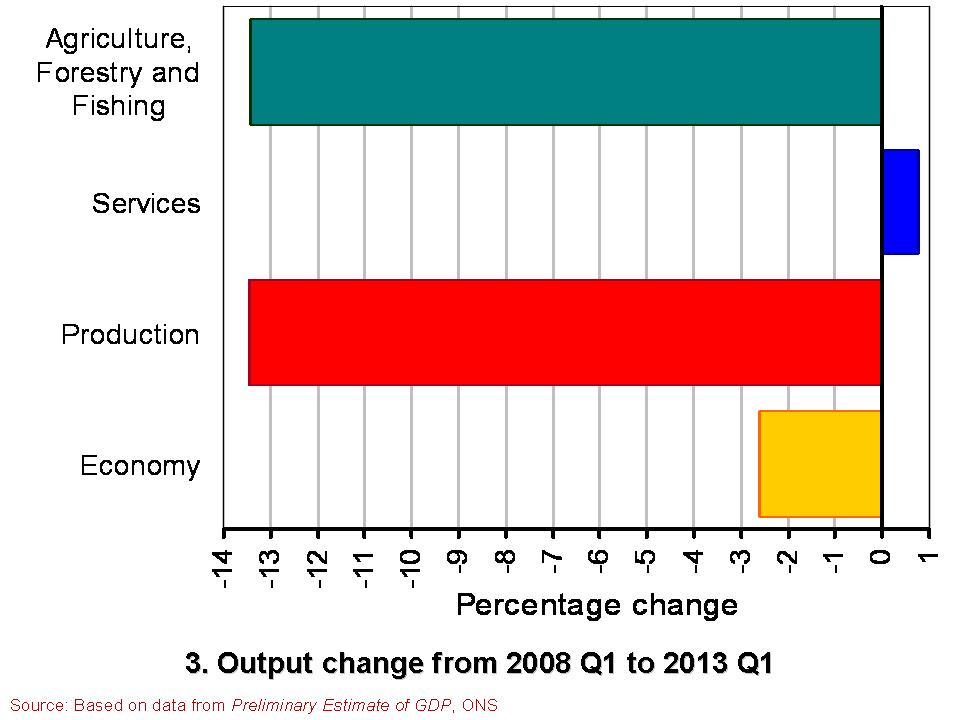 Chart 3 compares the output of agriculture, the production industries and the service sector between the first quarter of 2008 and the first quarter of 2013. (Click here for a PowerPoint of the Chart). It shows the dramatically different experience of the service sector compared with agriculture and the production industries. While output in the service sector is now 0.8 per cent higher, output across agriculture and the production industries is almost 13.5 per cent lower. Within the production industries, output in mining and quarrying is 38 per cent lower, in the construction sector 19 per cent lower and 10 per cent lower in manufacturing. It is perhaps not surprising then that we get such different messages about the state of the economy. The devil really is in the detail.
Data
Preliminary Estimate of GDP – Time Series Dataset Q1 2013 Office for National Statistics
Statistical Bulletin: Gross Domestic Product Preliminary Estimate Q1 2013 Office for National Statistics
Articles
UK avoids triple-dip recession with better-than-expected 0.3% GDP growth Guardian, Heather Stewart (25/4/13)
UK economy shows 0.3% growth Financial Times, Claire Jones (25/4/13)
UK avoids triple-dip recession with 0.3pc GDP growth Telegraph, Szu Ping Chan (25/4/13)
Osborne claims UK economy is ‘healing’ Financial Times, George Parker and Claire Jones (25/4/13)
UK narrowly escapes triple-dip recession as GDP figures show 0.3% growth in first three months of year Independent, Ben Chu (25/4/13)
UK economy avoids triple-dip recession BBC News (25/4/13)
Questions
- What is the difference between nominal and real GDP? Which of these helps to track changes in economic output?
- How would we identify a recession in either of the first two charts?
- What is a double-dip recession? What is a triple-dip recession?
- The UK economy in Q1 2013 was 2.6 per cent smaller than in Q1 2008. What factors do you think help explain why after 5 years UK real GDP is still lower?
- Why if output in the production and agricultural sectors is 13.5 per cent lower in Q1 2013 compared to Q1 2008 is the economy’s total output only 2.6 per cent lower?
- Economic growth rates fluctuate quite significantly. Can economic theory help to explain why this is the case?
 In the blogs The capital adequacy of UK banks and A co-operative or a plc? we focus on how British banks continue to look to repair their balance sheets. To do so, banks need to ‘re-balance’ their balance sheets. This may involve them holding more reserves and equity capital and/or a less risky and more liquid profile of assets. The objective is to make banks more resilient to shocks and less susceptible to financial distress.