 In April we asked how sustainable is the UK’s appetite for credit? Data in the latest Bank of England’s Money and Credit publication suggest that such concerns are likely grow. It shows net lending (lending net of repayments) by monetary financial institutions (MFIs) to individuals in March 2016 was £9.3 billion, the highest monthly total since August 2007. This took net borrowing over the previous 12 months to £58.6 billion, the highest 12-month figure since September 2008.
The latest credit data raise fears about the impact on the financial well-being of individuals. The financial well-being of people, companies, banks and governments can have dramatic effects on economic activity. These were demonstrated vividly in the late 2000s when a downturn resulted from attempts by economic agents to improve their financial well-being. Retrenchment led to recession. Given the understandable concerns about financial distress we revisit our April blog.
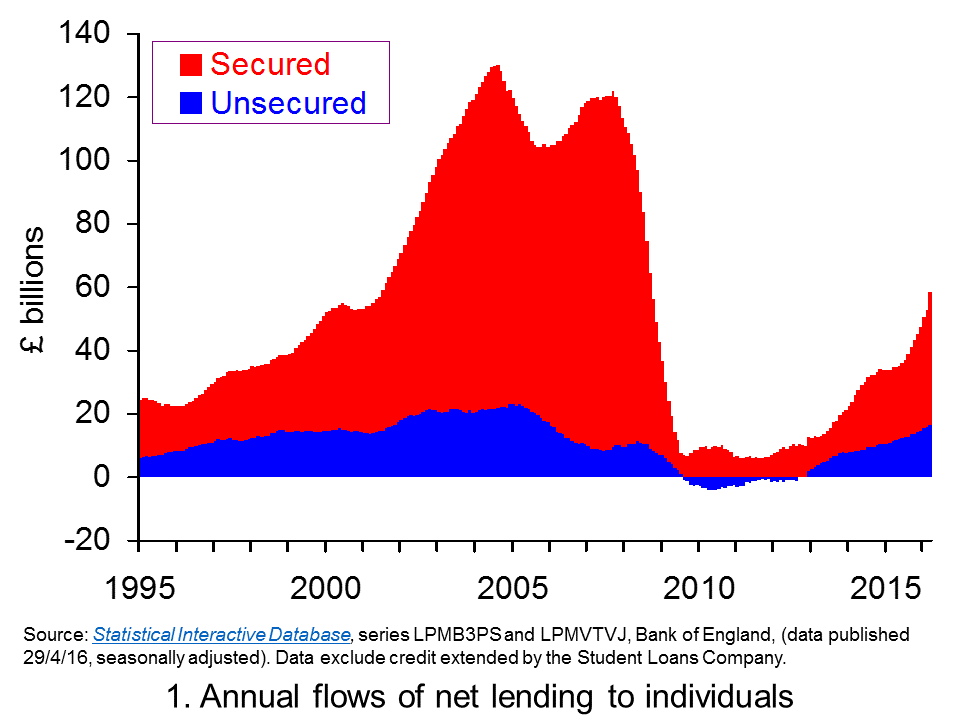 Chart 1 shows the annual flow of lending extended to individuals, net of repayments. (Click here to download a PowerPoint of Chart 1.) The chart provides evidence of cycles both in secured lending and in consumer credit (unsecured lending).
The growth in net lending during the 2000s was stark as was the subsequent squeeze on lending that followed. During 2004, for example, annual net flows of lending from MFIs to individuals exceeded £130 billion, the equivalent of close on 10.5 per cent of annual GDP. Secured lending was buoyed by strong house price growth with UK house price inflation rising above 14 per cent. Nonetheless, consumer credit was very strong too equivalent to 1.8 per cent of GDP.
Net lending collapsed following the financial crisis. In the 12 months to March 2011 the flow of net lending amounted to just £3.56 billion, a mere 0.2 per cent of annual GDP. Furthermore, net consumer credit was now negative. In other words, repayments were exceeding new sums being extended by MFIs.
Clearly, as Chart 1 shows, net lending to individuals is again on the rise. This partly reflects a rebound in sections of the UK housing market. Net secured lending in March was £7.435 billion, the highest monthly figure since November 2007. Over the past 12 months net secured lending has amounted to £42.1 billion, the highest 12-month figure since October 2008.
Yet the growth of unsecured credit has been even more spectacular. In March net consumer credit was £1.88 billion (excluding debt extended by the Student Loans Company). This is the highest month figure since March 2005. It has taken the amount of net consumer credit extended to individuals over the past 12 months to £16.435 billion, the highest figure since December 2005.
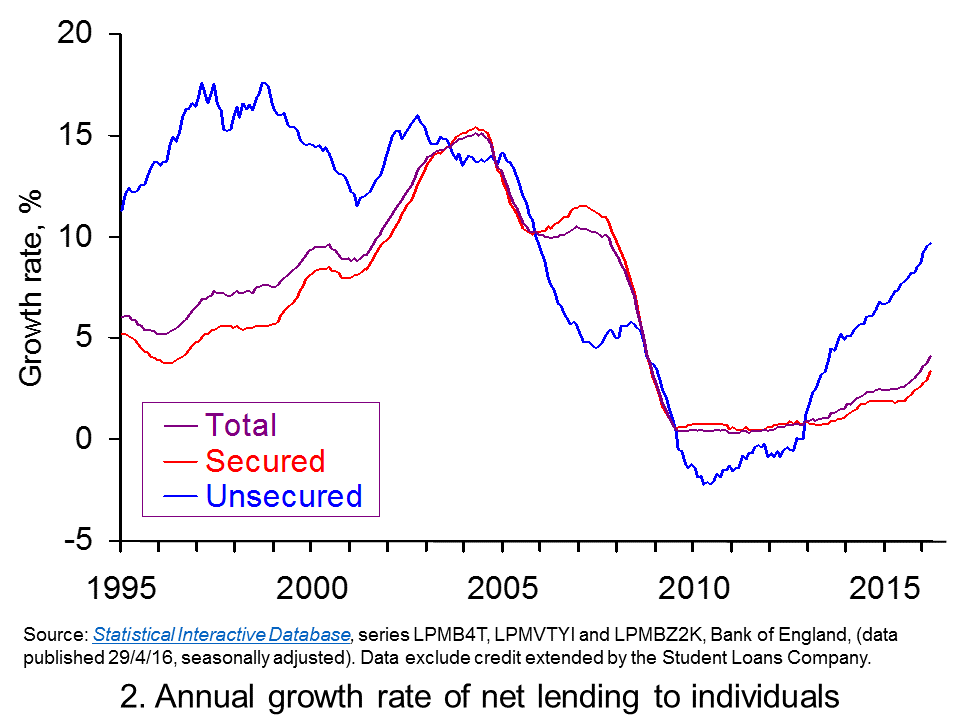 Chart 2 shows the annual growth rate of both forms of net lending by MFIs. In essence, this mirrors the growth rate in the stocks of debt – though changes in debt stocks can also be affected by the writing off of debts. The chart captures the very strong rates of growth in net unsecured lending from MFIs. We are now witnessing the strongest annual rate of growth in consumer credit since November 2005. (Click here to download a PowerPoint of the chart.)
The growth in household borrowing, especially that in consumer credit, evidences the need for individuals to be mindful of their financial well-being. Given that these patterns are now becoming well-established you can expect to see considerable comment in the months ahead about our appetite for credit. Can such an appetite for borrowing be sustained without triggering a further balance sheet recession as experienced at the end of the 2000s?
Articles
Consumer credit rises at fastest pace for 11 years The Guardian, Hilary Osborne (29/4/16)
Debt bubble fears increase as consumer credit soars to 11-year high The Telegraph, Szu Ping Chan (29/4/16)
Fears of households over-stretching on borrowing as consumer credit grows The Scotsman, (29/4/16)
History repeating? Fears of another financial crisis as borrowing reaches 11-year high Sunday Express, Lana Clements (29/4/16)
The chart that shows we put more on our credit cards in March than in any month in 11 years Independent, Ben Chu (1/4/16)
Britain’s free market economy isn’t working The Guardian (13/1/16)
Data
Money and Credit – March 2016 Bank of England
Bankstats (Monetary and Financial Statistics) – Latest Tables Bank of England
Statistical Interactive Database Bank of England
Questions
- What does it mean if individuals are financially distressed?
- How would we measure the financial well-being of individuals and households?
- What actions might individuals take it they are financially distressed? What might the economic consequences be?
- How might uncertainty affect spending and saving by households?
- What measures can policymakers take to reduce the likelihood that flows of credit become too excessive?
- What is meant by a balance sheet recession?
- Explain the difference between secured debt and unsecured debt.
- Should we be more concerned about the growth of consumer credit than secured debt?
The latest Bank of England’s Money and Credit release shows net lending (lending net of repayments) by Monetary Financial Institutions (MFIs) to individuals in February was £4.9 billion. Although down on the £5.4 billion in January, it nonetheless means that over the last 12 months the flow of net lending amounted to £52.8 billion. This is the highest 12-month figure since October 2008.
The latest credit data raise concerns about levels of lending and their potential to again impact on the financial well-being of individuals, particularly in light of the falling proportion of income that households are saving. As we saw in UK growth fuelled by consumption as households again lose affection for their piggy banks the saving ratio fell to an historic low of 4.2 per cent for 2015.
An important factor affecting the financial well-being of individuals and households is the extent of their indebtedness. Flows of credit accumulate to become stocks of debt. Stocks of debt affect the extent to which household incomes becomes prey to debt servicing costs. Put simply, more and more income, all other things being equal, is needed for interest payments and capital repayments as debt stocks rise. Rising stocks of debt can also affect the ability of people to further fund borrowing, particularly if debt levels grow more quickly than asset values, such as the value of financial assets accumulated through saving. Consequently, the growth of debt can result in households incurring what is called balance sheet congestion with deteriorating financial well-being or increased financial stretch.
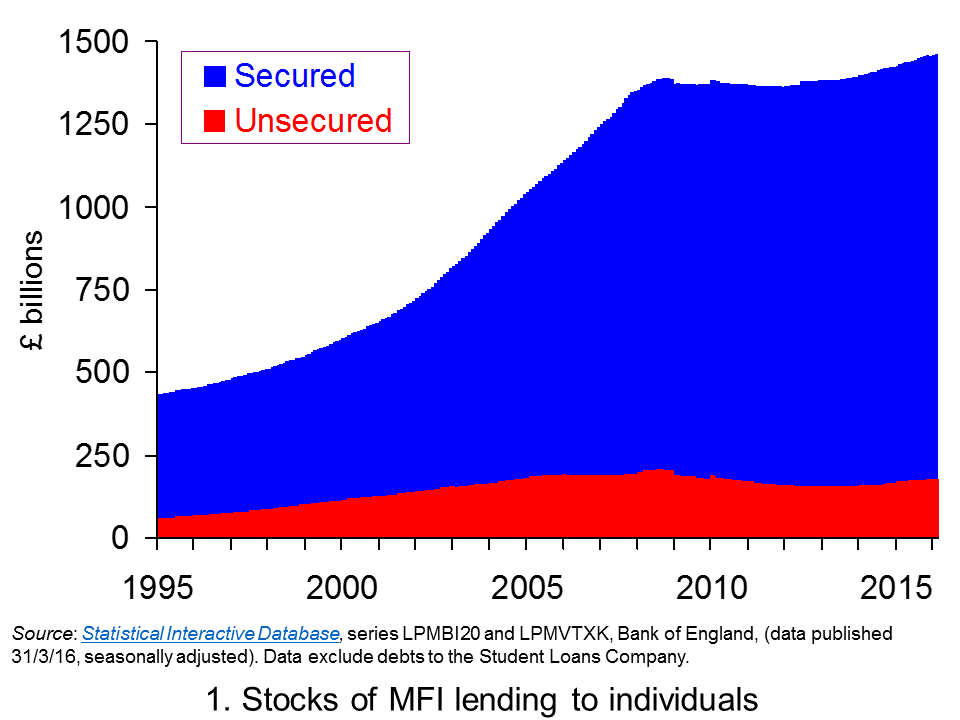 Chart 1 shows the stocks of debt acquired by individuals from MFIs, i.e. deposit-taking financial institutions. It shows both secured debt stocks (mortgage debt) and unsecured debt stocks (consumer credit). The scale of debt accumulation, particularly from the mid 1990s up to the financial crisis of the late 2000s is stark.
At the start of 1995 UK individuals had debts to MFIs of a little over £430 billion, the equivalent of roughly 55 per cent of annual GDP (Gross Domestic Product). By the autumn of 2008 this had hit £1.39 trillion, the equivalent of roughly 90 per cent of annual GDP. At both points around 85 per cent of the debt was secured debt, though around the start of the decade it had fallen back a little to around 80 per cent. (Click here to download a PowerPoint of Chart 1.)
The path of debt at the start of the 2010s is consistent with a story of consolidation. Both financially-distressed individuals and MFIs took steps to repair their balance sheets following the financial crisis. These steps, it is argued, are what resulted in a balance sheet recession. This saw the demand for and supply of additional credit wane. Consequently, as Chart 1 shows debt accumulation largely ceased.
More recently the indebtedness to MFIs of individuals has started to rise again. At the end of February 2014 the stock of debt was just shy of £1.4 trillion. By the end of February 2016 it had risen to £1.47 trillion (a little under 80 per cent of annual GDP). This is an increase of 4.7 per cent. Interestingly, the rise was largely driven by unsecured debt. It rose by 13.4 per cent from £159.4 billion to £180.7 billion. Despite the renewed buoyancy of the housing market, particularly in South East England, the stock of secured debt has risen by just 3.6 per cent from £1.24 trillion to £1.28 trillion.
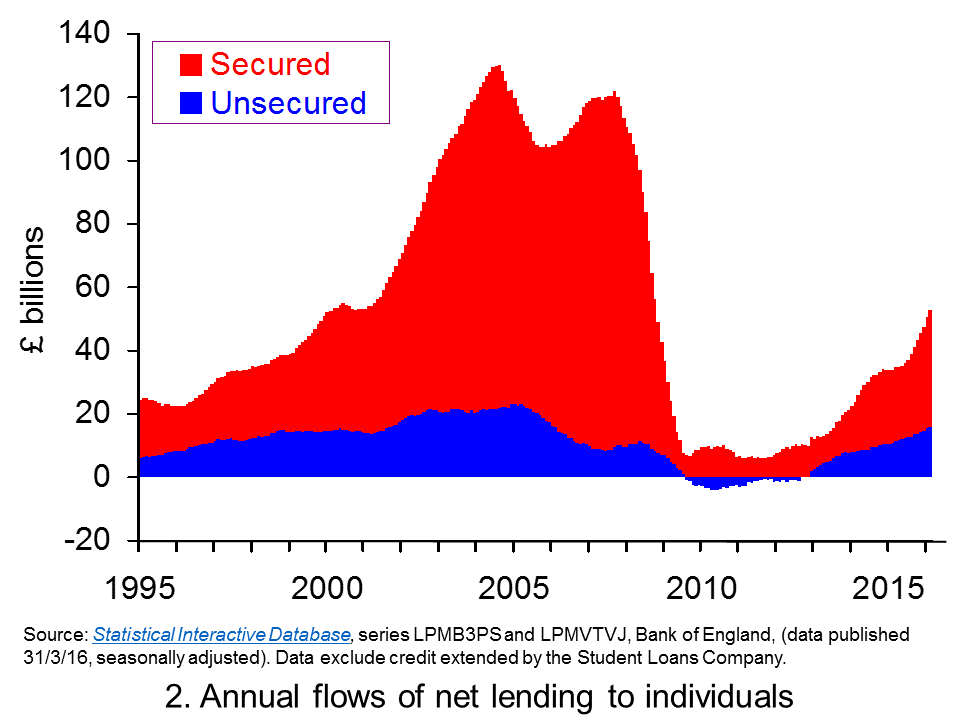 Chart 2 shows the annual flow of lending extended to individuals, net of repayments. (Click here to download a PowerPoint of Chart 2.) The chart provides evidence of cycles both in secured lending and in consumer credit (unsecured lending).
The growth in net lending during the 2000s was stark as was the subsequent squeeze on lending that followed. During 2004, for example, annual net flows of lending from MFIs to individuals exceeded £130 billion, the equivalent of close on 10.5 per cent of annual GDP. Secured lending was buoyed by strong house price growth with UK house price inflation rising above 14 per cent. Nonetheless, consumer credit was very strong too equivalent to 1.8 per cent of GDP.
Net lending collapsed following the financial crisis. In the 12 months to March 2011 the flow of net lending amounted to just £3.56 billion, a mere 0.2 per cent of annual GDP. Furthermore, net consumer credit was now negative. In other words, repayments were exceeding new sums being extended by MFIs.
Clearly, as Chart 2 shows, we can see that net lending to individuals is again on the rise. As we noted earlier, part of this this reflects a rebound in parts of the UK housing market. It is perhaps worth noting that secured lending helps individuals to purchase housing and thereby acquire physical wealth. While secured lending can find its way to fuelling spending, for example, through the purchase of goods and services when people move into a new home, consumer credit more directly fuels spending and so aggregate demand. Furthermore, consumer credit is not matched on the balance sheets by an asset in the same way that secured credit is.
 Chart 3 shows the annual growth rate of both forms of net lending by MFIs. In essence, this mirrors the growth rate in the stocks of debt though changes in the stocks of debt can also be affected by the writing off of debts. What the chart nicely shows is the strong rates of growth in net unsecured lending from MFIs. In fact, it is the strongest annual rate of growth since January 2006 (Click here to download a PowerPoint of the chart.)
The growth in consumer credit, the fall in the saving ratio and the growth in consumer spending point to a need for individuals to be mindful of their financial well-being. What is for sure, is that you can expect to see considerable comment in the months ahead about consumption, credit and income data. Fundamental to these discussions will be the sustainability of current lending patterns.
Articles
Consumer Lending Growth Highest Since 2005 Sky News, (31/3/16)
Britons raid savings to fund spending as economists warn recovery ‘built on sand’ Telegraph, Szu Ping Chan (31/3/16)
Household debt binge has no end in sight, says OBR Telegraph, Szu Ping Chan (17/3/16)
Surge in borrowing… as savings dwindle: Household savings are at an all-time low as families turn to cheap loans and credit cards Daily Mail, James Burton (1/4/16)
George Osborne banks on household debt time bomb to meet his Budget targets Mirror, Ben Glaze (29/3/16)
Britain’s free market economy isn’t working Guardian (13/1/16)
Data
Bankstats (Monetary and Financial Statistics) – Latest Tables Bank of England
Statistical Interactive Database Bank of England
Questions
- What does it mean if individuals are financially distressed?
- How would we measure the financial well-being of individuals and households?
- What actions might individuals take it they are financially distressed? What might the economic consequences be?
- How might uncertainty affect spending and saving by households?
- What measures can policymakers take to reduce the likelihood that flows of credit become too excessive?
- What is meant by a balance sheet recession?
- Explain the difference between secured debt and unsecured debt.
- Should we be more concerned about the growth of consumer credit than secured debt?
 The latest data in the Quarterly National Accounts show that UK households in 2015 spent £1.152 trillion, the equivalent of 62 per cent of the country’s Gross Domestic Product (GDP). In real terms, household spending rose by 2.8 per cent in 2015 in excess of the 2.3 per cent growth observed in GDP. In the final quarter of 2015 real household spending rose by 0.6 per – the same rate of growth as that recorded for the UK economy. This was the tenth consecutive quarter of positive consumption growth and the twelfth of economic growth.
It is the consistent growth seen over the recent past in real household spending that marks it out from the other components of aggregate demand. Consequently, household spending remains the bedrock of UK growth.
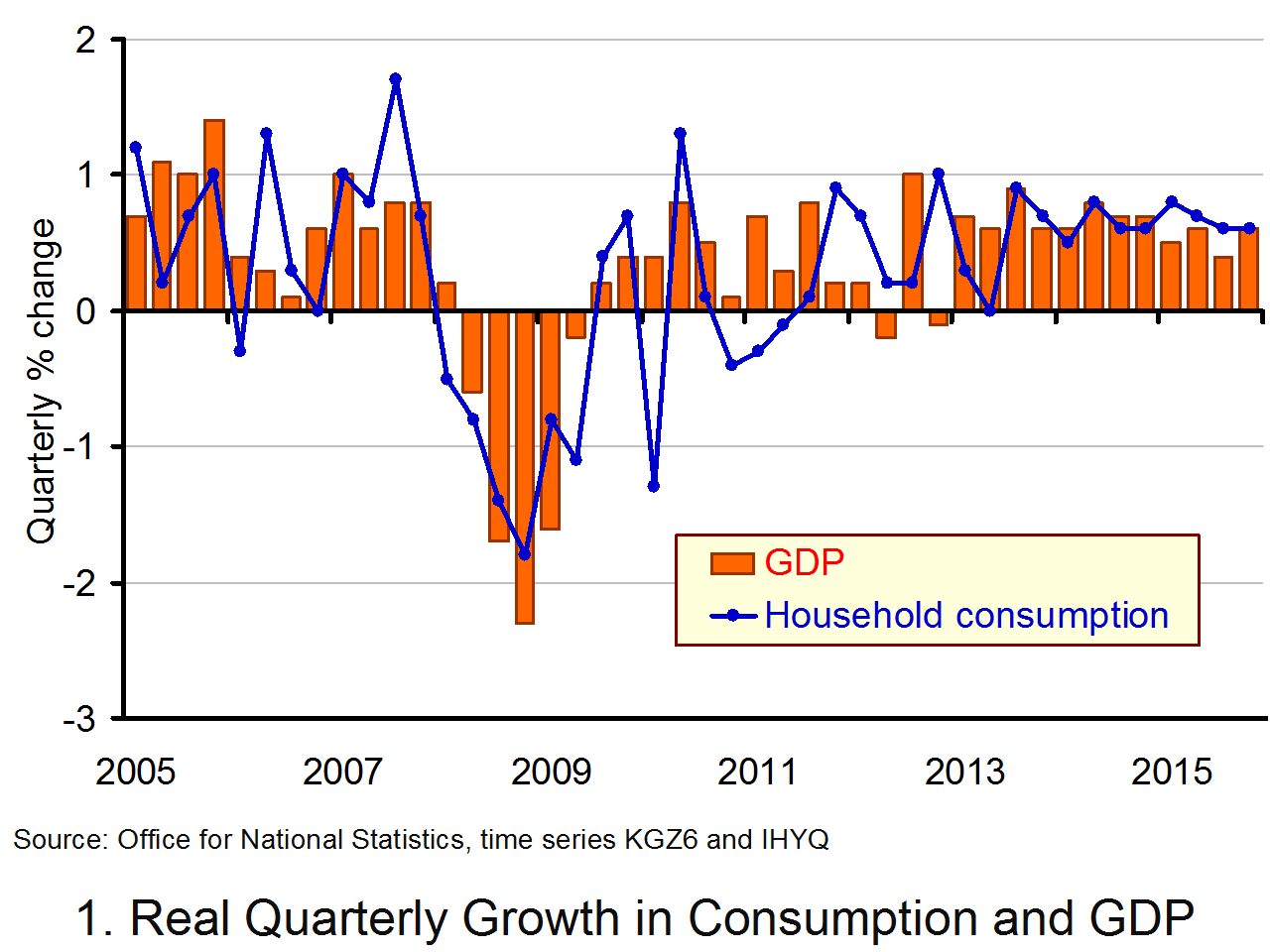 Chart 1 helps to evidence the close relationship between consumption and economic growth. It picks out nicely the stark turnaround both in economic growth and consumer spending following the financial crisis. Over the period from 2008 Q1 to 2011 Q2, real consumer spending typically fell by 0.4 per cent each quarter. This weakness in consumption was mirrored by economic growth. Real GDP contracted over this period by an average of 0.2 per cent each quarter. (Click here to download a PowerPoint of the chart.)
Since 2011 Q3 real consumption growth has averaged 0.6 per cent per quarter – the rate at which consumption grew in 2015 Q4 – while, real GDP growth has averaged 0.5 per cent per quarter. Over this same period the real disposable income (post-tax income) of the combined household and NPISH (non-profit institutions serving households), has typically grown by 0.4 per cent per quarter. (NPISHs are charities and voluntary organisations.)
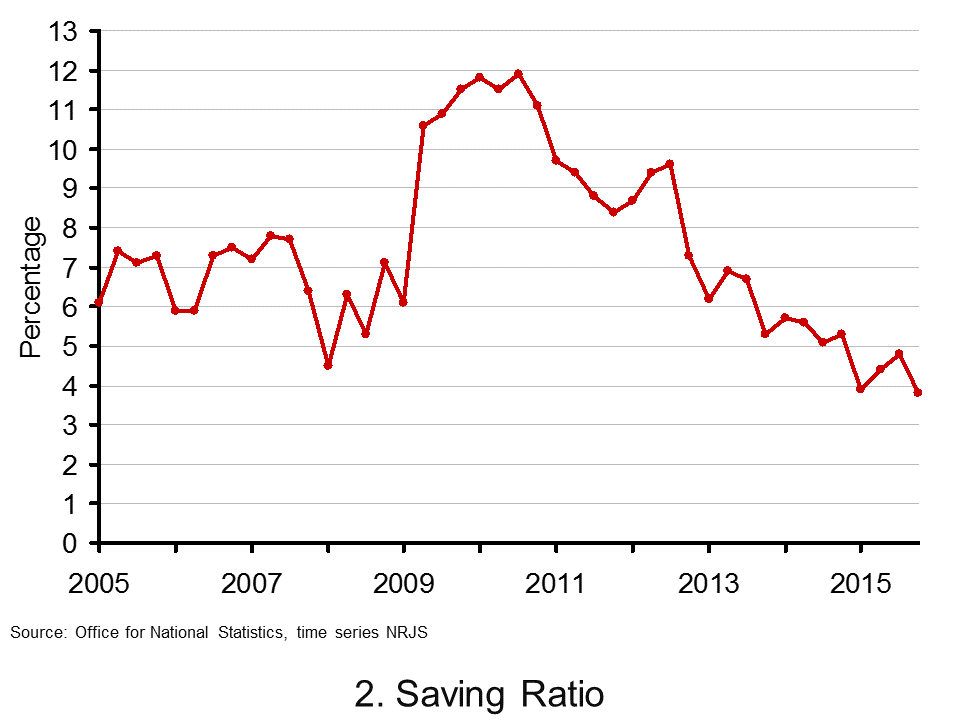 The strength of consumption relative to income is evidenced by the decline in the saving ratio as can be observed in Chart 2. The ratio captures the percentage of disposable income that households (and NPISHs) choose to save. In 2010 Q3 the proportion of income saved hit 11.9 per cent having been as low as 4.5 per cent in 2008 Q1. By 2015 Q4 the saving ratio had fallen to 3.8 per cent, the lowest value since the series began in 1963 Q1. (Click here to download a PowerPoint.)
The historic low in the saving ratio in the final quarter of 2015 reflects the strength of consumption alongside a sharp fall in real disposable income of 0.6 per cent in the quarter. However, the bigger picture shows a marked downward trend in the saving ratio over the period from 2012.
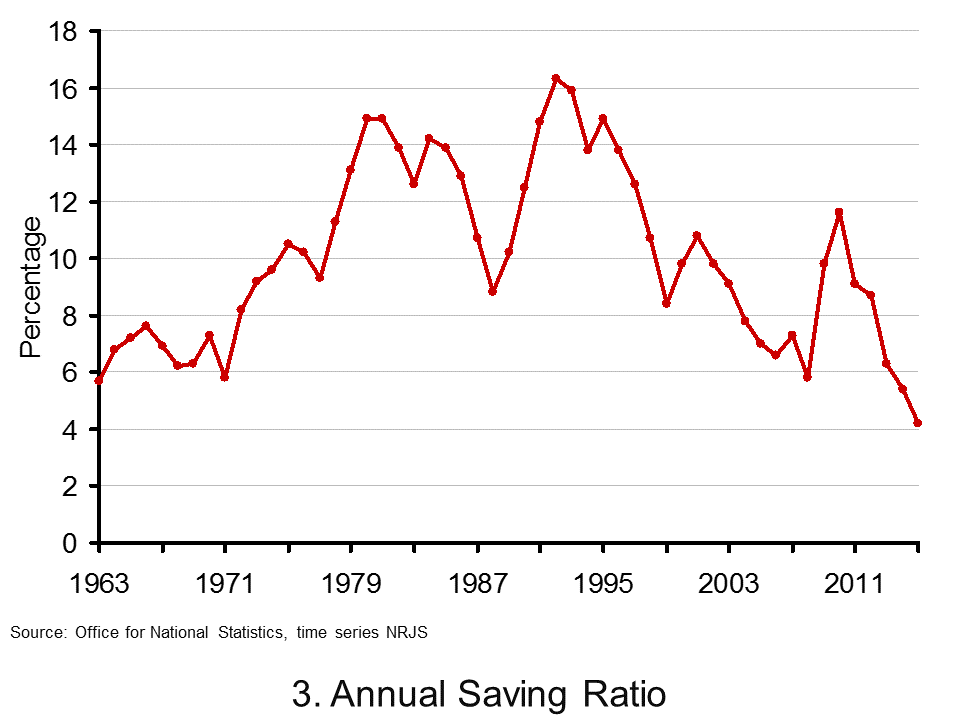 When seen in a more historic context the latest numbers taken on even greater significance. Chart 3 shows the annual saving ratio since 1963. From it we can see that the 2015 value of 4.2 was the first year when the ratio fell below 5 per cent. With 2014 being the previous historic low, there must be some concern that UK consumption growth is not being underpinned by income growth. (Click here to download a PowerPoint.)
 Of course, consumption theory places great emphasis on expected future income in determining current spending. To some extent it may be argued that households were liquidity-constrained following the financial crisis. They were unable to borrow to support spending and, as time moved on, to borrow against the expectation of stronger income growth in the future. This would have depressed consumption growth. But, there may also have been a self-imposed liquidity constraint as the financial crisis unfolded. Heightened uncertainty may have led households to be more prudent and divert resources to saving. Such precautionary saving would tend to boost the saving ratio and so may be a factor in the sharp rise we observed in the ratio.
 The easing of credit constraints as we headed through the early 2010s allied with stronger economic growth may help to explain the strength of the recovery in consumption growth. However, it is the extent and, in particular, the duration of this strong consumption growth that is fuelling a debate over its sustainability. The current uncertainty around future income growth and the need for households to be mindful of the indebtedness built up prior to the financial crisis point to households needing to retain a degree of caution. Consequently, the debates around the financial well-being of households and the need to rebalance the UK economy away from consumer spending are likely to be further intensified by the latest consumption and saving data.
Data
All data related to Quarterly National Accounts: Quarter 4 (Oct to Dec) 2015 Office for National Statistics
Office for National Statistics Office for National Statistics
Articles
Britons raid savings to fund spending as economists warn recovery ‘built on sand’ Telegraph, Szu Ping Chan (31/3/16)
UK Growth Higher But Deficit Hits New Record Sky News, (31/3/16)
Britain is a nation that has forgotten how to save Telegraph, Jeremy Warner (31/3/16)
A vulnerable economy: the true cost of Britain’s current account deficit Guardian, Larry Elliott (31/3/16)
U.K. Manufacturing ‘In the Doldrums’ Leaves Growth Lopsided Bloomberg, Emma Charlton (1/4/16)
Pound drops as UK manufacturing languishes in the doldrums Telegraph, Szu Ping Chan (1/4/16)
Questions
- Why is the distinction between nominal and real growth an important one when looking at many macroeconomic variables.
- Examine the argument that the historic low saving ratio in the UK is a cause for concern.
- What factors might we expect to impact on the saving ratio?
- To what extent do you think the current growth in consumer spending is sustainable?
- How important are expectations in determining consumer behaviour?
- Explain what you understand by consumption smoothing.
- Why would we would typically expect consumption growth to be less variable than that in disposable income?
- Why might consumption sometimes be observed to be less sensitive or more sensitive to income changes?
- What factors might cause households to be liquidity constrained?
- What is precautionary saving? What might affect its perceived importance among households?
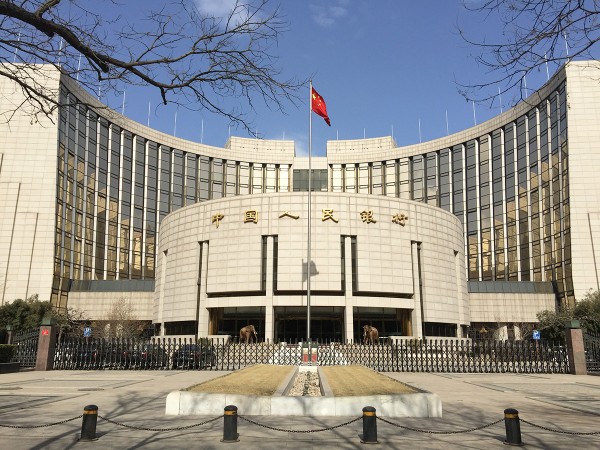 In recent months the Chinese central bank (the People’s Bank of China) has taken a number of measures to boost aggregate demand and arrest the slowing economic growth rate. Such measures have included quantitative easing, cuts in interest rates, a devaluation of the yuan and daily injections of liquidity through open-market operations. It has now announced that from 1 March it will reduce the reserve requirement ratio (RRR) for banks by a half percentage point.
The RRR is the percentage of liabilities that banks are required to hold in the form of cash reserves – money that could otherwise have been used for lending. This latest move will bring the compulsory ratio for the larger banks down from 17.5% to 17%. This may sound like only a small reduction, but it will release some ¥650bn to ¥690bn (around $100bn) of reserves that can be used for lending.
The cut from 17.5% to 17% is the fourth this year. Throughout 2014 and 2015 it was stable at 20%.
The hope is that this lending will not only help to boost economic growth but also stimulate demand for the consumption of services. The measure can thus be seen as part of a broader strategy as the authorities seek to re-balance the economy away from its reliance on basic manufacturing towards a more diversified economy. It is also hoped that the extra demand will help to boost jobs and thus provide more opportunities for people laid off from traditional manufacturing industries.
It is expected that further reductions in the RRR will be announced later in the year – perhaps a further 1.5 to 2 percentage points.
 But what will be the effect of the releasing of reserves? Will the boost be confined to $100bn or will there be a money multiplier effect? It is certainly hoped by the authorities that this will stimulate the process of credit creation. But how much credit is created depends not just on banks’ willingness to lend, but also on the demand for credit. And that depends very much on expectations about future rates of economic growth.
One issue that concerns both the Chinese and overseas competitors is the effect of the measure on the exchange rate. By increasing the money supply, the measure will put downward pressure on the exchange rate as it will boost the demand for imports.
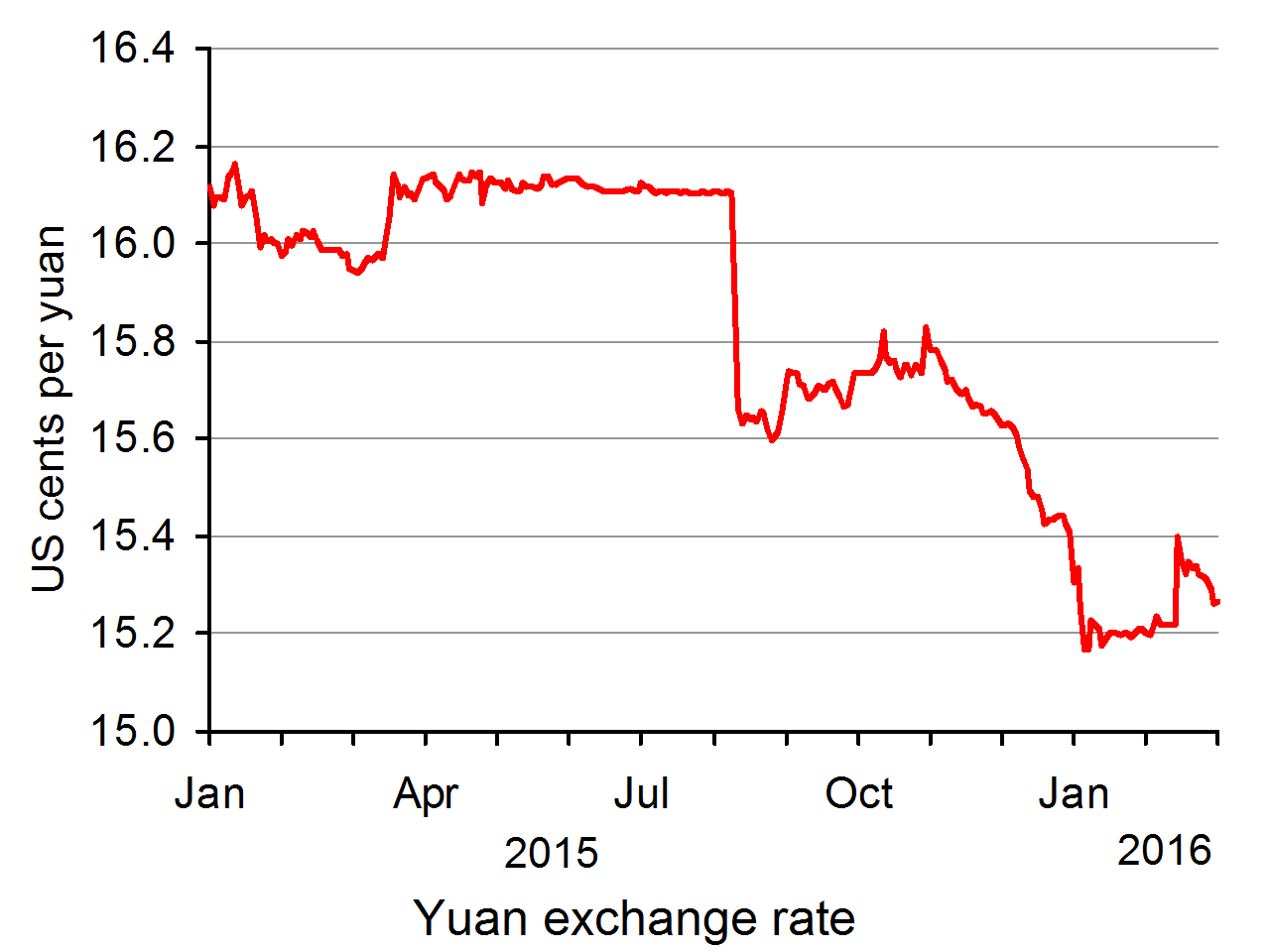 The Chinese authorities have been intervening in the foreign exchange market to arrest a fall in the yuan (¥) because of worries about capital outflows from China. The yuan was devalued by 2.9% in August 2015 from approximately ¥1 = ¢16.11 to approximately ¥1 = ¢15.64 (see chart) and after a modest rally in November 2015 it began falling again, with the Chinese authorities being unwilling to support it at the November rate. By January 2016, it had fallen a further 2.8% to approximately ¢15.20 (click here for a PowerPoint file of the chart).
But despite the possible downward pressure on the yuan from the cut in the reserve requirement, it will probably put less downward pressure than a cut in interest rates. This is because an interest rate cut has a bigger effect on capital outflows as it directly reduces the return on deposits in China. The central bank had already cut its benchmark 1-year lending rate from 6% to 4.35% between November 2014 and October 2015 and seems reluctant at the current time to cut it further.
China central bank resumes easing cycle to cushion reform pain Reuters, Pete Sweeney (29/2/16)
China cuts reserve requirements for banks to boost economy PressTV (29/2/16)
China Moves to Bolster Lending by Easing Banks’ Reserve Ratio New York Times, Neil Gough (29/2/16)
Economists React: China’s ‘Surprise’ Bank Reserve Cut Wall Street Journal (29/2/16)
 China Cuts Banks’ Reserve Requirement Ratio Bloomberg, Enda Curran (29/2/16)
China Reserve-Ratio Cut Signals Growth Is Priority Over Yuan Bloomberg, Andrew Lynch (29/2/16)
China reserve ratio cut not a signal of impending large-scale stimulus: Xinhua Reuters, Samuel Shen and John Ruwitch (2/3/16)
China injects cash to boost growth and counter capital outflows Financial Times, Gabriel Wildau (29/2/16)
China’s Economic Policy Akin To Pushing On A String Seeking Alpha, Bruce Wilds (2/3/16)
China cuts banks’ reserve ratio for fifth time in a year: Why and what’s next Channel NewsAsia, Tang See Kit, (1/3/16)
Questions
- Explain what is mean by the required reserve ratio (RRR).
- Explain how credit creation takes place.
- What will determine the amount of credit creation that will take place as a result of the $100bn of reserves in Chinese banks released for lending by the cut in the RRR from 17.5% to 17%.
- What prompted the recent cuts in the RRR?
- Why may China’s recent monetary policy measures be like pushing on a string?
- Is the reduction in the RRR a purely demand-side measure, or will it have supply-side consequences?
- Explain how different types of monetary policy affect the exchange rate.
- Should other countries welcome the cut in China’s RRR? Explain.
 There is a lot of pessimism around about the state of the global economy and the prospects for more sustained growth. Stock markets have been turbulent; oil and other commodity prices have fallen; inflation has been below central bank targets in most countries; and growth has declined in many countries, most worryingly in China.
The latest worry, expressed by finance ministers at the G20 conference in Shanghai, is that UK exit from the EU could have a negative impact on economic growth, not just for the UK, but for the global economy generally.
But is this pessimism justified? In an interesting article in the Independent, Hamish McRae argues that there are five signs that the world economy is not doomed yet! These are:
|
|
| • |
There are more monetary and fiscal measures that can still be taken to boost aggregate demand. |
| • |
Despite some slowing of economic growth, there is no sign of a global recession in the offing. |
|
|
| • |
US and UK growth are relatively buoyant, with consumer demand ‘driving the economy forward’. |
| • |
Deflation worries are too great, especially when lower prices are caused by lower commodity prices. These lower costs should act to stimulate demand as consumers have more real purchasing power. |
| • |
Inflation may start to edge upwards over the coming months and this will help to increase confidence as it will be taken as a sign that demand is recovering. |
So, according to McRae, there are five things we should look for to check on whether the global economy is recovering. He itemises these at the end of the article. But are these the only things we should look for?
Five signs that the world economy is not doomed yet Independent, Hamish McRae (27/2/15)
Questions
- What reasons are there to think that the world will grow more strongly in 2016 than in 2015?
- What reasons are there to think that the world will grow less strongly in 2016 than in 2015?
- Distinguish between leading and lagging indicators of economic growth.
- Do you agree with McRae’s choice of five indicators of whether the world economy is likely to grow more strongly?
- What indicators would you add to his list?
- Give some examples of ‘economic shocks’ that could upset predictions of economic growth rates. Explain their effect.