The first article below, from The Economist, examines likely macroeconomic policy under Donald Trump. He has stated that he plans to cut taxes, including reducing the top rates of income tax and reducing taxes on corporate income and capital gains. At the same time he has pledged to increase infrastructure spending.
This expansionary fiscal policy is unlikely to be accompanied by accommodating monetary policy. Interest rates would therefore rise to tackle the inflationary pressures from the fiscal policy. One effect of this would be to drive up the dollar and therein lies significant risks.
The first is that the value of dollar-denominated debt would rise in foreign currency terms, thereby making it difficult for countries with high levels of dollar debt to service those debts, possibly leading to default and resulting international instability. At the same time, a rising dollar may encourage capital 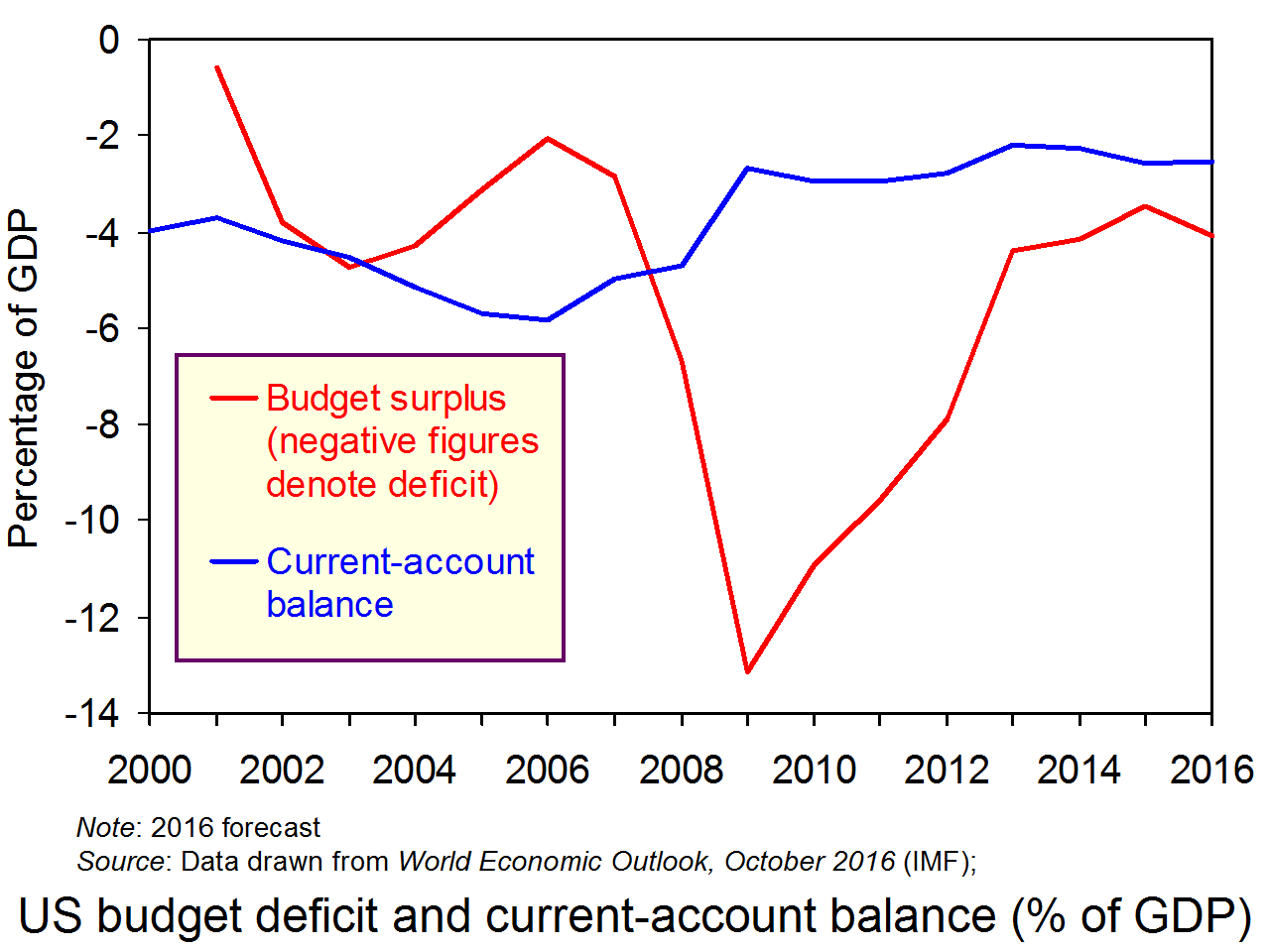 flight from weaker countries to the US (see The Economist article, ‘Emerging markets: Reversal of fortune’).
The second risk is that a rising dollar would worsen the US balance of trade account as US exports became less competitive and imports became more so. This may encourage Donald Trump to impose tariffs on various imports – something alluded to in campaign speeches. But, as we saw in the blog, Trump and Trade, “With complex modern supply chains, many products use components and services, such as design and logistics, from many different countries. Imposing restrictions on imports may lead to damage to products which are seen as US products”.
The third risk is that the main beneficiaries of Trump’s likely fiscal measures will be the rich, who would end up paying significantly less tax. With all the concerns from poor Americans, including people who voted for Trump, about growing inequality, measures that increase this inequality are unlikely to prove popular.
Articles
That Eighties show The Economist, Free Exchange (19/11/16)
The unbearable lightness of a stronger dollar Financial Times (18/11/16)
Questions
- What should the Fed’s response be to an expansionary fiscal policy?
- Which is likely to have the larger multiplier effect: (a) tax revenue reductions from cuts in the top rates of income; (b) increased government spending on infrastructure projects? Explain your answer.
- Could Donald Trump’s proposed fiscal policy lead to crowding out? Explain.
- What would protectionist policies do to (a) the US current account and (b) dollar exchange rates?
- Why might trying to protect US industries from imports prove difficult?
- Why might Trump’s proposed fiscal policy lead to capital flight from certain developing countries? Which types of country are most likely to lose from this process?
- Go though each of the three risks referred to in The Economist article and identify things that the US administration could do to mitigate these risks.
- Why may the rise in the US currency since the election be reversed?
 We have frequently looked at patterns in lending by financial institutions in our blogs given that many economies, like the UK, display cycles in credit. Central banks now pay considerable attention to the possibility of such cycles destabilising economies and causing financial distress to people and businesses. There is also increased interest here in the UK in bank lending data in light of Brexit. Patterns in credit flows may indicate whether it is affecting the lending choices of financial institutions and borrowing choices of people and businesses.
Data from the Bank of England’s Money and Credit – September 2016 statistical release shows net lending (lending net of repayments) by monetary financial institutions (MFIs) to individuals in September 2016 was £4.65 billion. This compares with £8.89 billion back in March 2016 which then was the highest monthly total since August 2007. However, the March figure was something of a spike in lending and this September’s figure is actually very slightly above the monthly average over the last 12 months, excluding March, of £4.5 billion. In other words, as yet, there is no discernible change in the pattern of credit flows post-Brexit.
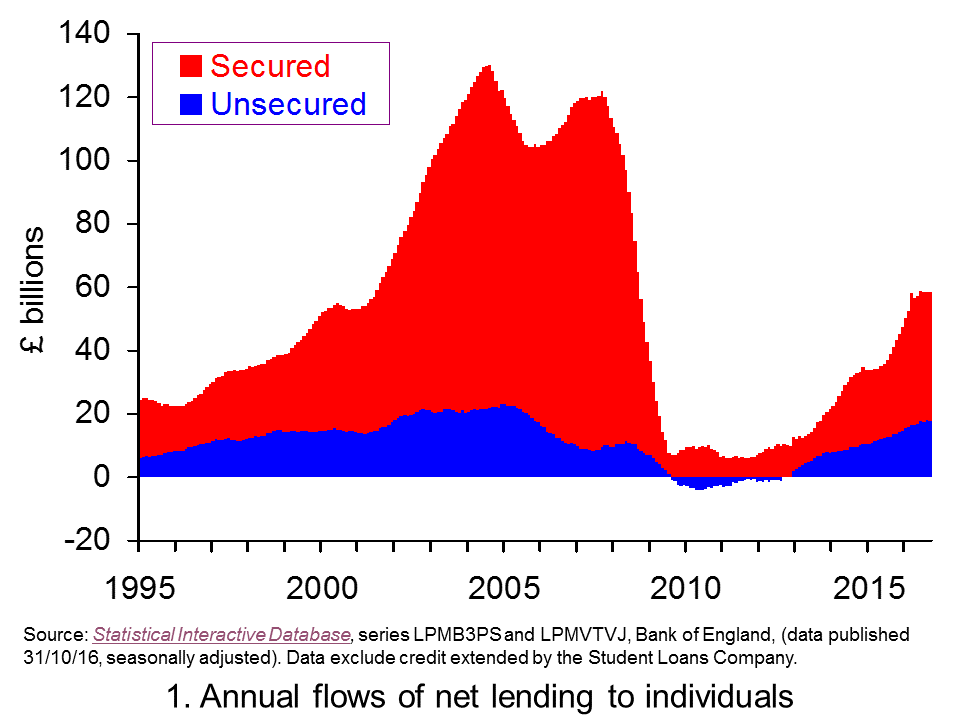 Leaving aside the question of the economic impact of Brexit, we still need to consider what the credit data mean for financial stability and for our financial well-being. Chart 1 shows the annual flows of lending by banks and building societies since the mid 1990s. The chart evidences the cycles in secured lending and in consumer credit (unsecured lending) with its consequent implications for economic and financial-welling being.(Click here to download a PowerPoint of Chart 1.)
After the financial crisis, as Chart 1 shows, net lending to individuals collapsed. More recently, net lending has been on the rise both through secured lending and in consumer credit. The latest data show that annual flows have begun to plateau. Nonetheless, the total flow of credit in the 12 months to September of £58 billion compares with £33 billion and £41 billion in the 12 months to September 2014 and 2015 respectively. Having said this, in the 12 months to September 2007 the figure was £112 billion! £58 billion is currently equivalent to around about 3 per cent of GDP.
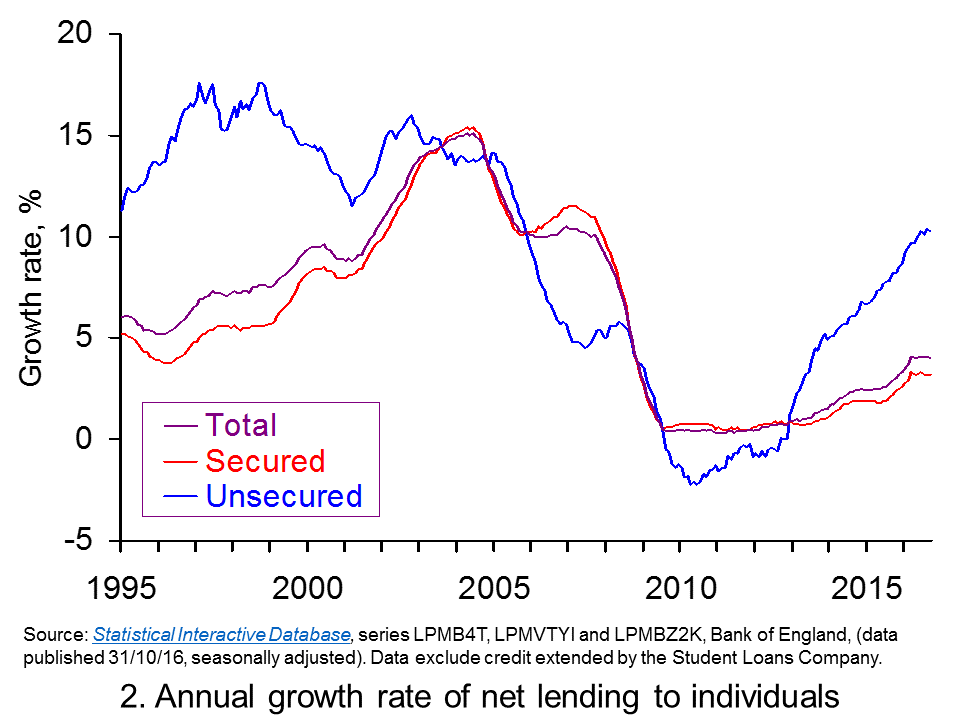 To more readily see the effect of the credit flows on debts stocks, Chart 2 shows the annual growth rate of net lending by MFIs. In essence, this mirrors the growth rate in the stocks of debt which is an important metric of financial well-being. The chart nicely captures the pick up in the growth of lending from around the start of 2013. What is particularly noticeable is the very strong rates of growth in net unsecured lending from MFIs. The growth of unsecured lending remains above 10 per cent, comparable with rates in the mid 2000s. (Click here to download a PowerPoint of Chart 2.)
The growth in debt stocks arising from lending continues to demonstrate the need for individuals to be mindful of their financial well-being. This caution is perhaps more important given the current economics uncertainties. The role of the Financial Policy Committee in the UK is to monitor the financial well-being of economic agents in the context of ensuring the resilience of the financial system. It therefore analyses the data on credit flows and debt stocks referred to in this blog along with other relevant metrics. At this moment its stance is not to apply any additional buffer – known as the Countercyclical Capital Buffer – on a financial institution’s exposures in the UK over and above internationally agreed standards. Regardless, the fact that it explicitly monitors financial well-being and risk shows just how significant the relationship between the financial system and economic outcomes is now regarded.
Articles
Higher inflation and rising debt threaten millions in UK The Guardian, Angela Monaghan (5/11/16)
Consumer spending has saved the economy in the past – but we cannot bet on it forever Sunday Express, Geff Ho (13/11/16)
Warning as household debts rise to top £1.5 trillion BBC News, Hannah Richardson (7/11/16)
Household debt hits record high – How to get back on track if you’re in the red Mirror, Graham Hiscott (7/12/16)
Data
Money and Credit – September 2016 Bank of England
Bankstats (Monetary and Financial Statistics) – Latest Tables Bank of England
Statistical Interactive Database Bank of England
Questions
- Explain the difference between secured debt and unsecured debt.
- What does it mean if individuals are financially distressed?
- How would we measure the financial well-being of individuals and households?
- What actions might individuals take it they are financially distressed? What might the economic consequences be?
- How might uncertainty, such as that following the UK vote to leave the European Union, affect spending and savings’ decisions by households?
- What measures can institutions, like the UK’s Financial Policy Committee, take to reduce the likelihood that flows of credit become too excessive?
 The article below looks at the economy of Brazil. The statistics do not look good. Real output fell last year by 3.8% and this year it is expected to fall by another 3.3%. Inflation this year is expected to be 9.0% and unemployment 11.2%, with the government deficit expected to be 10.4% of GDP.
The article considers Keynesian economics in the light of the case of Brazil, which is suffering from declining potential supply, but excess demand. It compares Brazil with the case of most developed countries in the aftermath of the financial crisis. Here countries have suffered from a lack of demand, made worse by austerity policies, and only helped by expansionary monetary policy. But the effect of the monetary policy has generally been weak, as much of the extra money has been  used to purchase assets rather than funding a growth in aggregate demand.
Different policy prescriptions are proposed in the article. For developed countries struggling to grow, the solution would seem to be expansionary fiscal policy, made easy to fund by lower interest rates. For Brazil, by contrast, the solution proposed is one of austerity. Fiscal policy should be tightened. As the article states:
Spending restraint might well prove painful for some members of Brazilian society. But hyperinflation and default are hardly a walk in the park for those struggling to get by. Generally speaking, austerity has been a misguided policy approach in recent years. But Brazil is a special case. For now, anyway.
The tight fiscal policies could be accompanied by supply-side policies aimed at reducing bureaucracy and inefficiency.
Article
Brazil and the new old normal: There is more than one kind of economic mess to be in The Economist, Free Exchange Economics (12/10/16)
Questions
- Explain what is meant by ‘crowding out’.
- What is meant by the ‘liquidity trap’? Why are many countries in the developed world currently in a liquidity trap?
- Why have central banks in the developed world found it difficult to stimulate growth with policies of quantitative easing?
- Under what circumstances would austerity policies be valuable in the developed world?
- Why is crowding out of fiscal policy unlikely to occur to any great extent in Europe, but is highly likely to occur in Brazil?
- What has happened to potential GDP in Brazil in the past couple of years?
- What is meant by the ‘terms of trade’? Why have Brazil’s terms of trade deteriorated?
- What sort of policies could the Brazilian government pursue to raise growth rates? Are these demand-side or supply-side policies?
- Should Brazil pursue austerity policies and, if so, what form should they take?
 In our blog What can we read into signs of easing consumer confidence? we noted the slight easing in consumer confidence that had occurred since the autumn of last year. Nonetheless, at that time, survey data from the European Commission was continuing to show consumer confidence levels still well above their long-run average. However, following the UK vote to leave the European Union consumer confidence has fallen sharply and now the headline confidence indicator has fallen below its long-term average for the first time since June 2013.
 We take this opportunity to update our May blog to better understand the extent and nature of the decline in confidence. The importance of confidence changes is typically modelled by economists in their models of the macroeconomy as a demand-side shock. Falling consumer confidence would be expected to dampen an economy’s output levels since aggregate demand falls as households spend less. Consequently, a marked fall in confidence amounts to a negative demand-side shock.
The European Commission’s confidence measure is collated from questions in a monthly survey. In the UK around 2000 individuals are surveyed. Across the current 28 member states over 41 000 people are surveyed.
In the survey individuals are asked a series of 12 questions which are designed to provide information on spending and saving intentions. These questions include perceptions of financial well-being, the general economic situation, consumer prices, unemployment, saving and the undertaking of major purchases.
 The responses elicit either negative or positive responses. For example, respondents may feel that over the next 12 months the financial situation of their household will improve a little or a lot, stay the same or deteriorate a little or a lot. A weighted balance of positive over negative replies can be calculated. The balance can vary from –100, when all respondents choose the most negative option, to +100, when all respondents choose the most positive option.
The European Commission’s principal consumer confidence indicator is the average of the balances of four of the twelve questions posed: the financial situation of households, the general economic situation, unemployment expectations (with inverted sign) and savings, all over the next 12 months. These forward-looking balances are seasonally adjusted.
Sometimes other combinations of the 12 questions are averaged to produce alternative headline confidence numbers (see, for example, the newspaper articles below). These may include a mix of forward and backward-looking questions. However, in this blog we report on the European Commission’s principal confidence indicator as outlined above. The intention is that this or any other confidence indicator tracks developments in households’ spending intentions and, in turn, likely changes in the rate of growth of household consumption.
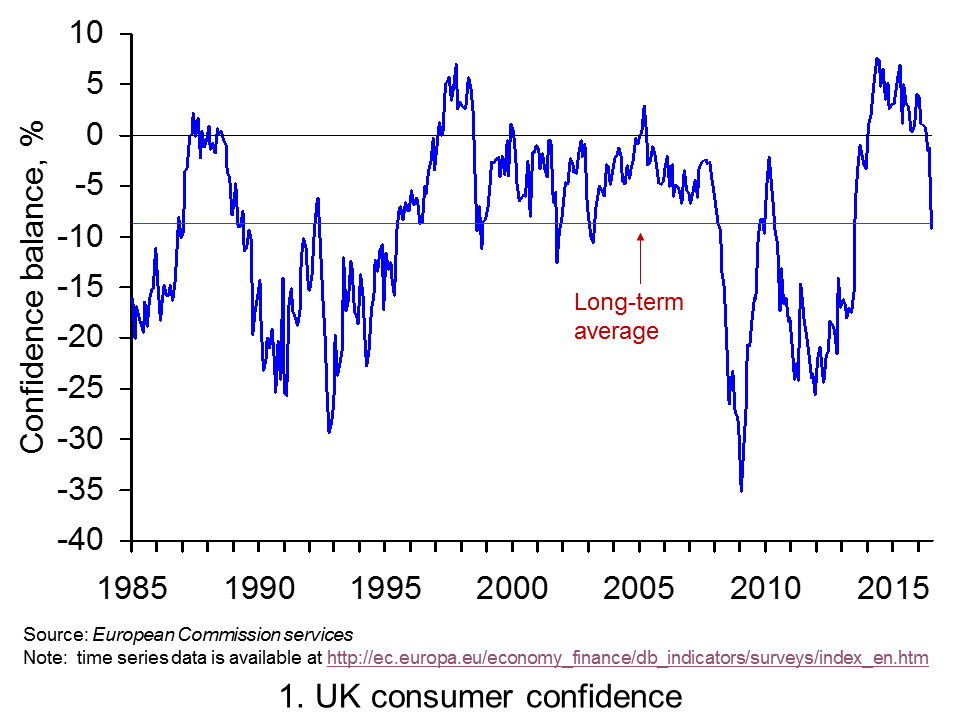 Chart 1 shows the consumer confidence indicator for the UK. The long-term average of –8.7 shows that negative responses across the four questions typically outweigh positive responses.
In July the confidence balance stood at –9.2 down from –1.2 in June. This 8 point fall is the largest monthly fall in this particular headline indicator since January 1991 when it fell 11 points. The fall also means that not only do negative responses now dominate but more so than is usual. The fall in confidence is therefore very stark indeed. (Click here to download a PowerPoint of the chart.)
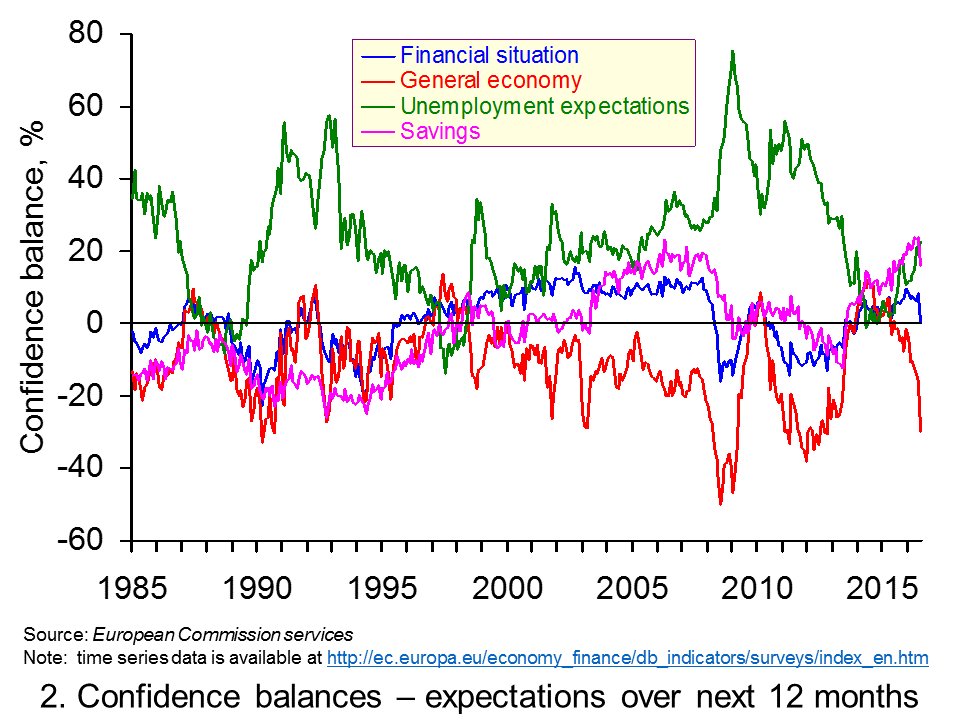 Chart 2 is important because it enables us to see what drives the European Commission’s headline confidence indicator for the UK by looking at its four component balances. The sharp decline in confidence is reflected in a deterioration in all four components. (Click here to download a PowerPoint of the chart.)
The most notable change in the individual confidence balances is the sharp deterioration in expectations for the general economy. In July the forward-looking general economic situation balance fell to –29.9 having stood at –15.7 in June. As recently as last December it registered –1.4. This is the lowest forward-looking general economy confidence balance since October 2012, though still some way above the –50.1 reported in July 2008 when the financial crisis was unfolding.
Alongside the 14 point drop in the balance for general economy expectations, the UK experienced 8 point drops in both the balances for households’ financial expectations and the expectations of saving over the next 12 months. In other words, households expect to become financially poorer and less able to save.
The monthly survey contains other questions that can help to predict future spending patterns. For example, we might expect the responses to questions relating to perceptions around what the survey call ‘major purchases’ to give us some important insight in households’ financial well-being and spending plans. ‘Major purchases’ are taken to be items such as furniture, electrical goods and electronic devices.
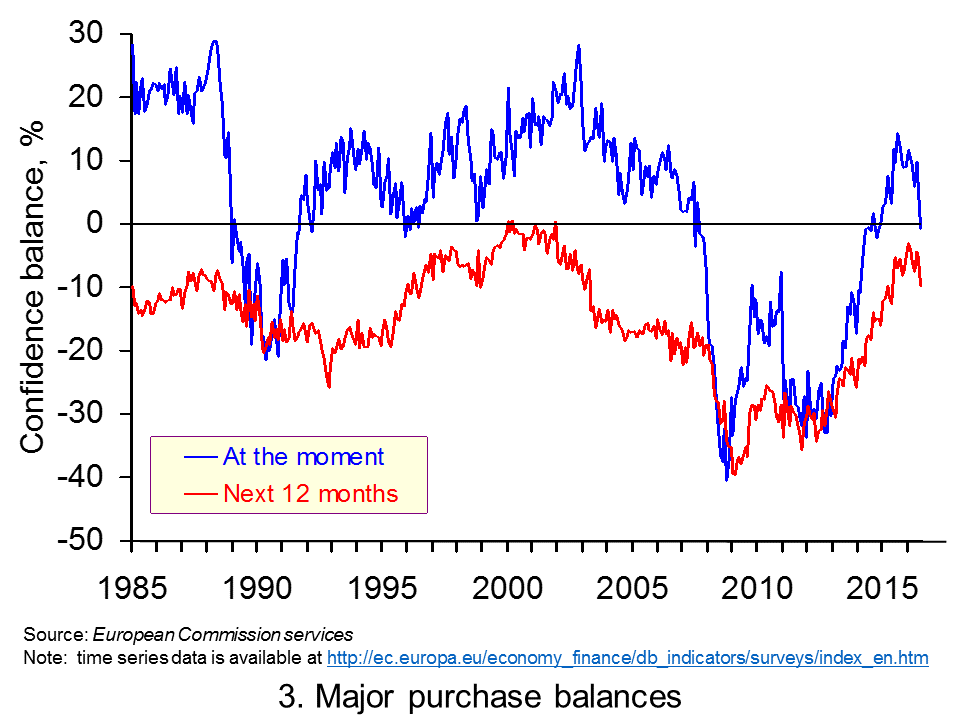 Chart 3 shows the balances to both whether now is the right time to make major purchases and to whether respondents expect to spend more on major purchases in the coming 12 months compared to the past 12 months. July’s data show a marked deterioration in sentiment towards making major purchases. The balance relating to whether now is the right time to make major purchases fell by 6.5 points, the largest fall since December 2011, while the forward-looking major purchase balance fell by 4.6 points, the largest fall since January 2011. (Click here to download a PowerPoint of the chart.)
The fall in the major purchases balances is consistent with the idea that households are feeling a sense of heightened uncertainty. The implication of this is that households will tend to be more cautious, cutting back on expenditures, including major purchases.
The magnitude of the fall in UK consumer confidence following the outcome of the EU referendum on 23 June is even more stark when compared to developments in consumer confidence across the 28 member states of the European Union and in the 19 countries that make up the Euro area.
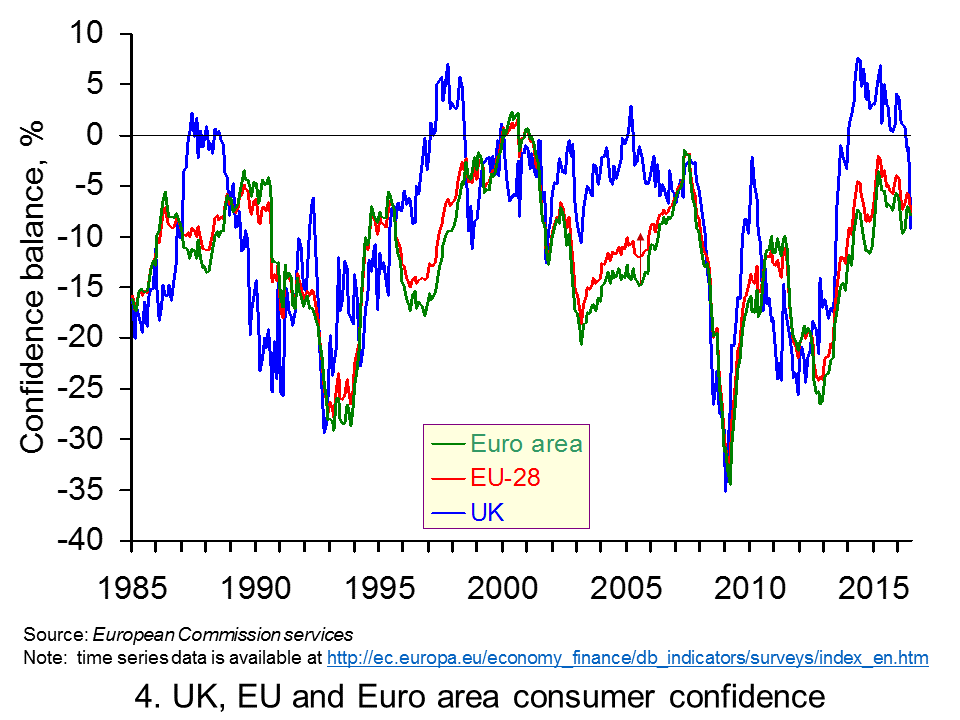 Chart 4 shows how UK consumer confidence recovered relatively more strongly following the financial crisis of the late 2000s. The headline confidence indicator rose strongly from the middle of 2013 and, as we noted earlier, was consistently in positive territory during 2014 and remained so at the start of this year. The slump in consumer confidence in the UK means that the headline confidence measure has now fallen below that across the EU as well as that in the euro area. In fact, confidence in the euro area has been consistently between –7 or –9 for the past six months. (Click here to download a PowerPoint of the chart.)
 Interest now turns to whether the slump in confidence in the UK will persist or, worse still, deepen further. The implied negative impact on aggregate demand would be expected to translate into weaker growth. The concern therefore is the extent to which we can expect UK growth to weaken in the months ahead. The prospect of weaker growth is likely to influence economic policy.
The government has already talked about ‘resetting fiscal policy’ which can be taken to mean a relative loosening in its fiscal policy relative to the Government’s original plans. Similarly we might yet see a further loosening of monetary policy. While the Bank of England’s Monetary Policy Committee held the official Bank Rate at 0.5 per cent at its July meeting, many commentators expect a cut sooner rather than later. The confidence data will be one important consideration in the Bank’s calculations.
Articles
UK sees biggest fall in consumer confidence for 26 years after Brexit vote The Guardian, Katie Allen (29/7/16)
UK consumer confidence takes biggest drop since 1990s ITV News (29/7/16)
Consumer confidence suffers biggest drop in 26 years after Brexit vote The Telegraph, Szu Ping Chan (29/7/16)
Consumer confidence slides at fastest pace in 26 years after Brexit vote Indepedent, Ben Chu (29/7/16)
Housing Outlook ’Uncertain’ as Brexit Hits Consumer Confidence Bloomberg, Charlotte Ryan (28/7/16)
Brexit Sees U.K. Consumer Confidence Fall Most Since 1990 Bloomberg, Charlotte Ryan (29/7/16)
Consumer confidence nosedives in Scotland in wake of Brexit vote Herald Scotland, Helen McArdle (29/7/16)
Data
Business and Consumer Surveys European Commission
Questions
- Draw up a series of factors that you think might affect consumer confidence.
- Analyse the ways in which consumer confidence might affect economic activity.
- Explain what you understand by a positive and a negative demand-side shock. How might changes in consumer confidence initiate demand shocks?
- Which of the following statements is likely to be more accurate? (a) Consumer confidence drives economic activity. (b) Economic activity drives consumer confidence.
- What macroeconomic indicators would those compiling the consumer confidence indicator hope that the indicator would help to predict?
- Analyse the possible economic implications of the fall in consumer confidence following the EU referendum vote.
- What economic effects might any persistence in the fall in consumer confidence have?
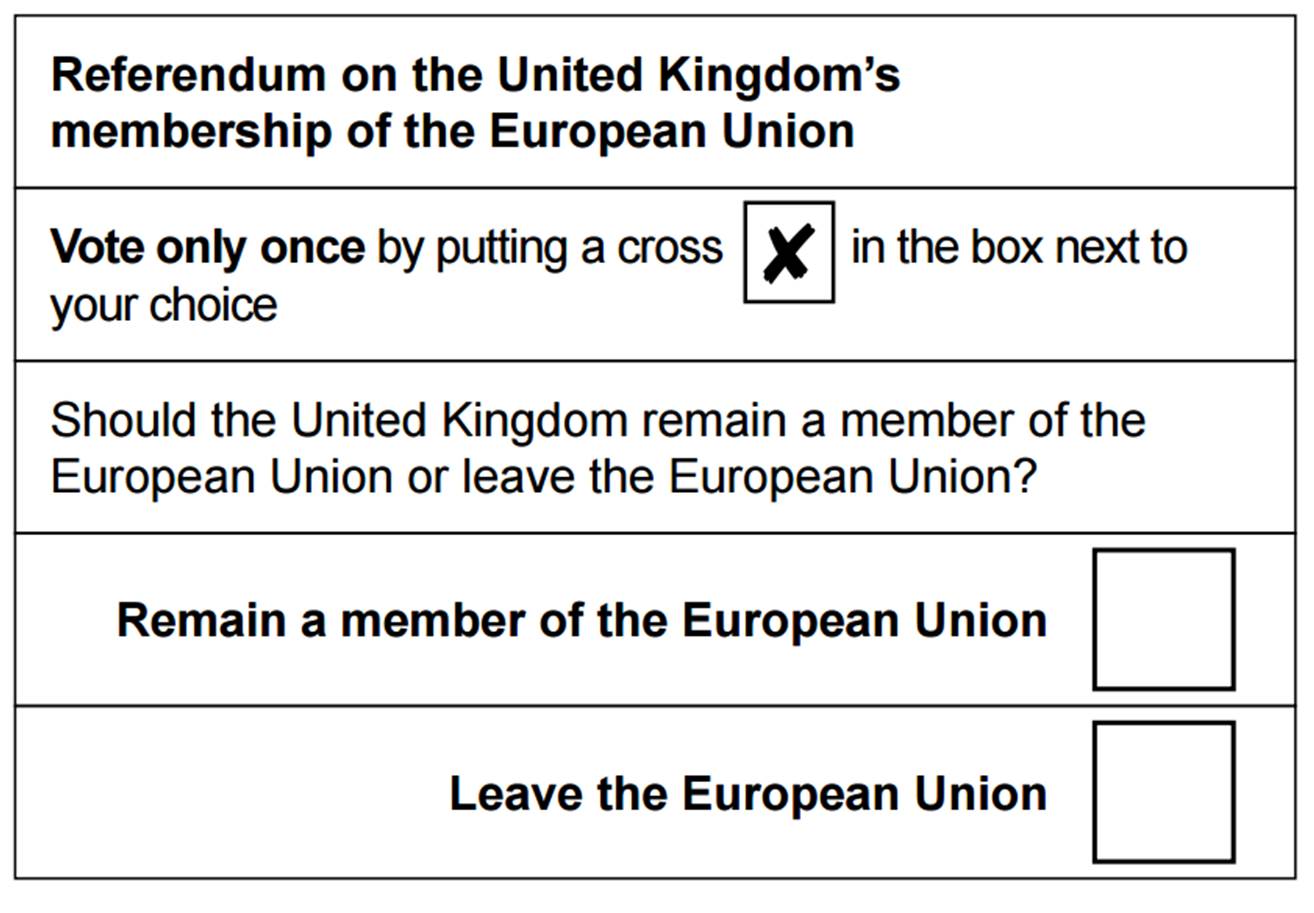
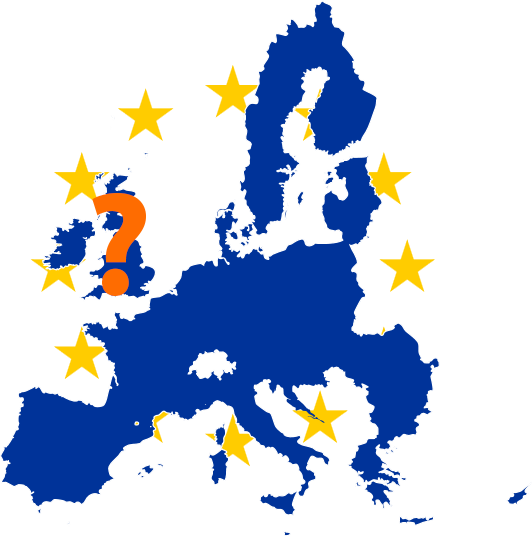 Before the referendum, economists overwhelmingly argued that the economic case for the UK remaining in the EU was much stronger than that for leaving. They warned of serious economic consequences, both short term and long term, of a Brexit vote. And yet, by a majority of 51.9% to 48.1% of the 72.1% of the electorate who voted, the UK voted to leave the EU.
Does this mean that economists failed to communicate to the electorate? Were the arguments presented poorly or in too academic a way?
Or did people simply not believe the economists’ forecasts, being cynical about the ability of economists to forecast? During the campaign, on several occasions I heard people repeating the joke that economists had successfully predicted five out of the last two recessions!
 Did they not believe the data that immigrants from other EU countries to the UK contribute more in taxes they draw in benefits and that overall they make a net positive contribution to output per head? Or perhaps they believed the claims that immigrants imposed a net cost on the economy.
Or were there ‘non-economic’ issues that people found more persuasive, such as questions of sovereignty or national identity? Or was the strain on local resources, such as health services, schools and housing, blamed on immigration itself rather than on a lack of spending on additional resources – the funding for which could have come from the extra GDP generated by the immigration?
Or were there so many lies told by politicians and those with vested interests that people simply didn’t know whom to believe?
Economists will, no doubt, do a lot of soul searching over the coming months. One such economist is Paul Johnson, Director of the Institute for Fiscal Studies, whose article is linked below.
Article
We economists must face the plain truth that the referendum showed our failings Institute for Fiscal Studies newspaper articles. Paul Johnson (28/6/16)
Questions
- In what ways could economists have communicated better to the general public during the referendum campaign?
- For what reasons may people distrust economists?
- Were economists hampered in delivering their message by ‘balanced reporting’?
- Comment on Paul Johnson’s statement that, ‘The most politically engaged of us spend decades working out how to tweak tax policy, or labour market policy, or competition policy to deliver small benefits. How many times over would our work have been repaid if we had simply convinced a few more people of the basics?’
- Do economists, or at least some of them, need to become more ‘media savvy’?
- How could institutions, such as the Royal Economic Society and the Society of Business Economists, do more to help economists collectively to communicate with the general public?
- Give some examples of the terminology/jargon we use which might be inappropriate for communicating with the general public. Suggest some alternative terms to the examples you’ve given.