 Prices of used fully electric cars (EVs) are falling in the UK, even though prices of used internal combustion engine (ICE) cars are rising. According to Auto Trader (see the first two articles below), in February 2023 the average price of used petrol cars rose by 3.3% compared with January and the price of used diesel cars rose by 1.4%. But the price of used EVs fell by 9.1%. This follows a fall of 2.1% in January.
But why are used EV prices falling? After all, the last few years has seen a drive to replace ICEs with EVs and hybrids, with many consumers preferring electric cars to petrol and diesel ones. What is more, vehicle excise duty is currently zero for EVs (and will be until 2025) and the sale of new ICEs will be banned from the end of the decade. The answer lies in demand and supply.
 On the demand side, many existing and potential EV owners worry about the charging infrastructure. The number of EVs has grown more rapidly than the number of charging points. In 2020 there was one charging point per 16 cars; by 2022 this had worsened to one per 30 cars. Also the distribution of charging points is patchy and there is a lack of rapid and ultra-rapid chargers. Increasingly, people have to queue for access to a charger and this can substantially delay a journey and could mean missed appointments. There were many pictures in the media around Christmas of long queues for chargers at service stations and supermarkets. Poor charging infrastructure can be more of a problem for second-hand EVs, which tend to have a smaller range.
Also on the demand side is the price of fuel. After the Russian invasion of Ukraine and the rise in oil prices, the price of petrol and diesel soared. This increased the cost of running ICE vehicles and boosted the demand for EVs. But the war also drove up the price of natural gas and this price largely determines the wholesale price of electricity. With government subsidies for electricity, this constrained the rise in electricity prices. This made running an EV for a time comparatively cheaper.  More recently, the price of oil has fallen and with it the price of petrol and diesel. But electricity prices are set to rise in April as government subsidies cease. The cost advantage of running an electric car is likely to disappear, or at least substantially decline.
Another substitute for second-hand EVs is new EVs. As the range of new EVs increases, then anyone thinking about buying an EV may be more tempted to buy a new one rather than a used one. Such demand has also been driven by Tesla’s decision to cut the UK prices of many of it models by between 10% and 13%.
The fall in demand for used EVs is compounded, at least in the short term, by speculation. People thinking of trading in their ICE or hybrid car for a fully electric one are likely to wait if they see prices falling. Why buy now if, by waiting, you could get the same model cheaper?
On the supply side, EV owners, faced with the infrastructure problems outlined above, are likely to sell their EV and buy an ICE or hybrid one instead. This increases the supply of used EVs. This is again compounded by speculation as people thinking of selling their EV do so as quickly as possible before price falls further.
In many other countries, there is much more rapid investment in charging infrastructure and/or subsidies for purchasing not only new but used EVs. This has prevented or limited the fall in price of used EVs.
Articles
- Auto Trader diagnoses used car sector’s ‘robust health’ after February value rise
AM-online, Tom Sharpe (20/2/23)
- Auto Trader: Used car prices UP AGAIN in February but EV prices continue to tumble
Car Dealer, James Baggott (20/2/23)
- Used electric car prices caught in vicious downward cycle as experts warn of trouble ahead
Car Dealer, James Baggott (13/2/23)
- Used EV market needs more support in Spring Budget, says Vehicle Remarketing Association
Car Dealer, Jack Williams (15/2/23)
- Middle classes cannot afford electric cars, warns Vauxhall owner
The Telegraph, Howard Mustoe (23/2/23)
- British drivers are hurtling towards the electric car cliff edge
The Telegraph on msn, Ben Marlow (23/2/23)
- Cars Drivers should be ‘cautious’ when buying a used EV before 2030 car ban – ‘still an issue!’
Express, Felix Reeves (12/2/23)
- Motorpoint revenues accelerate but dealership group issues profit warning as used electric car prices crash
This is Money, Camilla Canocchi (27/1/23)
- Tesla cuts prices by up to a fifth to boost demand
BBC News, Lucy Hooker (13/1/23)
Questions
- Draw a supply and demand diagram to illustrate what has been happening in the market for used EVs.
- How has the price elasticity of (a) demand and (b) supply affected the amount by which used EV prices have fallen?
- Identify substitutes and complements for used electric vehicles. How relevant is the cross-price elasticity of demand for these complements and substitutes in determining price changes of used EVs?
- Draw a diagram to illustrate the effect of speculation on used EV prices.
- What is likely to happen to used EV prices in the months ahead? Explain.
- How are externalities in car usage relevant to government action to influence the market for EVs? What should determine the size of this intervention?
- Devise a short survey for people thinking of buying an EV to determine the factors that are likely to affect their decision to buy one and, if so, whether to buy a new or used one.
 Tickets for Beyonce’s 2023 UK Renaissance tour went on general sale via Ticketmaster’s website at 10am on Tuesday 7 February. Throughout the day, social media were full of messages from fans complaining about technical issues, long online queues and rising prices. This is not the first time this has happened. Similar complaints were made in 2022 when tickets went on sale for tours by Bruce Springsteen, Harry Styles and Taylor Swift.
With the general sale of tickets for Beyonce’s tour, many fans complained they were waiting in online queues of over 500 000 people. Others reported their frustration with continually receiving ‘403 error’ messages.
Market dominance
In November 2022, Ticketmaster’s website in the USA constantly crashed during the pre-sale of tickets for Taylor Swift’s tour. This led to the general sale of tickets being cancelled.
In response to the public anger that followed this decision, the Senate’s antitrust subcommittee organised a hearing with the title – ‘That’s The Ticket: Promoting Competition and Protecting Competition and Protecting Consumers in Live Entertainment.’
Senator Amy Klobuchar, the Chair of this committee, stated that
The issues within America’s ticketing industry were made painfully obvious when Ticketmaster’s website failed hundreds of thousands of fans hoping to purchase tickets for Taylor Swift’s new tour, but these problems are not new. For too long, consumers have faced long waits and website failures, and Ticketmaster’s dominant market position means the company faces inadequate pressure to innovate and improve.
Ticketmaster merged with Live Nation in 2010 to become the largest business in the primary ticket market for live music events. Some people have accused the firm of abusing its dominant market position by failing to invest enough money in its website, so leading to poor customer service.
Dynamic pricing
 Fans have also been complaining about the system of dynamic pricing that Ticketmaster now uses for big live events. What exactly is dynamic pricing?
Firms with market power often adjust their prices in response to changing market conditions. For example, if a business experiences significant increases in demand for its products in one quarter/year it may respond by raising prices in the following quarter/year.
With dynamic pricing, these price changes take place over much shorter time periods: i.e. within minutes. For example, in one media report, a Harry Styles fan placed £155 tickets in their basket for a concert at Wembley stadium. When the same fan then tried to purchase the tickets, Ticketmaster’s website sent a message stating that they were no longer available. However, in reality they were still available but for £386 – the price had instantly jumped because of high demand. Continually monitoring market conditions and responding to changes so quickly requires the use of specialist software and sophisticated algorithms.
Arguments for dynamic pricing
With ticket sales taking place months/years in advance of most live events, it is difficult for artists/promotors to predict future levels of demand. Given this uncertainty and the importance for the artist of playing in front of a full venue, event organisers may err on the side of caution when pricing tickets.
If the demand for tickets proves to be much stronger than initially forecast, then resellers in the secondary market can take advantage of the situation and make significant amounts of money. Dynamic pricing enables sellers in the primary market, such as Ticketmaster, to adjust to market conditions and so limits the opportunities of resale for a profit.
Ticketmaster argues that without dynamic pricing, artists will miss out on large amounts of revenue that will go to re-sellers instead. A spokesperson for the company stated that
Over the past few years, artists have lost money to resellers who have no investment in the event going well. As such event organisers have looked to market-based pricing to recapture that lost revenue.
Critics have claimed that Ticketmaster’s use of dynamic pricing is simply an example of price gouging.
No doubt the controversy over the sale of tickets for live music events will continue in the future.
Articles
- Beyoncé tour: UK fans snap up tickets despite Ticketmaster glitches
BBC News, Ian Youngs (7/2/23)
- Beyoncé Fans Are Going to Extreme Lengths to Secure Renaissance Tour Tickets
Time, Mariah Espada (10/2/23)
- Live music: How buying concert tickets could be made better
BBC News, Mark Savage (26/1/23)
- Ticketmaster demand-based pricing system criticised
BBC News, Annabel Rackham (10/10/22)
- Did Ticketmaster’s Market Dominance Fuel the Chaos for Swifties?
Yale Insights, Florian Ederer (23/11/22)
 Taylor Swift ticket sale problems spark widespread criticism of Ticketmaster
PBS NewsHour on YouTube, Diana Moss and John Yang (17/11/22)
- Springsteen tickets are going for a whopping $4,000 – what else are we paying dynamic prices for?
The Guardian, Arwa Mahdawi (27/7/22)
- Will the Taylor Swift-Ticketmaster Senate Hearing Actually Change Anything?
Variety, Dean Budnick (1/2/23)
- Beyonce fans scramble for Renaissance tickets as sellers warn availability is already ‘extremely limited’
Sky News, Bethany Minelle (3/2/23)
Questions
- Explain the difference between the primary and secondary market for ticket sales for live events.
- Draw a demand and supply diagram to illustrate the primary market for tickets. Using this diagram explain how below market clearing prices in the primary market enable re-sellers to make money in the secondary market.
- What are the limitations of using demand and supply diagrams to analyse the primary market for tickets?
- Who has the greater market power – Ticketmaster or artists such as Taylor Swift and Beyonce?
- Try to provide a precise definition of the term ‘price gouging’.
- What other sectors commonly use dynamic pricing?
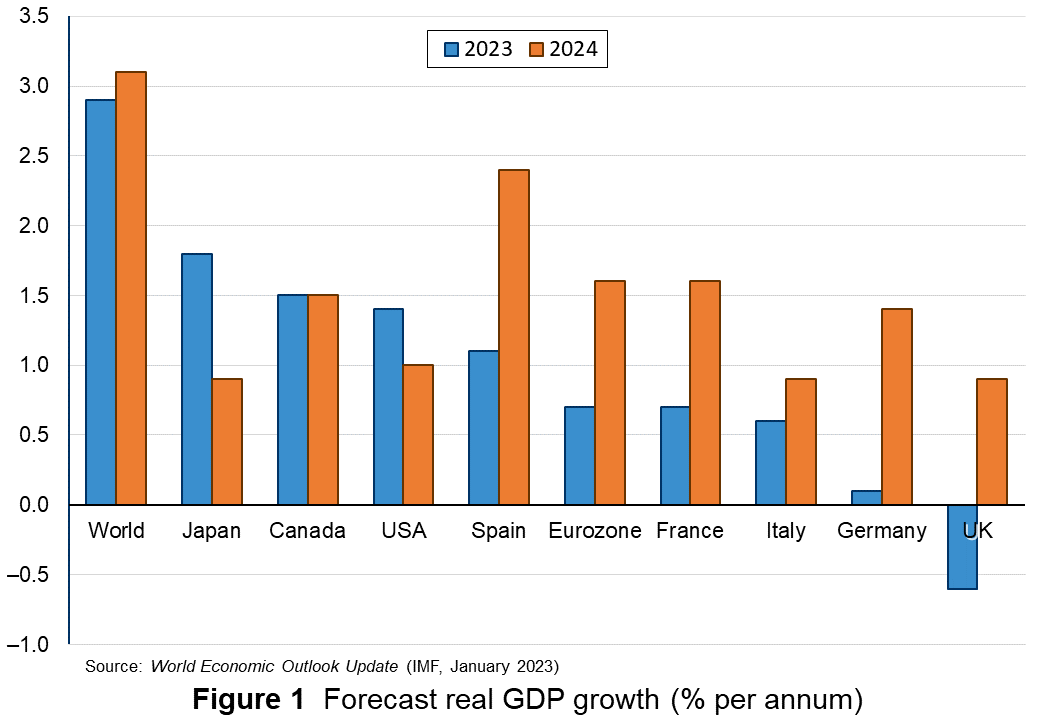 In its latest World Economic Outlook update, the IMF forecasts that the UK in 2023 will be the worst performing economy in the G7. Unlike all the other countries and regions in the report, only the UK economy is set to shrink. UK real GDP is forecast to fall by 0.6% in 2023 (see Figure 1: click here for a PowerPoint). In the USA it is forecast to rise by 1.4%, in Germany by 0.1%, in France by 0.7% and in Japan by 1.8%. GDP in advanced countries as a whole is forecast to grow by 1.2%, while world output is forecast to grow by 2.9%. Developing countries are forecast to grow by 4.0%, with China and India forecast to grow by 5.2% and 6.1%, respectively. And things are not forecast to be a lot better for the UK in 2024, with growth of 0.9% – bottom equal with Japan and Italy.
Low projected growth in the UK in part reflects the tighter fiscal and monetary policies being implemented to curb inflation, which is slow to fall thanks to tight labour markets and persistently higher energy prices. The UK is particularly exposed to high wholesale gas prices, with a larger share of its energy coming from natural gas than most countries.
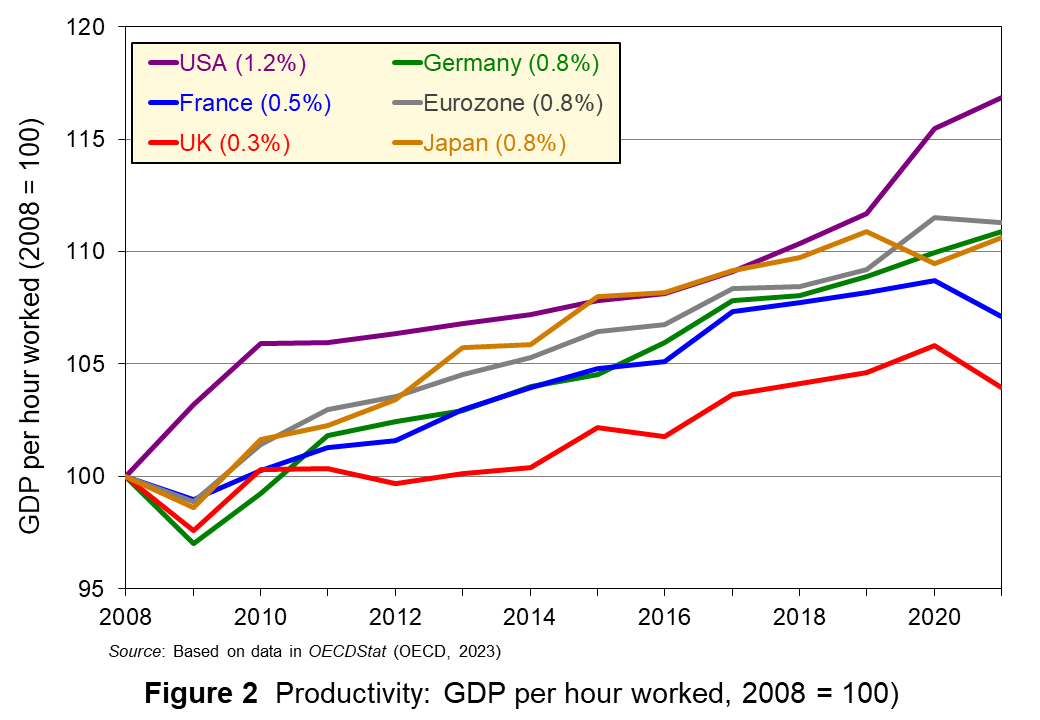 But the UK’s lower forecast growth relative to other countries reflects a longer-term problem in the UK and that is the slow rate of productivity growth. This is illustrated in Figure 2, which shows output (GDP) per hour worked in major economies, indexed at 100 in 2008 (click here for a PowerPoint). As you can see, the growth in productivity in the UK has lagged behind that of the other economies. The average annual percentage growth in productivity is shown next to each country. The UK’s growth in productivity since 2008 has been a mere 0.3% per annum.
Causes of low productivity/low productivity growth
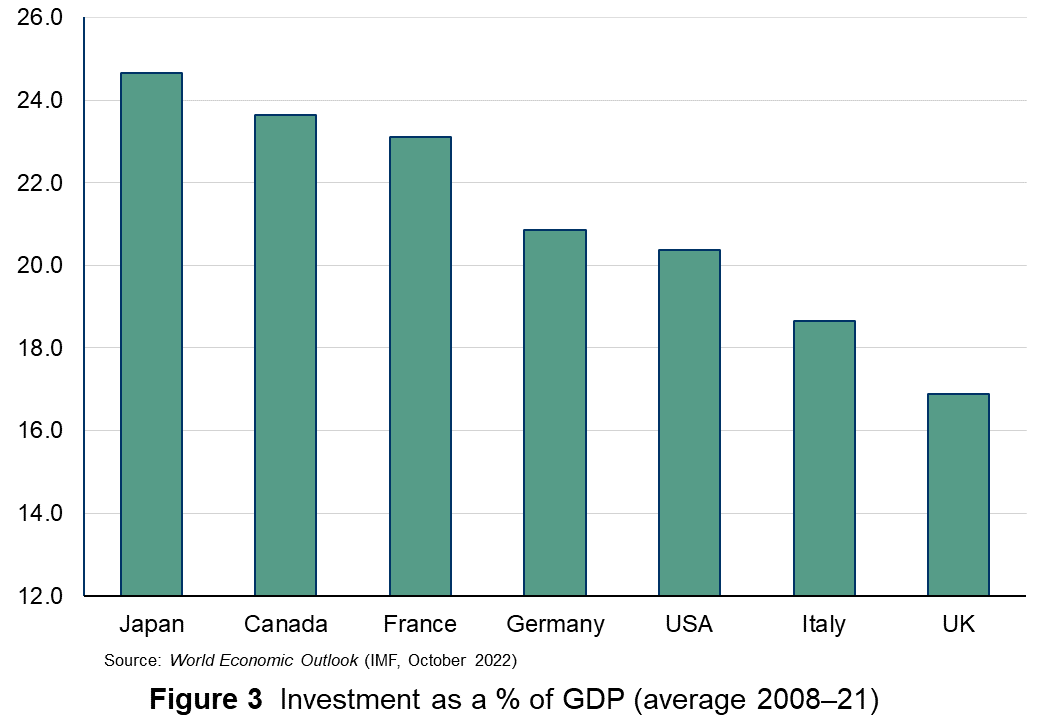 A major cause of low productivity growth is low levels of investment in physical capital. Figure 3 shows investment (gross capital formation) as a percentage of GDP for the G7 countries from the 2007–8 financial crisis to the year before the pandemic (click here for a PowerPoint). As you can see, the UK performs the worst of the seven countries.
Part of the reason for the low level of private investment is uncertainty. Firms have been discouraged from investing because of a lack of economic growth and fears that this was likely to remain subdued. The problem was compounded by Brexit, with many firms uncertain about their future markets, especially in the EU. COVID affected investment, as it did in all countries, but supply chain problems in the aftermath of COVID have been worse for the UK than many countries. Also, the UK has been particularly exposed to the effects of higher gas prices following the Russian invasion of Ukraine, as a large proportion of electricity is generated from natural gas and natural gas is the major fuel for home heating.
Part of the reason is an environment that is unconducive for investment. Access to finance for investment is more difficult in the UK and more costly than in many countries. The financial system tends to have a short-term focus, with an emphasises on dividends and short-term returns rather than on the long-term gains from investment. This is compounded by physical infrastructure problems with a lack of investment in energy, road and rail and a slow roll out of advances in telecoms.

To help fund investment and drive economic growth, in 2021 the UK government established a government-owned UK Infrastructure Bank. This has access to £22 billion of funds. However, as The Conversation article below points out:
According to a January 2023 report from Westminster’s Public Accounts Committee, 18 months after its launch the bank had only deployed ‘£1 billion of its £22 billion capital to 10 deals’, and had employed just 16 permanent staff ‘against a target of 320’. The committee also said it was ‘not convinced the bank has a strategic view of where it best needs to target its investments’.
Short-termism is dominant in politics, with ministers keen on short-term results in time for the next election, rather than focusing on the long term when they may no longer be in office. When the government is keen to cut taxes and find ways of cutting government expenditure, it is often easier politically to cut capital expenditure rather than current expenditure. The Treasury oversees fiscal policy and its focus tends to be short term. What is needed is a government department where the focus is on the long term.
One problem that has impacted on productivity is the relatively large number of people working for minimum wages or a little above. Low wages discourage firms from making labour-saving investment and thereby increasing labour productivity. It will be interesting to see whether the labour shortages in the UK, resulting from people retiring early post-COVID and EU workers leaving, will encourage firms to make labour-saving investment.
Another issue is company taxation. Until recently, countries have tended to compete corporate taxes down in order to attract inward investment. This was stemmed somewhat by the international agreement at the OECD that Multinational Enterprises (MNEs) will be subject to a minimum 15% corporate tax rate from 2023. The UK is increasing corporation tax from 19% to 25% from April 2023. It remains to be seen what disincentive effect this will have on inward investment. Although the new rate is similar to, or slightly lower, than other major economies, there are some exceptions. Ireland will have a rate of just 15% and is seen as a major alternative to the UK for inward investment, especially with its focus on cheaper green energy. AstraZeneca has just announced that instead of building its new ‘state-of-the-art’ manufacturing plant in England close to its two existing plats in NW England, it will build it in Ireland instead, quoting the UK’s ‘discouraging’ tax rates and price capping for drugs by the NHS.
 And it is not just physical investment that affects productivity, it is the quality of labour. Although a higher proportion of young people go to university (close to 50%) than in many other countries, the nature of the skills sets acquired may not be particularly relevant to employers.
What is more, relatively few participate in vocational education and training. Only 32% of 18-year olds have had any vocational training. This compares with other countries, such as Austria, Denmark and Switzerland where the figure is over 65%. Also a greater percentage of firms in other countries, such as Germany, employ people on vocational training schemes.
Another aspect of labour quality is the quality of management. Poor management practices in the UK and inadequate management training and incentives have resulted in a productivity gap with other countries. According to research by Bloom, Sadun & Van Reenen (see linked article below, in particular Figure A5) the UK has an especially large productivity gap with the USA compared with other countries and the highest percentage of this gap of any country accounted for by poor management.
Solutions
Increasing productivity requires a long-term approach by both business and government. Policy should be consistent, with no ‘chopping and changing’. The more that policy is changed, the less certain will business be and the more cautious about investing.
As far a government investment is concerned, capital investment needs to be maintained at a high level if significant improvements are to be made in the infrastructure necessary to support increased growth rates. As far as private investment is concerned, there needs to be a focus on incentives and finance. If education and training are to drive productivity improvements, then there needs to be a focus on the acquisition of transferable skills.
Such policies are not difficult to identify. Carrying them out in a political environment focused on the short term is much more difficult.
Podcasts
Articles
- UK to perform worst of major economies in 2023, says IMF – here’s how to achieve long-term growth
The Conversation, Michael Kitson (2/2/23)
- The UK economy has recovered from doom and recession before – and it can do so again: the Economy 2030 Inquiry
Resolution Foundation, Centre for Economic Performance and Nuffield Foundation, Krishan Shah (7/2/23)
- Minding the (productivity and income) gaps: the Economy 2030 Inquiry
Resolution Foundation, Centre for Economic Performance and Nuffield Foundation, Krishan Shah and Gregory Thwaites (3/2/23)
- How to fix the British economy
Financial Times, Tim Harford (3/2/23)
- Is the IMF right about the UK economy?
Financial Times, Chris Giles (31/1/23)
- Why is UK Productivity Low and How Can It Improve?
The National Institute of Economic and Social Research (NIESR), Issam Samiri and Stephen Millard (26/9/22)
- Britain’s productivity puzzle
LSE British Politics and Policy, Ben Clift and Sean McDaniel (7/9/22)
- Why is the UK So Unproductive Compared to Germany?
Agency Central (26/8/20)
- Smarter taxes could ease UK productivity crisis
Reuters, Francesco Guerrera (9/1/23)
- Diagnosing the UK productivity slowdown: which sectors matter and why?
The Bennett Institute for Public Policy, University of Cambridge, Lucy Hampton (20/1/23)
- Management as a Technology?
National Bureau of Economic Research, Nicholas Bloom, Raffaella Sadun & John Van Reenen (October 2017)
- Take AstraZeneca’s warning seriously. The UK is missing out in life sciences
The Guardian, Nils Pratley (9/2/23)
Data
Questions
- What features of the UK economic and political environment help to explain its poor productivity growth record?
- What are the arguments for and against making higher education more vocational?
- Find out what policies have been adopted in a country of your choice to improve productivity. Are there any lessons that the UK could learn from this experience?
- How could the UK attract more inward foreign direct investment? Would the outcome be wholly desirable?
- What is the relationship between inequality and labour productivity?
- What are the arguments for and against encouraging more immigration in the current economic environment?
- Could smarter taxes ease the UK’s productivity crisis?