 What will production look like in 20 years time? Will familiar jobs in both manufacturing and the services be taken over by robots? And if so, which ones? What will be the effect on wages and on unemployment? Will most people be better off, or will just a few gain while others get by with minimum-wage jobs or no jobs at all?
The BBC has been running a series looking at new uses for robots and whether they will take people’s jobs? This complements three reports: one by Boston Consulting one by Deloitte and an earlier one by Deloitte and Michael Osborne and Carl Frey from Oxford University’s Martin School. As Jane Wakefield, the BBC’s technology reporter states:
Boston Consulting Group predicts that by 2025, up to a quarter of jobs will be replaced by either smart software or robots, while a study from Oxford University has suggested that 35% of existing UK jobs are at risk of automation in the next 20 years.
Jobs at threat from machines include factory work, office work, work in the leisure sector, work in medicine, law, education and other professions, train drivers and even taxi and lorry drivers. At present, in many of these jobs machines work alongside humans. For example, robots on production lines are common, and robots help doctors perform surgery and provide other back-up services in medicine.
A robot may not yet have a good bedside manner but it is pretty good at wading through huge reams of data to find possible treatments for diseases.
Even if robots don’t take over all jobs in these fields, they are likely to replace an increasing proportion of many of these jobs, leaving humans to concentrate on the areas that require judgement, creativity, human empathy and finesse.
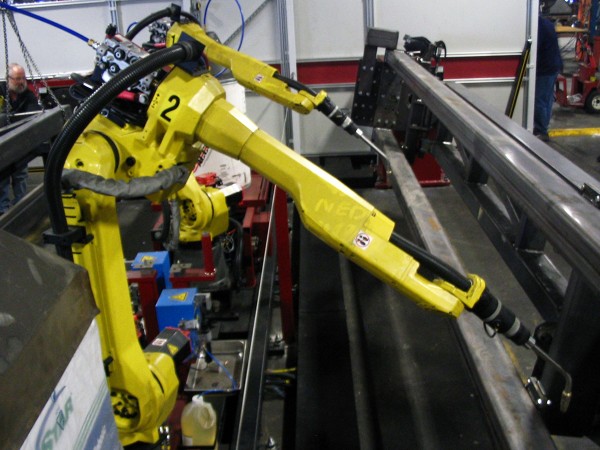 These developments raise a number of questions. If robots have a higher marginal revenue product/marginal cost ratio than humans, will employers choose to replace humans by robots, wholly or in part? How are investment costs factored into the decision? And what about industrial relations? Will employers risk disputes with employees? Will they simply be concerned with maximising profit or will they take wider social concerns into account?
Then there is the question of what new jobs would be created for those who lose their jobs to machines. According to the earlier Deloitte study, which focused on London, over 80% of companies in London say that over the next 10 years they will be most likely to take on people with skills in ‘digital know-how’, ‘management’ and ‘creativity’.
 But even if new jobs are created through the extra spending power generated by the extra production – and this has been the pattern since the start of the industrial revolution some 250 years ago – will these new jobs be open largely to those with high levels of transferable skills? Will the result be an ever widening of the income gap between rich and poor? Or will there be plenty of new jobs throughout the economy in a wide variety of areas where humans are valued for the special qualities they bring? As the authors of the later Deloitte paper state:
The dominant trend is of contracting employment in agriculture and manufacturing being more than offset by rapid growth in the caring, creative, technology and business services sectors.
The issues of job replacement and job creation, and of the effects on income distribution and the balance between work and leisure, are considered in the following videos and articles, and in the three reports.
Videos
 What is artificial intelligence? BBC News, Valery Eremenko (13/9/15)
What jobs will robots take over? BBC News, David Botti (15/8/14)
Could a robot do your job? BBC News, Rory Cellan-Jones (14/9/15)
Intelligent machines: The robots that work alongside humans BBC News, Rory Cellan-Jones (14/9/15)
Intelligent machines: Will you be replaced by a robot? BBC News, John Maguire (14/9/15)
Will our emotions change the way adverts work? BBC News, Dan Simmons (24/7/15)
Could A Robot Do My Job? BBC Panorama, Rohan Silva (14/9/15)
Articles
Technology has created more jobs in the last 144 years than it has destroyed, Deloitte study finds Independent, Doug Bolton (18/8/15)
Technology has created more jobs than it has destroyed, says 140 years of data The Guardian, Katie Allen (18/8/15)
Will a robot take your job? BBC News (11/9/15)
Intelligent Machines: The jobs robots will steal first BBC News, Jane Wakefield (14/9/15)
Robots Could Take 35 Per Cent Of UK Jobs In The Next 20 Years Says New Study Huffington Post, Thomas Tamblyn (14/9/15)
The new white-collar fear: will robots take your job? The Telegraph, Rohan Silva (12/9/15)
Does technology destroy jobs? Data from 140 years says no Catch news, Sourjya Bhowmick (11/9/15)
Reports
Takeoff in Robotics Will Power the Next Productivity Surge in Manufacturing Boston Consulting Group (10/2/15)
Agiletown: the relentless march of technology and London’s response Deloitte (November 2014)
Technology and people: The great job-creating machine Deloitte, Ian Stewart, Debapratim De and Alex Cole (August 2015)
Questions
- Which are the fastest growing and fastest declining occupations? To what extent can these changes be explained by changes in technology?
- What type of unemployment is caused by rapid technological change?
- Why, if automation replaces jobs, have jobs increased over the past 250 years?
- In what occupations is artificial intelligence (AI) most likely to replace humans?
- To what extent are robots and humans complementary rather than substitute inputs into production?
- “Our analysis of more recent employment data also reveals a clear pattern to the way in which technology has affected work.” What is this pattern? Explain.
- Why might AI make work more interesting for workers?
- Using a diagram, show how an increase in workers’ marginal productivity from working alongside robots can result in an increase in employment. Is this necessarily the case? Explain.
 Productivity has been a bit of a problem for the UK economy for a number of years. Earlier posts from 2015 have discussed the trend in Tackling the UK’s poor productivity and The UK’s poor productivity record. Although the so-called ‘productivity gap’ has been targeted by the government, with George Osborne promising to take steps to encourage more long-term investment in infrastructure and create better incentives for businesses to improve productivity, the latest data suggest that the problem remains.
The ONS has found that the UK continues to lag behind the other members of the G7, but perhaps more concerning is that the gap has grown to its biggest since 1991. The data showed that output per hour worked was 20 percentage points lower in the UK than the average for the other G7 countries. The economic downturn did cause falls in productivity, but the UK has not recovered as much as other advanced nations. One of the reasons, according to the Howard Archer, chief UK economist at IHS Global Insight is that it ‘had been held back since the financial crisis by the creation of lots of low-skilled, low-paid jobs’. These are the jobs where productivity is lowest and this may be causing the productivity gap to expand. Other cited reasons include the lack of investment which Osborne is attempting to address, fewer innovations and problems of finance.
Despite these rather dis-heartening data, there are some signs that things have begun to turn around. In the first quarter of 2015, output per hour worked did increase at the fastest annual growth rate in 3 years and Howard Archer confirmed that this did show ‘clear sign that UK productivity is now seeing much-needed improvement.’ There are other signs that we should be optimistic, delivered by the Bank of England. Sir John Cunliffe, Deputy Governor for financial stability said:
“firms have a greater incentive to find efficiency gains and to switch away from more labour-intensive forms of production. This should boost productivity.”
The reason given for this optimism is the increase in the real cost of labour relative to the cost of investment. So, a bit of a mixed picture here. UK productivity remains a cause for concern and given its importance in improving living standards, the Conservative government will be keen to demonstrate that its policies are closing the productivity gap. The latest data is more promising, but that still leaves a long way to go. The following articles consider this data and news.
Articles
UK productivity shortfall at record high Financial Times, Emily Cadman (18/9/15)
UK productivity lags behind rest of 7 BBC News (17/9/15)
UK’s poor productivity figures show challenge for the government The Guardian, Katie Allen (18/9/15)
UK productivity lags G7 peers in 2014-ONS Reuters (18/9/15)
UK productivity second lowest in G7 Fresh Business Thinking, Jonathan Davies (18/9/15)
UK is 33% less productive than Germany Economia (18/9/15)
UK productivity is in the G7 ‘slow lane’ Sky News (18/9/15)
Data
AMECO Database European Commission, Economic and Financial Affairs
Labour Productivity, Q1 2015 ONS (1/7/15)
International Comparisons of Productivity, 2014 – First Estimates ONS (18/9/15)
Questions
- How could we measure productivity?
- Why should we be optimistic about productivity if the real cost of labour is rising?
- If jobs are being created at slower rate and the economy is still expanding, why does this suggest that productivity is rising? What does it suggest about pay?
- Why is a rise in productivity needed to improve living standards?
 You may be used to these types of blogs by now … On my commute to work on the 18th May, I listened to Start the Week on BBC radio 4 and happened upon a fascinating discussion on inequality.
Of those discussing the issue, one certainly needs no introduction: Joseph Stiglitz, a prominent economist, author and commentator on economics, in particular on inequality. He was joined by Steve Hilton, who has worked for David Cameron for many years in providing advice on a range of issues, including inequality and strategy and has written on existing institutions and their effectiveness. The final panellist was Masha Gessen, who has written extensively on Russia and in particular on the journey of the infamous Boston Bomber.
Though the discussion covers a variety of areas relevant to economics, one key area that is addressed is inequality and the policies that are being used to address the causes and the symptoms. You can access the 45-minute discussion at the link below.
Joseph Stiglitz and Steve Hilton on inequality BBC Radio 4 (18/5/15)
Questions
- How would you measure inequality?
- Why is it important to distinguish between the causes and symptoms of poverty when designing government policy?
- To what extent do you believe that education is an essential requirement for growth and development?
- Why has inequality grown in some of the most developed nations?
- How is it possible that inequality in the developed world has grown, while global inequality has fallen?
- Why does the report argue that the reforms they suggest would help boost growth?
- Do you agree that existing institutions are not suitable for society today?
 New Look was founded in 1969 and is an iconic budget retailer found on most British high streets. In its history, it has been a family business; it has been listed on the London stock exchange; returned to a private company and then had the potential to be re-listed. Now, it is moving into South African ownership for £780 million.
90% of New Look will now be owned by Christo Wiese who controls Brait and who has been linked with other take-overs of British retailers in recent years. The remaining 10% will remain in the hands of the founding family. The company has been struggling for some time and in 2010 did have plans to relist the company on the London Stock Exchange. However, volatile market conditions meant that this never occurred and the two private equity firms, Apax and Permira, appeared very eager to sell. New Look’s Chairman, Paul Mason, said:
“This is an ideal outcome for New Look. The Brait team demonstrated to us that they have the long-term vision to help Anders and the team grow this brand.”
It is not yet clear what this move will mean for the retailer, New Look, but with an estimated £1 billion debt, it is expected that changes will have to be made.  It is certainly an attractive investment opportunity and New Look does have a history of high rates of growth, despite its current debt. Furthermore, the debt levels are likely to have helped Mr. Wiese obtain a deal for New Look. Fashion retailing is a highly competitive market, but demand always appears to be growing. It is still relatively ‘new’ news, so we will have to wait to see what this means for the number of stores we see on the high streets and the number of jobs lost or created. The following articles consider this new New Look.
South African tycoon buys New Look fashion retailer BBC News (15/5/15)
South African tycoon enters UK retail fray with New Look purchase Financial Times, Andrea Felsted, Clare Barrett and Joseph Cotterill (15/5/15)
New Look snapped up by South African tycoon The Guardian, Sean Farrell (15/5/15)
New Look sold to South African billionaire for £780m The Telegraph, Elizabeth Anderson and Andrew Trotman (15/5/15)
Questions
- Why might a company become listed on the London stock exchange?
- How would volatile economic circumstances affect a company’s decision to become listed on the stock market?
- What do you think this purchase will mean for the number of New Look stores on British high streets? Do you think there will be job losses or jobs created by this purchase?
- How do you think the level of New Look’s debt affected Christo Wiese’s decision to purchase New Look?
- Which factors are likely to affect a firm’s decision to take-over or purchase another firm?
Real GDP depends on two things: output per hour worked and the number of hours worked. On the surface, the UK economy is currently doing relatively well, with growth in 2014 of 2.8%. After several years of poor economic growth following the financial crisis of 2007/8, growth of 2.8% represents a return to the long-run average for the 20 years prior to the crisis.
But growth since 2010 has been entirely due to an increase in hours worked. On the one hand, this is good, as it has meant an increase in employment. In this respect, the UK is doing better than other major economies. But productivity has not grown and on this front, the UK is doing worse than other countries.
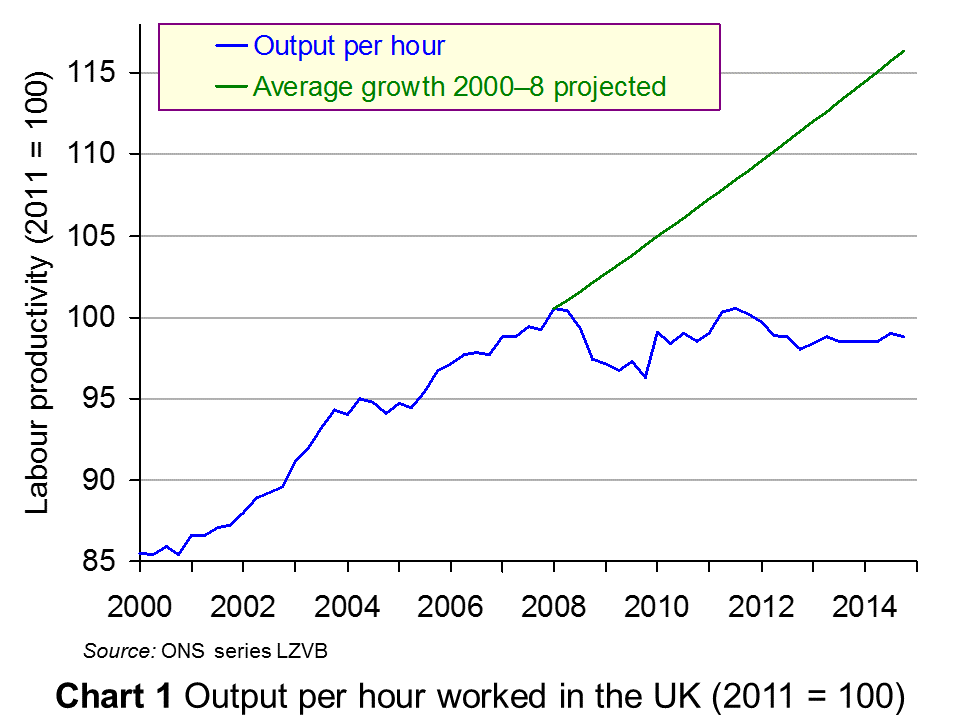 The first chart shows UK output per hour worked (click here for a PowerPoint). It is based on figures released by the ONS on 1 April 2015. Average annual growth in output per hour worked was 2.3% from 2000 to 2008. Since then, productivity growth has stalled and output per hour is now lower than at the peak in 2008.
The green line projects from 2008 what output per hour would have been if its growth had remained at 2.3%. It shows that by the end of 2014 output per hour would have been nearly 18% higher if productivity growth had been maintained.
 The second chart compares UK productivity growth with other countries (click here for a PowerPoint). Up to 2008, UK productivity was rising slightly faster than in the other five countries illustrated. Since then, it has performed worse than the other five countries, especially since 2011.
Productivity growth increases potential GDP. It also increases actual GDP if the productivity increase is not offset by a fall in hours worked. A rise in hours worked without a rise in productivity, however, even though it results in an increase in actual output, does not increase potential output. If real GDP growth is to be sustained over the long term, there must be an increase in productivity and not just in hours worked.
The articles below examines this poor productivity performance and looks at reasons why it has been so bad.
Articles
UK’s sluggish productivity worsened in late 2014 – ONS Reuters (1/4/15)
UK productivity growth is weakest since second world war, says ONS The Guardian, Larry Elliott (1/4/15)
UK productivity weakness worsening, says ONS Financial Times, Chris Giles (1/4/15)
Is the UK’s sluggish productivity a problem? Financial Times comment (1/4/15)
UK manufacturing hits eight-month high but productivity slump raises fears over sustainability of economic recovery This is Money, Camilla Canocchi (1/4/15)
Weak UK productivity unprecedented, ONS says BBC News (1/4/15)
Weep for falling productivity Robert Peston (1/4/15)
UK’s Falling Productivity Prevented A Massive Rise In Unemployment Forbes, Tim Worstall (2/4/15)
Data
Labour Productivity, Q4 2014 ONS (1/4/15)
AMECO database European Commission, Economic and Financial Affairs
Questions
- How can productivity be measured? What are the advantages and disadvantages of using specific measures?
- Draw a diagram to show the effects on equilibrium national income of (a) a productivity increase, but offset by a fall in the number of hours worked; (b) a productivity increase with hours worked remaining the same; (c) a rise in hours worked with no increase in productivity. Assume that actual output depends on aggregate demand.
- Is poor productivity growth good for employment? Explain.
- Why is productivity in the UK lower now than in 2008?
- What policies can be pursued to increase productivity in the UK?
 What will production look like in 20 years time? Will familiar jobs in both manufacturing and the services be taken over by robots? And if so, which ones? What will be the effect on wages and on unemployment? Will most people be better off, or will just a few gain while others get by with minimum-wage jobs or no jobs at all?
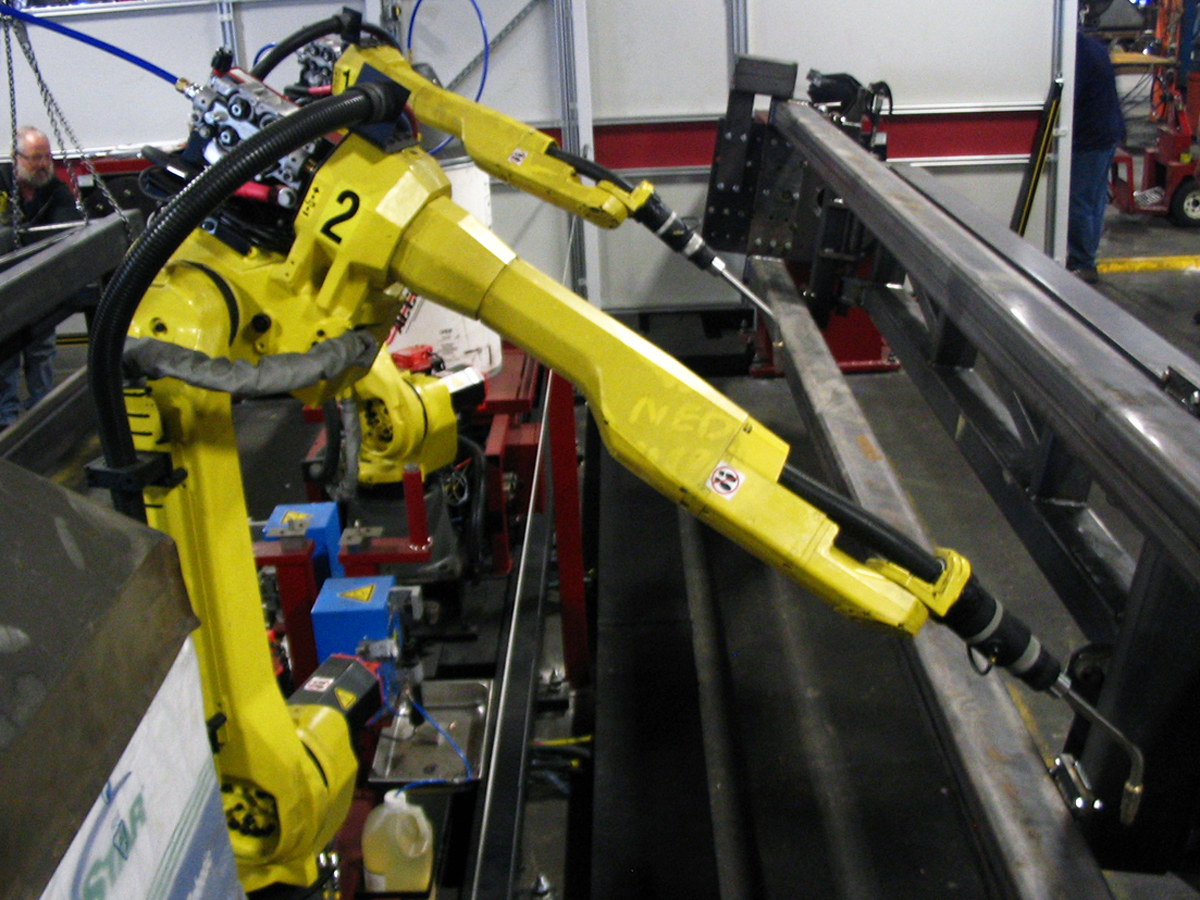 These developments raise a number of questions. If robots have a higher marginal revenue product/marginal cost ratio than humans, will employers choose to replace humans by robots, wholly or in part? How are investment costs factored into the decision? And what about industrial relations? Will employers risk disputes with employees? Will they simply be concerned with maximising profit or will they take wider social concerns into account?