 The spectre of debt has awoken many of us in the night. Indebtedness is a key economic issue in the 2010s. Economists are devoting ever increasing amounts of research time trying to understand its impact on economic behaviour. This will not surprise you when you learn that the debt owed by the UK non-bank private sector to banks stood at £2.17 trillion at the end of September. This is the equivalent to 150% of annual GDP.
 Chart 1 shows the stock of outstanding lending by Monetary Financial Institutions (banks and building societies) to the non-bank private sector bank since 1979. Back then the non-bank private sector had bank debt to the tune of around £70 billion or 10 per cent of GDP. Today’s figure is nearly 3000 per cent higher! Of this debt, around about 55 per cent is currently held by the household sector, 27 per cent by Other Financial Corporations (such as insurance companies and pension funds) and 18 per cent by private non-financial corporations. (Click here for a PowerPoint of the chart.)
 Chart 2 shows the stocks of debt as percentages of annual GDP. We can infer from it that there are waves of growth in bank debt. Two notable periods are during the 1980s and again from the late 1990s up to the financial crisis of the late 2000s. During the early and mid 1990s the relative size of debt stocks tended to stabilise while in the early 2010s the actual stocks of debt, as well as relative to GDP, declined. A credit binge seems to be followed by a period of consolidation. (Click here for a PowerPoint of the chart.)
It is important that we understand the drivers of the growth of debt. The impact of debt on the balance sheets of the non-bank private sector and on banks themselves has implications for economic behaviour. In the early 2010s this has been to markedly slow the pace of growth through its impact on aggregate demand. Economic agents have, in general, looked to consolidate. There is no doubt that this partly reflects a precautionary motive. An important means by which debt and the balance sheets on which it is recorded affect behaviour is through a precautionary mechanism. This is difficult to accurately quantify because it represents a psychological influence on spending. Furthermore, it is affected by the prevailing circumstances of the time.
In looking to understand the factors that affect the growth of debt we may, as a result, learn more about the framework within which we may want banks and their customers to operate. Consequently, we may be in a better position to ensure sustainable longer-term growth and development. If there are cycles in credit it is important that we understand why they arise and whether, as some have suggested, they are an inherent part of the financialised economy in which we live. If they are, can we mitigate their potentially destabilising effects?
Articles
Retail shares facing nightmare before Christmas The Telegraph, John Ficenec (9/11/14)
Growing wealth inequality in the UK is a ticking timebomb The Guardian, Danny Dorling (15/10/14)
Richest 10% of Britons now control more than half the country’s wealth: Nation is only member of G7 where inequality between rich and poor has increased this century Mail Online, Mark Duell and Corey Charlton, (15/11/14)
Household debt is growing as families struggle Yorkshire Evening Post (31/10/14)
Consumer spending forecast to be the highest for four years The Telegraph, Ashley Armstrong (10/11/14)
Data
Statistical Interactive Database Bank of England
Quarterly National Accounts, Q2 2014 Dataset Office for National Statistics
Questions
- What is the non-bank private sector?
- What factors might affect the rate at which non-bank private sector debt stocks grow?
- How might we go about assessing whether the aggregate level of lending by financial institutions to the non-bank private sector is sustainable?
- How might we go about assessing whether the level of lending by individual financial institutions to the non-bank private sector is sustainable?
- What information is conveyed in the balance sheets of economic agents, such as households and private non-financial corporations
- What is meant by precautionary saving?
- Can precautionary saving occur when the economy is growing strongly?
- What are the mechanisms by which non-bank private sector debt could impact on economic behaviour?
 One of the key battle grounds at the next General Election is undoubtedly going to be immigration. A topic that is very closely related to EU membership and what can be done to limit the number of people coming to the UK. One side of the argument is that immigrants coming into the UK boost growth and add to the strength of the economy. The other side is that once in the UK, immigrants don’t move into work and end up taking more from the welfare state than they give to it through taxation.
A new report produced by University College London’s Centre for Research and Analysis of Migration has found that the effect on the UK economy of immigrants from the 10 countries that joined the EU from 2004 has been positive. In the years until 2011, it has been found that these immigrants contributed £4.96 billion more in taxes than they took out in benefits and use of public services. Christian Dustmann, one of the authors of this report said:
“Our new analysis draws a positive picture of the overall fiscal contribution made by recent immigrant cohorts, particularly of immigrants arriving from the EU … European immigrants, particularly, both from the new accession countries and the rest of the European Union, make the most substantial contributions … This is mainly down to their higher average labour market participation compared with natives and their lower receipt of welfare benefits.”
 The report also found that in the 11 years to 2011, migrants from these 10 EU countries were 43 per cent less likely than native Britons to receive benefits or tax credits, and 7 per cent less likely to live in social housing. This type of data suggests a positive overall contribution from EU immigration. However, critics have said that it doesn’t paint an accurate picture. Sir Andrew Green, Chairman of Migration Watch commented on the choice of dates, saying:
“If you take all EU migration including those who arrived before 2001 what you find is this: you find by the end of the period they are making a negative contribution and increasingly so … And the reason is that if you take a group of people while they’re young fit and healthy they’re not going to be very expensive but if you take them over a longer period they will be.”
However, the report is not all positive about the effects of immigration. When considering the impact on the economy of migrants from outside of the EEA, the picture is quite different. Over the past 17 years, immigration has cost the UK economy approximately £120bn, through migrant’s greater consumption of public benefits, such as the NHS, compared to their contributions through taxation. The debate is likely to continue and this report will certainly be used by both sides of the argument as evidence that (a) no change in immigration policy is needed and (b) a major change is needed to immigration policy. The following articles consider this report.
Report
The Fiscal effects of immigration to the UK The Economic Journal, University College London’s Centre for Research and Analysis of Migration, Christian Dustmann and Tommaso Frattini (November 2014)
Articles
Immigration from outside Europe ‘cost £120 billion’ The Telegraph, David Barrett (5/11/14)
New EU members add £5bn to UK says Research BBC News (5/11/14)
UK gains £20bn from European migrants, UCL economists reveal The Guardian, Alan Travis (5/11/14)
EU immigrant tax gain revealed Mail Online (5/11/14)
Immigration question still open BBC News, Robert Peston (5/11/14)
EU migrants pay £20bn more in taxes than they receive Financial Times, Helen Warrell (5/11/14)
Questions
- Why is immigration such a political topic?
- How are UK labour markets be affected by immigration? Use a demand and supply diagram to illustrate the effect.
- Based on your answer to question 2, explain why some people are concerned about the impact of immigration on UK jobs.
- What is the economic argument in favour of allowing immigration to continue?
- What policy changes could be recommended to restrict the levels of immigration from outside the EEA, but to continue to allow immigration from EU countries?
- If EU migrants are well educated, does that have a positive or negative impact on UK workers, finances and the economy?
 Lloyds Banking Group has announced that it plans to reduce its labour force by 9000. Some of this reduction may be achieved by not replacing staff that leave, but some may have to be achieved through redundancies.
The reasons given for the reduction in jobs are technological change and changes in customer practice. More banking services are available online and customers are making more use of these services and less use of branch banking. Also, the increasingly widespread availability of cash machines (ATMs) means that fewer people withdraw cash from branches.
And it’s not just outside branches that technological change is impacting on bank jobs. Much of the work previously done by humans is now done by software programs.
One result is that many bank branches have closed. Lloyds says that the latest planned changes will see 150 fewer branches – 6.7% of its network of 2250.
What’s happening in banking is happening much more widely across modern economies. Online shopping is reducing the need for physical shops. Computers in offices are reducing the need, in many cases, for office staff. More sophisticated machines, often controlled by increasingly sophisticated computers, are replacing jobs in manufacturing.
So is this bad news for employees? It is if you are in one of those industries cutting employment. But new jobs are being created as the economy expands. So if you have a good set of skills and are willing to retrain and possibly move home, it might be relatively easy to find a new, albeit different, job.
As far as total unemployment is concerned, more rapid changes in technology create a rise in frictional and structural unemployment. This can be minimised, however, or even reduced, if there is greater labour mobility. This can be achieved by better training, education and the development of transferable skills in a more adaptive labour force, where people see changing jobs as a ‘normal’ part of a career.
Webcasts
 Lloyds Bank cuts 9,000 jobs – but what of the tech future? Channel 4 News, Symeon Brown (28/10/14)
Lloyds Bank confirms 9,000 job losses and branch closures BBC News, Kamal Ahmed (28/10/14)
Article
Lloyds job cuts show the technology axe still swings for white collar workers The Guardian, Phillip Inman (28/10/14)
Reports
Unleashing Aspiration: The Final Report of the Panel on Fair Access to the Professions Cabinet Office (July 2009)
Fair access to professional careers: a progress report Cabinet Office (30/5/12)
Questions
- Is a reduction in banking jobs inevitable? Explain.
- What could banks do to reduce the hardship to employees from a reduction in employment?
- What other industries are likely to see significant job losses resulting from technological progress?
- Distinguish between demand-deficient, real-wage, structural and frictional unemployment. Which of these are an example, or examples, of equilibrium unemployment?
- What policies could the government pursue to reduce (a) frictional unemployment; (b) structural unemployment?
- What types of industry are likely to see an increase in employment and in what areas of these industries?
 Following the financial crisis, all sectors of the economy continue to repair their balance sheets. As well as households, non-financial corporations and government, this is true of the banking sector. In part, the repairing and rebalancing of their balance sheets is being brought about by regulatory pressures. The objective is to make banks more resilient to shocks and less susceptible to financial distress.
The need for banks to repair and rebalance their balance sheets is significant because of their systemic importance to the modern-day economy. Financial institutions that are systemically important to national economies are know as SIFIs (systemically important financial institutions) while those of systemic importance to the global economy are know as G-SIFIs or G-SIBs (global systemically important banks). The increasing importance of financial institutions to economic activity is known as financialisation.
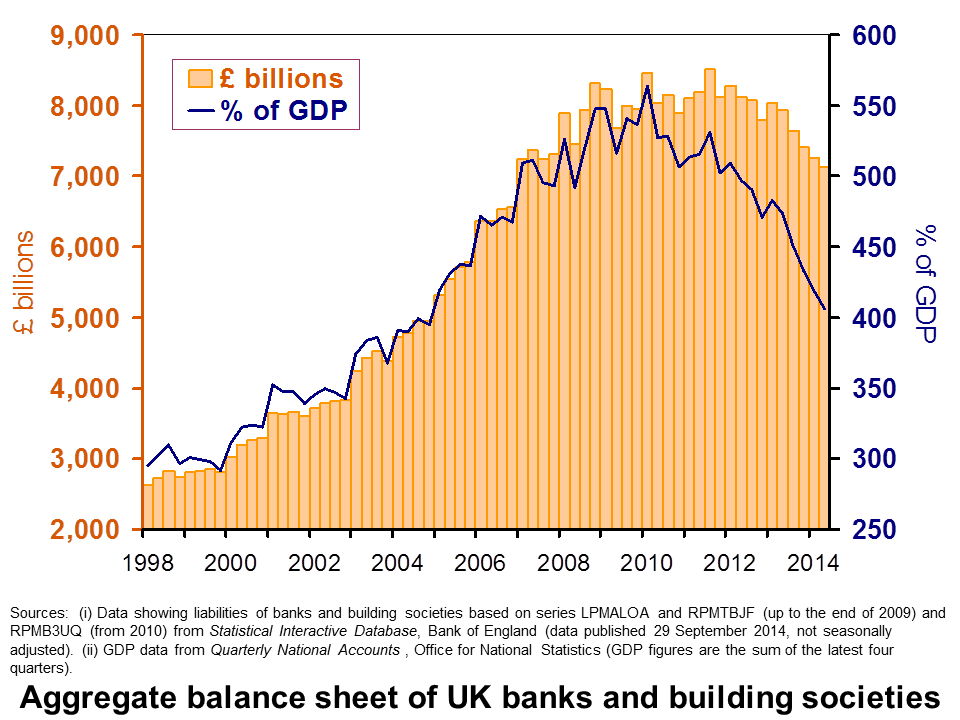 One way of measuring the degree of financialisation here in the UK is to consider the aggregate size of the balance sheet of resident UK banks and building societies (including foreign subsidiaries operating here). The chart shows that the balance sheet grew from £2.6 trillion in 1998 Q1 to £8.5 trillion in 2010 Q1. Another way of looking at this is to consider this growth relative to GDP. This reveals that the aggregate balance sheet of banks and building societies grew over this period from 3 times annual GDP to a staggering 5.6 times GDP. (Click here for a PowerPoint of the chart.)
But, now consider the aggregate banking balance sheet in the 2010s. This reveals a shrinking balance sheet. At the end of the second quarter of this year (2014 Q2) it had fallen back to £7.1 trillion or 4 times GDP. As a share of GDP, this was the smallest the aggregate balance sheet had been since 2005 Q1.
Does a shrinking balance sheet matter? This is where the analysis becomes tricky and open to debate. If the smaller size is consistent with a more stable financial system then undoubtedly that is a good thing. But, size is not that all matters. The composition of the balance sheet matters too. This requires an analysis of, among other things, the liquidity of assets (i.e. assets that can be readily turned in a given amount of cash), the reliability of the income flow from assets and the resources available to withstand periods of slow economic growth, including recessions, or periods of financial difficulty.
As we have identified before (see Financialisation: Banks and the economy after the crisis), the financial crisis could herald new norms for the banking system with important implications for the economy. If so, we may need to become accustomed to consistently lower flows of credit and not to the levels that we saw prior to the financial crisis of the late 2000s. However, an alternative view is that we are merely experiencing a pause before the next expansionary phase of the credit cycle. This is consistent with the financial instability hypothesis (see Keeping a Minsky-eye on credit) which argues that credit cycles are an integral part of modern financialised economies. Only time will tell which view will turn out to be right.
Articles
‘Cleaning up bank balance sheets is key’ Irish Examiner, John Walsh (10/10/14)
More action needed at European banks: Fitch Courier Mail, (17/10/14)
Bank lending to small businesses falls by £400m The Telegraph, Rebecca Burn-Callander (20/10/14)
Bank lending to SMEs falls by £400m SME insider, Lindsey Kennedy (21/10/14)
Record world debt could trigger new financial crisis, Geneva report warns The Guardian, Phillip Inman (29/10/14)
RBS shares jump as bank’s bad debts improve The Guardian, Jill Treanor (30/10/14)
Data
Statistical Interactive Database Bank of England
Questions
- Using examples, demonstrate your understanding of financialisation.
- Draw up a list of the alternative ways in which we might measure financialisation.
- What factors are likely to explain the recent reduction in the aggregate balance sheet of resident banks and building societies in the UK?
- How might we go about assessing whether the aggregate level of lending by financial institutions is sustainable?
- How might we go about assessing whether the level of lending by individual financial institutions is sustainable?
- How would reduced flows of credit be expected to impact on the economy both in the short term and in the longer term?
- Are credit cycles inevitable?
- Of what significance are credit cycles in explaining the business cycle?
 At least once a year The Economist publishes its ‘hamburger standard’ exchange rates for currencies. It is a light-hearted attempt to see if currencies are exchanging at their purchasing-power parity rates. The test is the price at which a ‘Big Mac’ McDonald’s hamburger sells in different countries!
According to this simplified version of the purchasing-power parity theory, exchange rates should adjust so that a Big Mac costs the same in dollars everywhere (see Economics 8th edition Box 25.4).
These Big Mac exchange rates can be used to compare various prices and incomes between countries. The article linked below from The Guardian compares minimum wages between European countries in Big Mac terms.
There are 25 countries across Europe which have minimum wages. A clear pattern of minimum wage rates can be seen: although actual exchange rates understate the purchasing power of incomes in poorer European countries compared to richer ones, minimum wages, even in purchasing-power standard terms, are still higher in the richer countries.
Luxembourg’s minimum wage buys you just about three Big Macs in an hour, while most of northern Europe (and France) between 2–2.5 Big Macs. Moving south, the minimum wage nets about one Big Mac an hour. As we progress east, it begins to cost more than an hour of work on the minimum wage in order to afford a Big Mac.
Of course, there are other factors determining the dollar price of a Big Mac other than the failure of exchange rates to reflect purchasing-power parities. Nevertheless, using the Big Mac index in this way does give a useful preliminary snap shot of differences in what minimum wages can buy in different countries.
Articles
Comparing the minimum wage across Europe using the price of a Big Mac The Guardian datablog, Alberto Nardelli (25/9/14)
Minimum wage statistics Eurostat (Sept/14)
Data
Earnings Database Eurostat
Questions
- What is meant by ‘purchasing-power parity exchange rates’?
- Why may actual exchange rates not accurately reflect the purchasing power of currencies within countries?
- Using the link to Eurostat article above, compare Big Mac minimum wages with (a) actual minimum wages and (b) minimum wages expressed in purchasing-power standard terms.
- Using the links to the Eurostat article and Eurostat data, describe how the proportion of employees earning minimum wages varies across European countries. What factors determine this proportion?
- Using the same links, describe how the monthly minimum wage as a proportion of average monthly earnings varies across European countries. Explain these differences.
 The spectre of debt has awoken many of us in the night. Indebtedness is a key economic issue in the 2010s. Economists are devoting ever increasing amounts of research time trying to understand its impact on economic behaviour. This will not surprise you when you learn that the debt owed by the UK non-bank private sector to banks stood at £2.17 trillion at the end of September. This is the equivalent to 150% of annual GDP.