 New Look was founded in 1969 and is an iconic budget retailer found on most British high streets. In its history, it has been a family business; it has been listed on the London stock exchange; returned to a private company and then had the potential to be re-listed. Now, it is moving into South African ownership for £780 million.
90% of New Look will now be owned by Christo Wiese who controls Brait and who has been linked with other take-overs of British retailers in recent years. The remaining 10% will remain in the hands of the founding family. The company has been struggling for some time and in 2010 did have plans to relist the company on the London Stock Exchange. However, volatile market conditions meant that this never occurred and the two private equity firms, Apax and Permira, appeared very eager to sell. New Look’s Chairman, Paul Mason, said:
“This is an ideal outcome for New Look. The Brait team demonstrated to us that they have the long-term vision to help Anders and the team grow this brand.”
It is not yet clear what this move will mean for the retailer, New Look, but with an estimated £1 billion debt, it is expected that changes will have to be made.  It is certainly an attractive investment opportunity and New Look does have a history of high rates of growth, despite its current debt. Furthermore, the debt levels are likely to have helped Mr. Wiese obtain a deal for New Look. Fashion retailing is a highly competitive market, but demand always appears to be growing. It is still relatively ‘new’ news, so we will have to wait to see what this means for the number of stores we see on the high streets and the number of jobs lost or created. The following articles consider this new New Look.
South African tycoon buys New Look fashion retailer BBC News (15/5/15)
South African tycoon enters UK retail fray with New Look purchase Financial Times, Andrea Felsted, Clare Barrett and Joseph Cotterill (15/5/15)
New Look snapped up by South African tycoon The Guardian, Sean Farrell (15/5/15)
New Look sold to South African billionaire for £780m The Telegraph, Elizabeth Anderson and Andrew Trotman (15/5/15)
Questions
- Why might a company become listed on the London stock exchange?
- How would volatile economic circumstances affect a company’s decision to become listed on the stock market?
- What do you think this purchase will mean for the number of New Look stores on British high streets? Do you think there will be job losses or jobs created by this purchase?
- How do you think the level of New Look’s debt affected Christo Wiese’s decision to purchase New Look?
- Which factors are likely to affect a firm’s decision to take-over or purchase another firm?
 Real GDP depends on two things: output per hour worked and the number of hours worked. On the surface, the UK economy is currently doing relatively well, with growth in 2014 of 2.8%. After several years of poor economic growth following the financial crisis of 2007/8, growth of 2.8% represents a return to the long-run average for the 20 years prior to the crisis.
But growth since 2010 has been entirely due to an increase in hours worked. On the one hand, this is good, as it has meant an increase in employment. In this respect, the UK is doing better than other major economies. But productivity has not grown and on this front, the UK is doing worse than other countries.
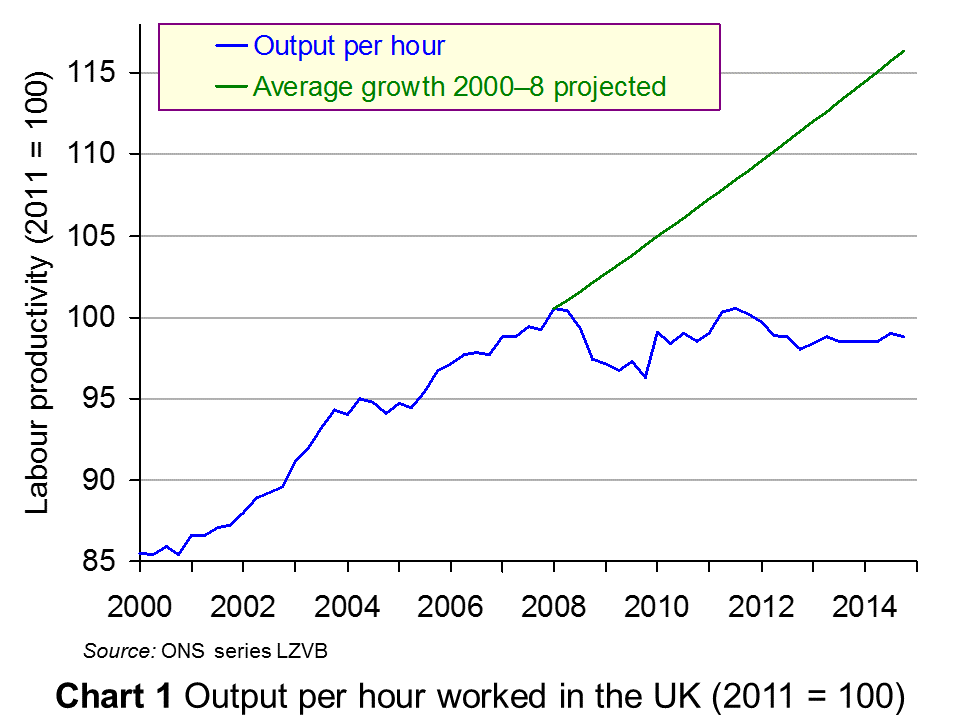 The first chart shows UK output per hour worked (click here for a PowerPoint). It is based on figures released by the ONS on 1 April 2015. Average annual growth in output per hour worked was 2.3% from 2000 to 2008. Since then, productivity growth has stalled and output per hour is now lower than at the peak in 2008.
The green line projects from 2008 what output per hour would have been if its growth had remained at 2.3%. It shows that by the end of 2014 output per hour would have been nearly 18% higher if productivity growth had been maintained.
 The second chart compares UK productivity growth with other countries (click here for a PowerPoint). Up to 2008, UK productivity was rising slightly faster than in the other five countries illustrated. Since then, it has performed worse than the other five countries, especially since 2011.
Productivity growth increases potential GDP. It also increases actual GDP if the productivity increase is not offset by a fall in hours worked. A rise in hours worked without a rise in productivity, however, even though it results in an increase in actual output, does not increase potential output. If real GDP growth is to be sustained over the long term, there must be an increase in productivity and not just in hours worked.
The articles below examines this poor productivity performance and looks at reasons why it has been so bad.
Articles
UK’s sluggish productivity worsened in late 2014 – ONS Reuters (1/4/15)
UK productivity growth is weakest since second world war, says ONS The Guardian, Larry Elliott (1/4/15)
UK productivity weakness worsening, says ONS Financial Times, Chris Giles (1/4/15)
Is the UK’s sluggish productivity a problem? Financial Times comment (1/4/15)
UK manufacturing hits eight-month high but productivity slump raises fears over sustainability of economic recovery This is Money, Camilla Canocchi (1/4/15)
Weak UK productivity unprecedented, ONS says BBC News (1/4/15)
Weep for falling productivity Robert Peston (1/4/15)
UK’s Falling Productivity Prevented A Massive Rise In Unemployment Forbes, Tim Worstall (2/4/15)
Data
Labour Productivity, Q4 2014 ONS (1/4/15)
AMECO database European Commission, Economic and Financial Affairs
Questions
- How can productivity be measured? What are the advantages and disadvantages of using specific measures?
- Draw a diagram to show the effects on equilibrium national income of (a) a productivity increase, but offset by a fall in the number of hours worked; (b) a productivity increase with hours worked remaining the same; (c) a rise in hours worked with no increase in productivity. Assume that actual output depends on aggregate demand.
- Is poor productivity growth good for employment? Explain.
- Why is productivity in the UK lower now than in 2008?
- What policies can be pursued to increase productivity in the UK?
 In recent times the notion that the financial sytem can be destabilising seems blindingly obvious. And, yet, for some time macroeconomic models of the economy tended to regard the financial system as benevolent. It served our interests. We were the masters; it was our servant. Now of course we accept that credit cycles can be destabilising. Policymakers, especially central banks, follow keenly the latest private-sector credit data. Here we look back at previous patterns in private-sector debt and crucially at what patterns are currently emerging.
First a bit of theory. The idea of credit cycles is not new. But the financial crisis of the late 2000s has helped to reignite analysis and interest. Economists are trying to gain a better understanding of the relationship between flows of credit and the state of the economy and, in particular, why might flows increase as the level of real GDP rises – why might they be endogenous variables in models of the determination of GDP. One possibility is the financial accelerator. This is the idea that as real GDP rises banks perceive lending to be less risky. After all, real incomes will tend to rise and collateral values (against which borrowing can be secured) are likely to be rising too.
Another possibility is growing exuberance as the economy grows. This has gained in popularity as an idea, with economists revisiting the work of Hyman Minsky (1919–96), an American economist. Here success breeds failure as the balance sheets of people and businesses deteriorate as they become increasingly burdened with debt. The balance sheets are said to be congested leading to a point when a deleveraging starts. A balance sheet recession then follows.
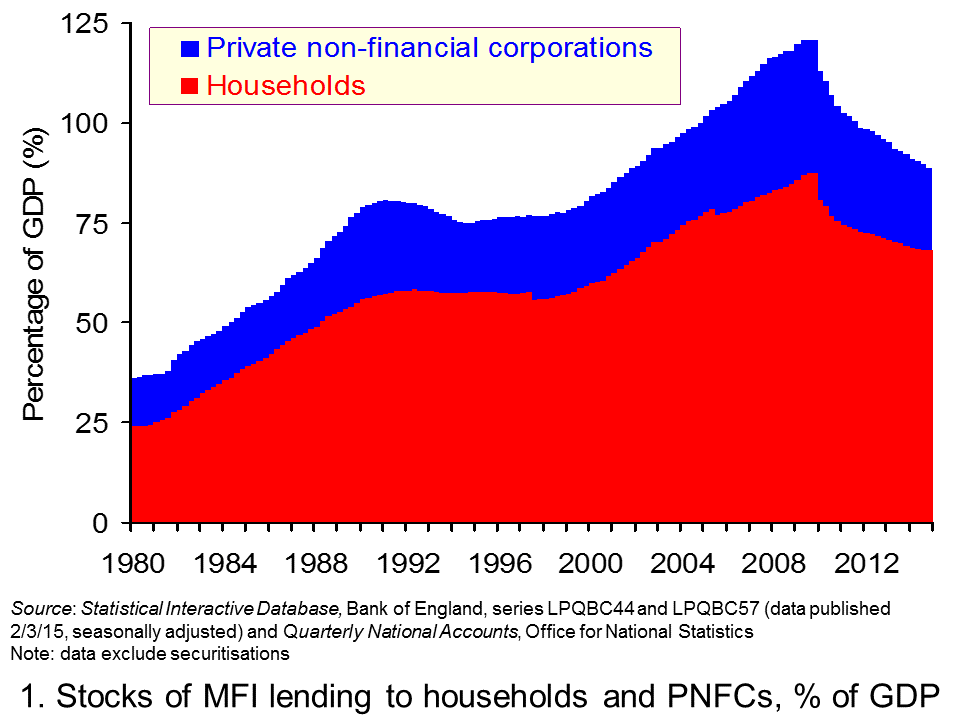 Now for the data. Consider first the stocks of debt acquired by households and private non-financial corporations from MFIs (Monetary Financial Institutions). The first chart shows debt stocks as a percentage of GDP. It illustrates nicely the phenomenon of financialisation. In essence, this is the increasing importance of MFIs to the economy. At the end of 2014, these two sectors had debt stocks outstanding equivalent to 90 per cent of GDP. In fact, this is down from a peak of 129 per cent in September 2009. (Click here for a PowerPoint of the chart.)
The growth in debt, especially in the 1990s and for much of the 2000s, was through financial innovation. In particular, the bundling of assets, such as mortgages, to form financial instruments which could then be purchased by investors helped to provide financial institutions with further funds for lending. This is the process of securitisation. Some argue that this was part of a super-cycle which works alongside the normal credit cycle, albeit over a much lengthier period. It can be argued that these cycles coincided during the 1990s and for much of the 2000s until financial distress hit. The distress was hastened by central banks raising interest rates to dampen the rising rate of inflation, partly attributable to rising global commodity prices, including oil.
Some refer to 2008 as a Minsky moment. Overstretched balance sheets needed repairing. But, the collective act of repair actually caused financial well-being to worsen as asset prices and aggregate demand fell.
The global response to the events of the financial crisis has been for policy-makers to pay more attention to the aggregate level of credit provision. The Bank of England’s Financial Policy Committee (FPC) has responsibility for monitoring and helping to ensure the soundness of the UK financial system.
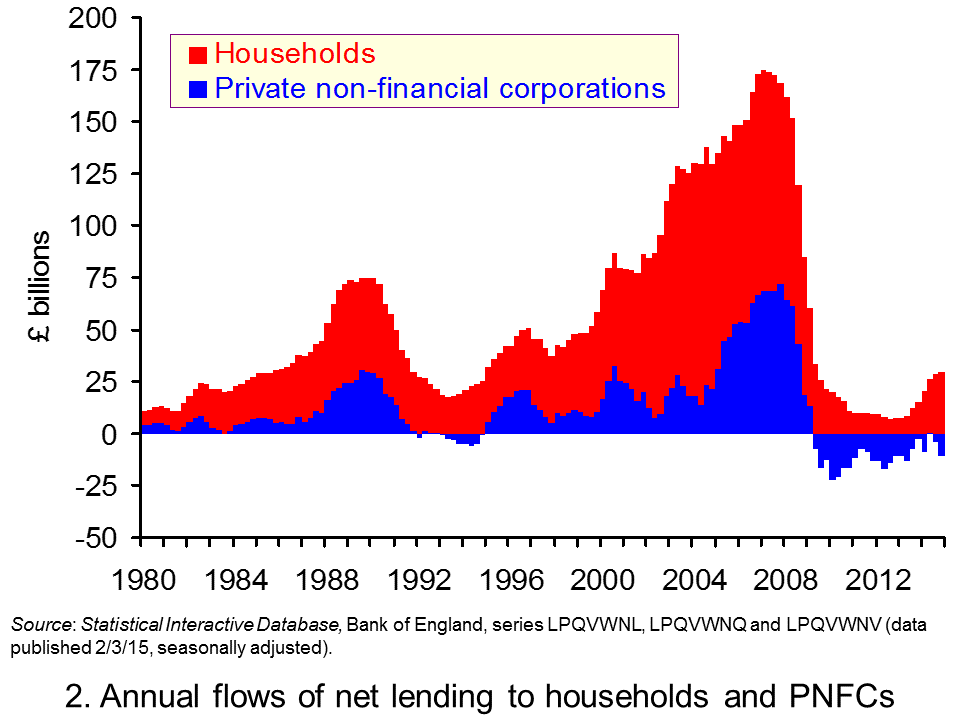 Undoubtedly, the FPC will have constructed a chart similar to our second chart. (Click here for a PowerPoint of the chart). This chart suggests some caution: the need for casting a ‘Minsky eye’ on lending patterns. Over 2014, the UK household sector undertook net lending (i.e. after deducting repayments) of £30 billion. While nothing like the £100 billion or so in 2007, this does mark something of a step up. Indeed it is almost exactly double the flow in 2013. In the months ahead we will continue to monitor the credit data. You can bet that the FPC will do too!
Articles
Comment: Household debt threatens return to spending Herald Scotland, Bill Jamieson (2/3/15)
Household debt rising at fastest rate for 10yrs moneyfacts.co.uk (10/2/15)
Housing starting to rally after home loan approvals rise in January London Evening Standard, Ben Chu (2/3/15)
Data
Bankstats (Monetary and Financial Statistics) – Latest Tables Bank of England
Statistical Interactive Database Bank of England
Questions
- What is meant by the term the business cycle?
- What does it mean for the determinants of the business cycle to be endogenous? What about if they are exogenous?
- Outline the ways in which the financial system can impact on the spending behaviour of households. Repeat the exercise for businesses.
- How might uncertainty affect spending and saving by households and businesses?
- What does it mean if bank lending is pro-cyclical?
- Why might lending be pro-cyclical?
- How might the differential between borrowing and saving interest rates vary over the business cycle?
- Explain what you understand by net lending to households or firms. How does net lending affect their stock of debt?
 ‘Employment has been strong, but productivity and real wages have been flat.’ This is one of the key observations in a new OECD report on the state of the UK economy. If real incomes for the majority of people are to be raised, then labour productivity must rise.
For many years, the UK has had a lower productivity (in terms of output per hour worked) than most other developed countries, with the exception of Japan. But from 1980 to the mid 2000s, the gap was gradually narrowing. Since then, however, the gap has been widening again. This is illustrated in Chart 1, which shows countries’ productivity relative to the UK’s (with the UK set at 100). (Click here for a PowerPoint.)
Compared with the UK, GDP per hour worked in 2013 (the latest data available) was 28% higher in France, 29% higher in Germany and 30% higher in the USA. What is more, GDP per hour worked  and GDP per capita in the UK fell by 3.8% and 6.1% respectively after the financial crisis of 2007/8 (see the green and grey lines in Chart 2). And while both indicators began rising after 2009, they were still both below their 2007 levels in 2013. Average real wages also fell after 2007 but, unlike the other two indicators, kept on falling and by 2013 were 4% below their 2007 levels, as the red line in Chart 2 shows. (Click here for a PowerPoint.)
Although productivity and even real wages are rising again, the rate of increase is slow. If productivity is to rise, there must be investment. 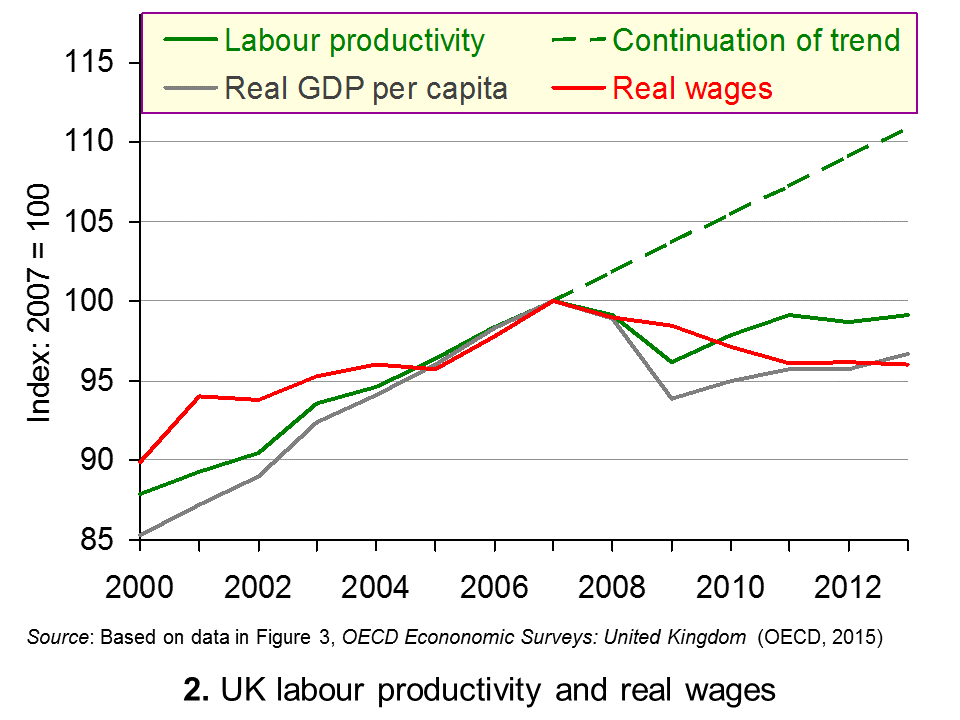 This could be in physical capital, human capital or, preferably, both. But for many years the UK has had a lower rate of investment than other countries, as Chart 3 shows. (Click here for a PowerPoint.) This chart measures investment in fixed capital as a percentage of GDP.
So how can investment be encouraged? Faster growth will encourage greater investment through the accelerator effect, but such an effect could well be short-lived as firms seek to re-equip but may be cautious about committing to increasing capacity. What is crucial here is maintaining 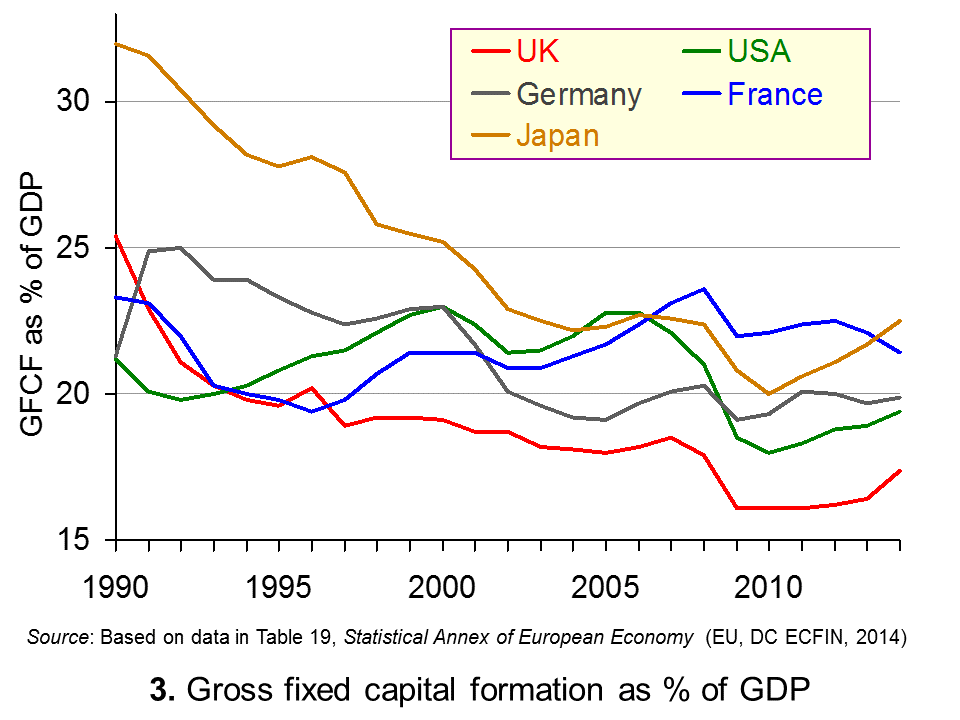 high degrees of business confidence over an extended period of time.
More fundamentally, there are structural problems that need tackling. One is the poor state of infrastructure. This is a problem not just in the UK, but in many developed countries, which cut back on public and private investment in transport, communications and energy infrastructure in an attempt to reduce government deficits after the financial crisis. Another is the low level of skills of many workers. Greater investment in training and apprenticeships would help here.
Then there is the question of access to finance. Although interest rates are very low, banks are cautious about granting long-term loans to business. Since the financial crisis banks have become much more risk averse and long-term loans, by their nature, are relatively risky. Government initiatives to provide finance to private companies may help here. For example the government has just announced a Help to Grow scheme which will provide support for 500 small firms each year through the new British Business Bank, which will provide investment loans and also grants on a match funding basis for new investment.
Articles
OECD: UK must fix productivity Economia, Oliver Griffin (25/2/15)
The UK’s productivity puzzle BBC News, Lina Yueh (24/2/15)
OECD warns UK must fix productivity problem to raise living standards The Guardian, Katie Allen (24/2/15)
Britain must boost productivity to complete post-crisis recovery, says OECD International Business Times, Ian Silvera (24/2/15)
OECD urges UK to loosen immigration controls on skilled workers Financial Times, Emily Cadman and Helen Warrell (24/2/15)
Report
OECD Economic Surveys, United Kingdom: Overview OECD (February 2015)
OECD Economic Surveys, United Kingdom: Full report OECD (February 2015)
Questions
- In what ways can productivity be measured? What are the relative merits of using the different measures?
- Why has the UK’s productivity lagged behind other industrialised countries?
- What is the relationship between income inequality and labour productivity?
- Why has UK investment been lower than in other industrialised countries?
- What are zombie firms? How does the problem of zombie firms in the UK compare with that in other countries? Explain the differences.
- What policies can be pursued to increased labour productivity?
- What difficulties are there in introducing effective policies to tackle low productivity?
- Should immigration controls be lifted to tackle the problem of a shortage of skilled workers?
 In a post last August we looked at the rising number of workers employed on ‘zero-hours’ contracts. These are contracts where there are no guaranteed minimum hours. Such contracts give employers the flexibility to employ workers as much or as little as suits the business. Sometimes it benefits workers, who might be given the flexibility to request the hours that suit them, but usually workers simply have to take the hours on offer.
Latest figures published by the Office for National Statistics show that zero-hours contracts are on the increase. In 2014 quarter 4, 697,000 workers were recorded as being on zero-hours contracts.  This represents 2.3% of people in employment. Ten years ago (2004, Q4) the figures were 108,000 or 0.4%: see chart. (Click here for a PowerPoint of the chart.)
Around one third of the 697,000 people on zero-hours contracts wanted more work if they could get it and most wanted it in their current job rather than having to move jobs. These people wanting more work can be classed as underemployed. They also include those not on a zero-hours contract who would like to work more if they could.
According to the ONS:
‘People on zero-hours contracts are more likely to be women, in full-time education or in young or older age groups when compared with other people in employment. On average, someone on a zero-hours contract usually works 25 hours a week.’ (See section 4 of the report for more details.)
As we saw in the earlier post, many public- and private-sector employers use such contracts, including many small and medium-sized enterprises and many well-known large companies, such as Sports Direct, Amazon, JD Wetherspoon and Cineworld. It gives them the flexibility to adjust the hours they employ people. It allows them to keep people in employment when demand is low. It also makes them more willing to take on staff when demand rises, as it removes the fear of being over-staffed if demand then falls back.
 As we also saw, zero-hours contracts are not the only form of flexible working. Other examples include: ‘self-employed’ workers, contracted separately for each job they do for a company; people paid largely or wholly on commission; on-call working; part-time working, where the hours are specified in advance, but where these are periodically re-negotiated; overtime; people producing a product or service for a company (perhaps at home), where the company varies the amount paid per unit according to market conditions.
The extent of zero-hours contracts varies dramatically from one sector of the economy to another. Only 0.6% of workers in the Information, Finance and Professional sectors were on zero-hours contracts in 2014 Q4, whereas 10% in the Accommodation and Food sectors were.
The flexibility that such contracts give employers may make them more willing to keep on workers when demand is low – they can reduce workers’ hours rather than laying them off. It also may make them more willing to take on workers (or increase their hours) when demand is expanding, not having to worry about being over staffed later on.
However, many workers on such contracts find it hard to budget when their hours are not guaranteed and can vary significantly from week to week.
Articles
lmost 700,000 people in UK have zero-hours contract as main job The Guardian, Phillip Inman (25/2/15)
UK firms use 1.8m zero-hours contracts, says ONS BBC News (25/1/15)
Zero-hours contracts jump in UK Financial Times, Emily Cadman (25/2/15)
Zero-hours contracts ‘disturbingly’ hit 1.8 million in 2014 International Business Times, Ian Silvera (25/2/15)
Zero-hours contracts a reality for almost 700,000 UK workers, ONS figures show Independent, Antonia Molloy (25/1/15)
Data
Contracts with No Guaranteed Hours, Zero Hour Contracts, 2014 ONS Release (25/1/15)
Supplementary LFS data on zero hours contracts – October to December 2014 ONS dataset (25/2/15)
Analysis of Employee Contracts that do not Guarantee a Minimum Number of Hours ONS Report (25/1/15)
Questions
- Distinguish between open unemployment, disguised unemployment and underemployment?
- Distinguish between functional, numerical and financial flexibility? Which type or types of flexibility do zero-hours contracts give the firm?
- In a ‘flexible’ labour market, what forms can that flexibility take?
- Why does the Accommodation and Food sector have a relatively high proportion of people employed on zero-hours contracts?
- What are the benefits and costs to employers of using zero-hours contracts?
- If a company introduces a system of zero-hours contracts, is this in accordance with the marginal productivity theory of profit maximisation from employment?
- What are the benefits and costs to employees of working on zero-hours contracts?
- Why has the use of zero-hours contracts risen so rapidly?
- Using the ONS data, find out how the use of zero-hours contracts varies by occupation and explain why.
- Identify what forms of flexible contracts are used for staff in your university or educational establishment. Do they benefit (a) staff; (b) students?
- Consider the arguments for and against (a) banning and (b) regulating zero-hours contracts.
 New Look was founded in 1969 and is an iconic budget retailer found on most British high streets. In its history, it has been a family business; it has been listed on the London stock exchange; returned to a private company and then had the potential to be re-listed. Now, it is moving into South African ownership for £780 million.
 It is certainly an attractive investment opportunity and New Look does have a history of high rates of growth, despite its current debt. Furthermore, the debt levels are likely to have helped Mr. Wiese obtain a deal for New Look. Fashion retailing is a highly competitive market, but demand always appears to be growing. It is still relatively ‘new’ news, so we will have to wait to see what this means for the number of stores we see on the high streets and the number of jobs lost or created. The following articles consider this new New Look.