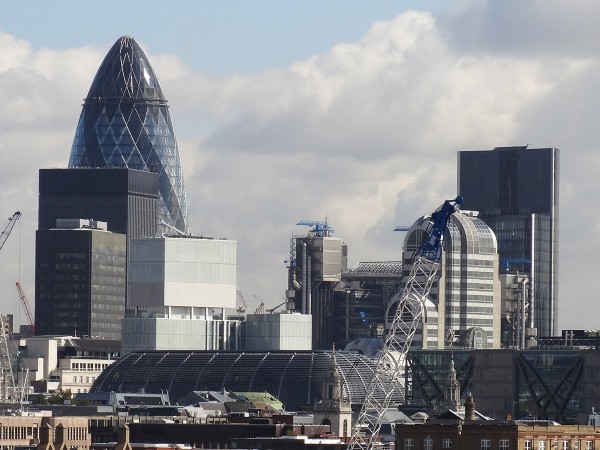
 While much of the UK is struggling to recover from recession, the London economy is growing strongly. This is reflected in strong investment, a growth in jobs and rapidly rising house prices.
There are considerable external economies of scale for businesses locating in London. There is a pool of trained labour and complementary companies providing inputs and services are located in close proximity. Firms create positive externalities to the benefit of other firms in the same industry or allied industries.
London is a magnet for entrepreneurs and highly qualified people. Innovative ideas and business opportunities flow from both business dealings and social interactions. As Boris Johnson says in the podcast, “It’s like a cyclotron on bright people… People who meet each other and spark off each other, and that’s when you get the explosion of innovation.”
 Then there is a regional multiplier effect. As the London economy grows, so people move to London, thereby increasing consumption and stimulating further production and further employment. Firms may choose to relocate to London to take advantage of its buoyant economy. There is also an accelerator effect as a booming London encourages increased investment in the capital, further stimulating economic growth.
But the movement of labour and capital to London can dampen recovery in other parts of the economy and create a growing divide between London and other parts of the UK, such as the north of England.
The podcast examines ‘agglomeration‘ in London and how company success breeds success of other companies. It also looks at some of the downsides.
Podcast
Boris Johnson: London is cyclotron on bright people BBC Today Programme, Evan Davis (3/3/14)
Articles
London will always win over the rest of the UK The Telegraph, Alwyn Turner (2/3/14)
Evan Davis’s Mind The Gap – the view from Manchester The Guardian, Helen Pidd (4/3/14)
London incubating a new economy London Evening Standard, Phil Cooper (Founder of Kippsy.com) (10/2/14)
Reports and data
London Analysis, Small and Large Firms in London, 2001 to 2012 ONS (8/8/13)
Regional Labour Market Statistics, February 2014 ONS (19/2/14)
London Indicators from Labour Market Statistics (11 Excel worksheets) ONS (19/2/14)
Annual Business Survey, 2011 Regional Results ONS (25/7/13)
Economies of agglomeration Wikipedia
Questions
- Distinguish between internal and external economies of scale.
- Why is London such an attractive location for companies?
- Are there any external diseconomies of scale from locating in London?
- In what ways does the expansion of London (a) help and (b) hinder growth in the rest of the UK?
- Examine the labour statistics (in the links above) for London and the rest of the UK and describe and explain the differences.
 Business performance is always affected by the economy and we can always look at the economic theory to explain why profits rise and fall. Some companies prosper during recession, whereas others decline and the key is to understand the economics behind the data. This blog takes a look at the performance of a variety of companies and asks you to think about the economic theory behind it.
The world of betting has grown significantly and the profits of companies in this market, while certainly linked to economic performance, is also dependent on sport results. Paddy Power has announced pre-tax profits of €141m for 2013, an increase from €139.2m, despite sporting results causing profit performance to fall. On the part of football clubs, Liverpool FC saw a loss emerge for the 2012-2013 financial year, whereas Newcastle’s profits rose by 900% to £9.9m. What factors can explain the vastly different performance (off and on the pitch) of these two clubs?
In the USA, Radio Shack has been forced to close 1100 stores. This is, in part, as a response to a change in the way we are shopping. More and more consumers are purchasing goods online and Radio Shack is therefore experiencing growing competition from online retailers. Sales fell by 10% last year and even during the fourth quarter sales continued to decline.
Companies based in the largest economy in Europe have also experienced declines in performance, showing that a strong performing country doesn’t imply the same for companies operating in it. RWE, Germany’s biggest energy provider, has not made a loss since 1949. However, in 2013, this company posted its first annual loss in over 60 years: a loss of £2.28bn. With energy being in constant demand and criticism being levelled at UK energy providers for the high profits they’re making, the economics behind these data is important.
In better news for a company, Thorntons has boasted a significant increase in pre-tax profits, with much of this due to strong trading in the months leading up to Christmas and a sensible business strategy, involving selling more in supermarkets. Thorntons has cut its number of stores, but its profitable position has been saved by a good business strategy and this is going to lead to significant investment by the company.
Another strong performance was recorded by Berkshire Hathaway, an investment firm run by Warren Buffett. The company made a profit of £11.6bn in 2013, a significant increase on its 2012 performance. It is the insurance, rail and energy parts of the business that have contributed to the big increase in profits.
These are just some recent examples of data on business performance and your job is to think about the economic theory that can be used to explain the varying performance of different companies.
Liverpool announce annual loss of £50m in new club accounts Guardian, David Conn (4/3/14)
Thorntons makes biggest manufacturing investment for 25 years Telegraph, Natalie Thomas (3/3/14)
Thorntons cashes in on the snowman Independent, Simon Neville (3/3/14)
Warren Buffett’s Berkshire Hathaway sees record profit BBC News (2/3/14)
Newcastle says ‘player trading’ helped increase profits to £9.9m BBC Sport (25/2/14)
RWE posts first annual net loss for over 60 years BBC News (4/3/14)
UK among RWE woes as it posts first annual loss since 1949 The Telegraph, Denise Roland (4/3/14)
Germany’s RWE slides into €2.8bn net loss for 2013 Financial Times, Jeevan Vasagar (4/3/14)
John Menzies profits hit by drop in magazine sales BBC News (4/3/14)
Fresnillo profits drop as gold prices and production falls The Telegraph, Olivia Goldhill (4/3/14)
Glencore 2013 profit rises 20% as copper production gains Bloomberg, Jesse Riseborough (4/3/14)
Questions
- In each of the cases above, explain the economic theory that can be used to explain the performance of the respective company.
- To what extent is a change in the market structure of an industry a contributing factor to the change in company performance?
- To what extent do you think a company’s performance is dependent on the performance of the economy in which it operates?
- Are the profits of a company a good measure of success? What else could be used?
 I am an avid tennis fan and have spent many nights and in the last 10 days had many early mornings (3am), where I have been glued to the television, watching in particular Rafael Nadal in the Australian Open. Tennis is one of the biggest sports worldwide and generates huge amounts of revenue through ticket sales, clothing and other accessories, sponsorship, television rights and many other avenues. When I came across the BBC article linked below, I thought it would make an excellent blog!
There are many aspects of tennis (and of every other sport) that can be analysed from a Business and Economics stance. With the cost of living having increased faster than wages, real disposable income for many households is at an all-time low. Furthermore, we have so many choices today in terms of what we do – the entertainment industry has never been so diverse. This means that every form of entertainment, be it sport, music, cinema, books or computer games, is in competition. And then within each of these categories, there’s further competition: do you go to the football or the tennis? Do you save up for one big event and go to nothing else, or watch the big event on TV and instead go to several other smaller events? Tennis is therefore competing in a highly competitive sporting market and a wider entertainment market. The ATP Executive Chairman and President said:
We’ve all got to understand the demands on people’s discretionary income are huge, they are being pulled in loads of different avenues – entertainment options of film, music, sport – so we just need to make sure that our market share remains and hopefully grows as well.
As we know from economic analysis, product differentiation and advertising are key and tennis is currently in a particularly great era when it comes to drawing in the fans, with four global superstars.
However, tennis and all sports are about more than just bringing in the fans to the live events. Sponsorship deals are highly lucrative for players and, in this case, for the ATP and WTA tennis tours. It is lucrative sponsorship deals which create prize money worth fighting for, which help to draw in the best players and this, in turn, helps to draw in the fans and the TV companies.
 With technological development, all sports are accessible by wider audiences and tennis is making the most of the fast growth in digital media. Looking at the packaging of tour events and how best to generate revenues through TV rights is a key part of strategic development for the ATP. It goes a long way to showing how even one of the world’s most successful sporting tours is always looking at ways to innovate and adapt to changing economic and social times. Tennis is certainly a sport that has exploited all the opportunities it has had and, through successful advertising, well-organised events and fantastic players, it has created a formidable product, which can compete with any other entertainment product out there. As evidence, the following fact was observed in the Telegraph article:
A 1400 megawatt spike – equivalent to 550,000 kettles being boiled – was recorded at around 9.20pm on that day [6/7/08] as Nadal lifted the trophy. The surge is seen as an indicator of millions viewing the final and then rushing to the kitchen after it is over. The national grid felt a bigger surge after the Nadal victory even than at half time during the same year’s Champions League final between Manchester United and Chelsea.
Tennis top guns driving ATP revenues BBC News, Bill Wilson (20/1/14)
The top 20 sporting moments of the noughties: The 2008 Wimbledon Final The Telegraph, Mark Hodgkinson (14/12/09)
 The global tennis industry in numbers BBC News (22/1/14)
Questions
- How does tennis generate its revenue?
- In which market structure would you place the sport of tennis?
- What are the key features of the ATP tour which have allowed it to become so successful? Can other sports benefit from exploiting similar things?
- How has technological development created more opportunities for tennis to generate increased revenues?
- Can game theory be applied to tennis and, if so, in what ways?
- Why does sponsorship of the ATP tour play such an important role in the business of tennis?
- How important is (a) product differentiation and (b) advertising in sport?
 The model of demand and supply is one of the first diagrams that any student of Economics will see and it’s a very important model. We can apply it to a multitude of markets and understand how market prices for products and services are determined. One such market is that of wine, where a recent report suggests that wine is in short supply. Bad news for everyone!
The price of wine is set by the interact of demand and supply. As with any market, numerous factors will affect how much wine is demanded at any price. Since 1996, global consumption of wine has been on the increase: for many, wine is a luxury good and thus as income rises, so does consumption. With the emergence of markets, such as China and subsequent income growth, consumption has risen. Furthermore, tastes have changed such that wine is becoming an increasingly desirable drink. So, this has all led to the demand curve shifting to the right.
 However, at the same time, the supply of wine has been falling, largely the result of ‘ongoing vine pull and poor weather’ across Europe. European production has fallen by around 10% over the past year and although production in other countries has been rising, overall production is still not sufficient to match the growth in demand.
So, what’s the result of this high growth in demand combined with the decline in supply? A shortage of wine. A report by analysts at Morgan Stanley suggests that the global wine shortage was some 300m cases in 2012. But, more importantly what is the effect of this shortage? When demand for a product exceeds the supply, the market mechanism will push up the price. As stocks of wine continue to be depleted and consumption of wine keeps rising, the only outcome is a rise in the price of a bottle and a crate of wine.
Concerns are also being raised about the future of prices of some of our other favourite luxury products, such as chocolate, goats cheese and olives. In each case, it’s all about demand and supply and how these curves interact with each other. The following articles consider the prices of some of these products.
Wine shortage: the top five wines to drink – before they run out The Telegraph, Susy Atkins (30/10/13)
World faces global wine shortage – report BBC News (30/10/13)
Luxury food shortage scares – should we believe the warnings? The Guardian, Emine Saner (5/11/13)
The global wine ‘shortage’ Napa Valley, Dan Berger (8/11/13)
Global Shortage of wine beckons Independent, Felicitiy Morse (30/10/13)
The global wine shortage is about to get worse (if you like Bordeaux) TIME World, David Stout (6/11/13)
Have no fears about a world wine shortage – the glass is still half fulll The Telegraph, Victoria Moore (31/10/13)
Drink it while you can, as study points to looming wine shortage Associated Press (31/10/13)
Don’t waste a drop! Wine prices to rise as demand grows Mail Online, Amie Keeley (31/10/13)
Questions
- Use a demand and supply diagram to illustrate how the market price for wine (or any other product) is determined.
- Why does the demand curve for wine slope downwards and the supply curve of wine slope upwards?
- Which factors will affect (a) the demand and (b) the supply of wine?
- One the diagram you drew in question, illustrate a shortage of wine. How will the price mechanism work to restore equilibrium?
- Why does the Morgan Stanley report suggest that a wine shortage might emerge?
- What suggestions are there that there is no wine shortage?
 ‘Farm-gate’ milk prices (the price paid to farmers) have been rising in the UK. In July they reached a record high of 31.4p per litre (ppl). This was 5.1ppl higher than in July 2012. There were further price rises this month (October). Sainsbury’s increased the price it pays farmers by nearly 2ppl to 34.15ppl and Arla Foods by 1.5ppl to 33.13ppl. Muller Wiseman is set to raise the price it pays to 32.5p per litre.
And yet many farmers are struggling to make a profit from milk production, claiming that their costs have risen faster than the prices they receive. Feed costs, for example, have risen by 2.12ppl. On average, farmers would need over 38p per litre just to cover their average variable costs. What is more, exceptional weather has reduced yields per cow by some 7%.
Meanwhile, in the USA, supply has risen by some 1.3% compared with a year ago. But despite this, the prices of dairy products are rising, thanks to strong demand. Cheese and butter prices, in particular, are rising rapidly, partly because of high demand from overseas. Demand for imported dairy products is particularly high in China, where supply has fallen by some 6% in the past couple of months.
 The problem for dairy farmers in the UK is partly one of the power balance in the industry. Farmers have little or no market power. Supermarkets, however, have considerable market power. As large oligopsonistic buyers, they can put downward pressure on the prices paid to their suppliers. These are mainly large processing firms, such as Robert Wiseman Dairies, Arla Foods and Dairy Crest. They, in turn, can use their market power to keep down the price they pay to farmers.
Articles
Dairy farmers renew protests over milk prices Farmers Weekly, Philip Case (5/9/13)
Dairy farmers ‘lost more than 1p/litre last year’ Farmers Weekly, Philip Case (2/10/13)
South West farming businesses and producers still making a loss on milk South West Business (3/10/13)
Q&A: Milk prices row and how the system works BBC News (23/7/12) (note date of this)
Positive Dairy Trend: Rising Milk Production and Strong Demand The Farmer’s Exchange, Lee Mielke (27/9/13)
Chinese supply crisis to delay dairy price adjustment Rabobank (25/9/13)
China milk ‘crisis’ fuels world dairy price rise Agrimoney (1/10/13)
Data
UK milk prices and composition of milk ONS
Combined IFCN world milk price indicator IFCN
Questions
- Give some examples of (a) variable costs and (b) fixed costs in milk production.
- Why may farmers continue in dairy production, at least for a time, even if they are not covering their average variable costs?
- What factors determine (a) the price of milk paid to farmers; (b) the retail price in supermarkets?
- Explain how dairy futures markets work.
- Could the milk processors use their market power in the interests of farmers? Is it in the interests of milk processors to do so?
- Why is there a Chinese “dairy supply crisis”? What is its impact on the rest of the world? What is the relevance of the price elasticity of demand for dairy products in China to this impact?
 While much of the UK is struggling to recover from recession, the London economy is growing strongly. This is reflected in strong investment, a growth in jobs and rapidly rising house prices.
 Then there is a regional multiplier effect. As the London economy grows, so people move to London, thereby increasing consumption and stimulating further production and further employment. Firms may choose to relocate to London to take advantage of its buoyant economy. There is also an accelerator effect as a booming London encourages increased investment in the capital, further stimulating economic growth.