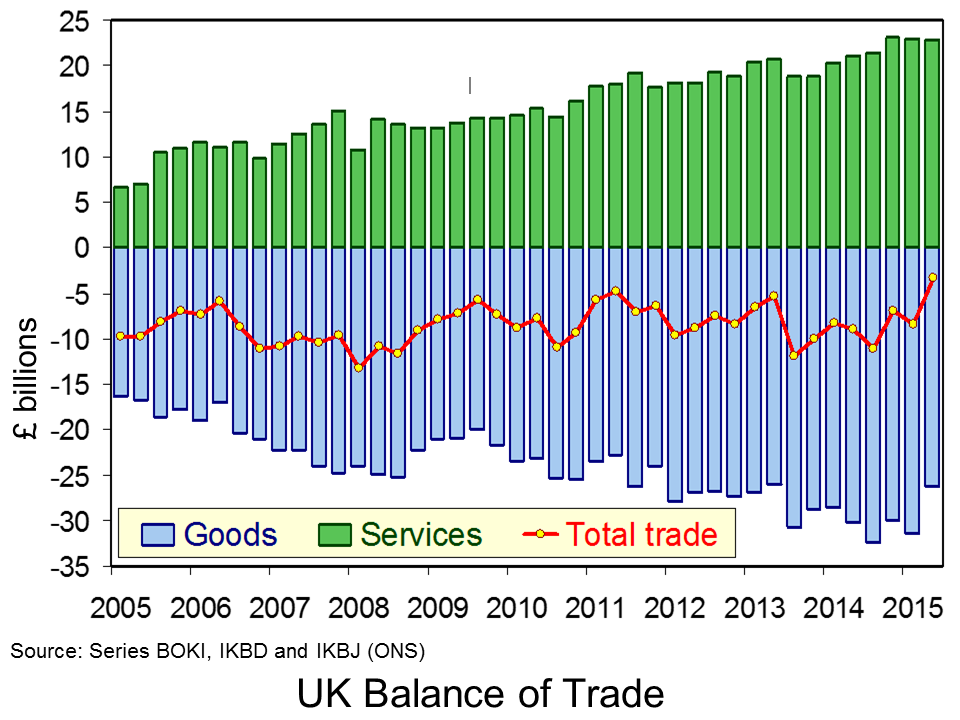
 The UK’s balance on trade continues to be sharply in deficit. At the same time, both manufacturing and overall production are still well below their pre-crisis levels. What is more, with a sterling exchange rate that has appreciated substantially over recent months, UK exports are at an increasing price disadvantage. The hoped-for re-balancing of the economy from debt-financed consumption to investment and exports has not occurred. Investment in the UK remains low relative to that in other major economies (see).
But other developments in the global economy are working in the UK’s favour.
Manufacturing globally is becoming more capital intensive, which reduces the comparative advantage of developing countries with low labour costs.
 At the same time, the dividing line between manufacturing and services is becoming more blurred. Manufacturers in developing countries may still produce parts, such as chips or engines, but the design, marketing and sales of the products may take place in developed countries, such as the UK. Indeed, as products become more sophisticated, an increasing amount of value added may occur in developed countries.
The UK may be particularly well-placed in this regard. It can provide many high-end services in IT, business support and financial services to international manufacturers. It may have a comparative advantage in idea-intensive production.
 Finally with a higher exchange rate, the UK’s terms of trade have been improving. The downside is that it makes UK exports more expensive in foreign currency terms, but it also makes commodity prices cheaper, which have already fallen in dollar terms, and also the prices of imported component parts. This helps offset the effect of the appreciation of the exchange rate on exports.
The following article by Jeremy Warner considers whether, despite its poor performance in traditional manufacturing, the UK might have hit an economic ‘sweet spot’ in its trade position.
Article
Unbalanced but lucky, Britain hits an economic sweet spot The Telegraph, Jeremy Warner (8/9/15)
Data
UK Trade (Excel file) ONS (9/9/15)
(See, for example, Worksheet 1. You can search for longer series using Google advanced search, putting www.ons.gov.uk in the ‘site or domaine’ box and searching for a particular series, using the series identifier found at the top of each column in the Excel file, such as BOKI for balance on trade in goods.)
Exchange rate data Bank of England Statistical Interactive Database
Questions
- Explain the difference between the balance on trade, the balance on trade in goods and the balance of payments on current account.
- Why has the UK not experienced a re-balancing of the economy as hope for by the Chancellor of the Exchequer, amongst others?
- What is meant by the ‘terms of trade’?
- What would cause an ‘improvement’ in the terms of trade?
- Are the UK’s terms of trade likely to move in the UK’s favour in the coming months? Explain.
- What current factors are mitigating against a recovery of UK manufacturing exports?
- Is de-industrialisation necessarily a ‘bad thing’?
- Does the development of new capital-intensive technologies in manufacturing mean that the UK could become a net exporter of manufactures? Explain why or why not.
 China has a key role in the global economy. Recording double digit growth for a number of years and posting impressive export figures, China’s has been an economy on an upward trajectory. But its growth has been slowing and this might spell trouble for the global economy, as was discussed in the following blog. For many, China is the pendulum and the direction it moves in will have a big influence on many other countries.
There are some suggestions that China’s rapid growth has been somewhat artificial, in particular following the financial crisis, where we saw massive investment by state-owner enterprises, banks and local government. This has led to a severe imbalance within the Chinese economy, with high levels of debt. One of the key factors that has enabled China to grow so quickly has been strong exports. China has typically had a large current account surplus, often balanced by large current account deficits in many Western countries.
The exchange rate is a key component in keeping strong export growth and the devaluation of the Chinese currency in August (see What a devalued yuan means to the rest of the world) is perhaps a suggestion that export growth in China is lower than desired. Devaluing the currency will boost the competitiveness of Chinese exports and this in turn may lead to a growth in the current account surplus, which had fallen quite significantly from around 10% to 2%.
The problem is that China is currently imbalanced and this is likely to create problems around the world. With globalisation, the free movement of capital and people, deflation in the West and falling world asset prices, the situation in China is crucial. Although you will find many articles about China and blogs on this site about its devaluation, its growth and policy, the BBC News article below considers the conflicts that exist between three key economic objectives:
1. currency stability
2. the free movement of capital
3. independent monetary policy
and the need for some international co-operation and co-ordination to enable China’s economy to return to internal and external balance.
China’s impossible trinity BBC News, Duncan Weldon (8/9/15)
Questions
- What is meant by internal balance?
- What is external balance?
- Would you suggest that China is suffering from an imbalanced economy? If so, which type of imbalance and why is this a problem for China and for the world economy?
- The article refers to the trilemma. Why can an country not achieve all 3 parts of the trilemma? You should explain why each combination of 2 aspects is possible, but why the third is problematic.
- Use a diagram to explain why a fall in the exchange rate will boost the competitiveness of exports and why this can create economic growth.
- Why is a devalued Chinese currency bad news for the rest of the world?
- How could international co-operation and co-ordination help China?
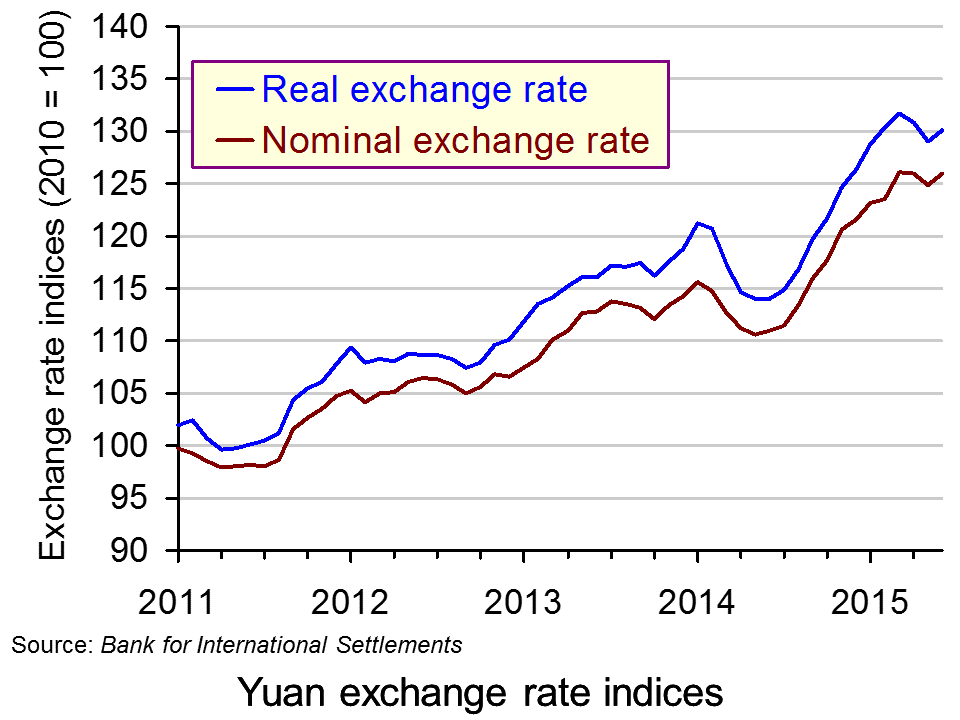
On August 11th, China devalued its currency, the yuan, by 1.9%. The next day it devalued it by a further 1.6% and on the next day by a further 1.1%. Even though the total devaluation was relatively small, especially given a much bigger revaluation over the previous three years (see chart below), traders in world markets greeted the news with considerable pessimism. Stock markets around the world fell. For example, the US Dow Jones was down by 1.1%, the FTSE 100 was down by 2.5% and the German DAX by 5.8%.
There are three major concerns of investors about the devaluation. The first is that a weaker yuan will make other countries’ exports more expensive in China, thereby making it harder to export to China. At the same time Chinese imports into the rest of the world will be cheaper, thereby making it harder for domestic producers to compete with Chinese imports.
 The second is that cheaper Chinese imports will put downward pressure on prices at a time when inflation rates in the major economies are already below target rates. The fear of deflation has not gone away and this further deflationary twist will intensify such fears and possibly dampen demand.
The third is that the devaluation is taken as a sign that the Chinese authorities are worried about a slowing Chinese economy and are using the devaluation to boost Chinese exports. The rapidly expanding Chinese economy has been one of the major motors of the global economy in recent years and hence a slowing Chinese economy is cause for serious concern at a time when the global economy is still only very slowly recovering from the shock of the financial crisis of 2007–8
But just how worried should the rest of the world be about the falling yuan? And will it continue to fall, or could this be seen as a ‘one-off’ correction? What effect will it have on the macroeconomic policies of the USA, the eurozone and other major countries/regions? The following articles analyse Chinese policy towards its currency and the implications for the rest of the world.
China weakens yuan for a third straight day on Thursday CNBC, Nyshka Chandran (13/8/15)
Markets reel as investors fear worst of Chinese slowdown is yet to come The Telegraph, Peter Spence (12/8/15)
China cannot risk the global chaos of currency devaluation The Telegraph, Ambrose Evans-Pritchard (12/8/15)
Beware a China crisis that could crash down on us all The Telegraph, Liam Halligan (15/8/15)
The curious case of China’s currency The Economist, Buttonwood’s notebook (11/8/15)
China’s yuan currency falls for a second day BBC News (12/8/15)
China slowdown forces devaluation BBC News, Robert Peston (11/8/15)
What the yuan devaluation means around the world BBC News, Lerato Mbele, Daniel Gallas and Yogita Limaye (12/8/15)
 China allows yuan currency to drop for third day BBC News, various reporters (13/8/15)
The Guardian view on global currencies: it’s the economy, stupid The Guardian, Editorial (14/8/15)
China’s currency gambit and Labour’s debate about quantitative easing: old and new ways to cope with economic crisis The Guardian, Paul Mason (16/8/15)
Questions
- By what percentages have the nominal and real yuan exchange rate indices appreciated since the beginning of 2011? Use data from the Bank for International Settlements.
- Explain the difference between nominal and real exchange rate indices.
- Compare the changes in the yuan exchange rate indices with that of the yuan/dollar exchange rate (see Bank of England Interactive Database). Explain the difference.
- How is the yuan exchange rate with other currencies determined?
- How have the Chinese authorities engineered a devaluation of the yuan? To what extent could it be described as a ‘depreciation’ rather than a ‘devaluation’?
- Why have world stock markets reacted so negatively to the devaluation?
- Why, in global terms, is the devaluation described as deflationary?
- How much should the rest of the world be worried by the devaluation of the yuan?
- Explain the statement by Robert Peston that ‘Beijing has done the monetary tightening that arguably the US economy needs’.
- Comment on the following statement by Stephen King of HSBC (see the second Telegraph article below): ‘The world economy is sailing across the ocean without any lifeboats to use in case of emergency.’
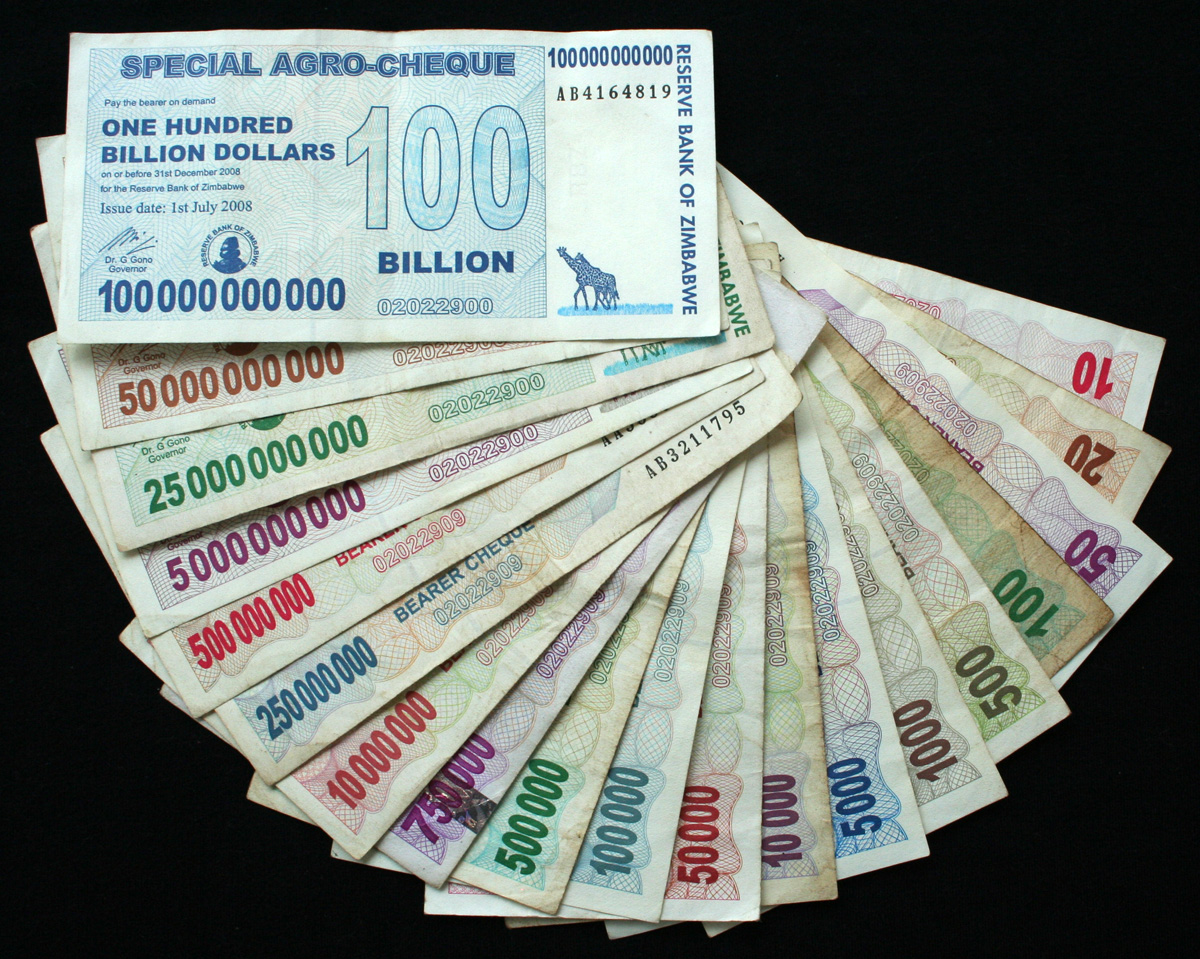
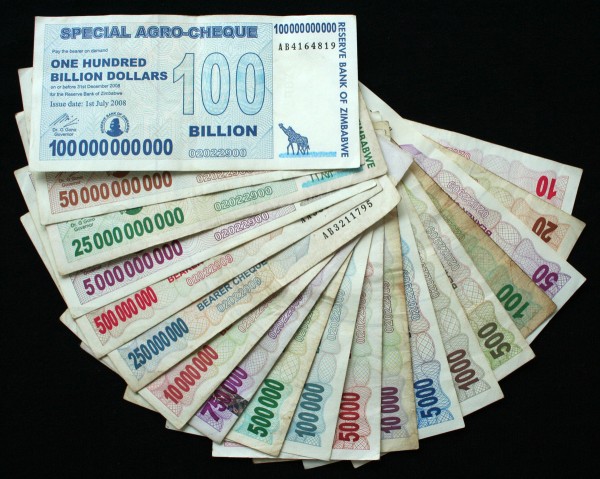 In the late 2000s, Zimbabwe experienced hyperinflation. As a post on this site in January 2009 said, two estimates of the inflation rate were made: one of 5 sextillion per cent (5 and 21 zeros); the other of 6.5 quindecillion novemdecillion per cent (65 and 107 zeros). In January 2009, in a last attempt to save the Zimbabwean currency, a new series of banknotes was issued, including a Z$100 trillion note.
Prices were typically being adjusted at least twice a day and people had to carry large bags of money around even to buy a couple of simple items. The currency was virtually worthless. As the Guardian article below states:
Hyperinflation in Zimbabwe left pensions, wages and investments worthless and spread poverty as everyday items became unaffordable. It also caused severe cash shortages, because the government could not afford to print bank notes to keep pace with inflation.
The solution was to allow other currencies, mainly the US dollar and the South African rand, to be used alongside the local currency. Although the Zimbabwean currency was still legal tender, it effectively went out of use. Prices stabilised and since then inflation has been in single figures.
 But many people still have stocks of the virtually worthless old currency, either in cash or in savings accounts. The Zimbabwean government has now said that it will exchange Zimbabwean dollar notes for US dollars at the rate of US$1 = Z$250tn (250,000,000,000). People have until September to do so. Up to now, they have mainly been used to sell as souvenirs to tourists! For people with Zimbabwean dollars in their bank accounts, they will get a minimum of US$5. For amounts beyond Z$175,000tn they will get an additional US dollar for each Z$35,000tn.
Historical examples of hyperinflation
As case study 15.5 in Economics 9e’s MyEconLab points out, several countries experienced hyperinflation after the First World War. In Austria and Hungary prices were several thousand times their pre-war level. In Poland they were over 2 million times higher, and in the USSR several billion times higher.
Germany in the 1920s
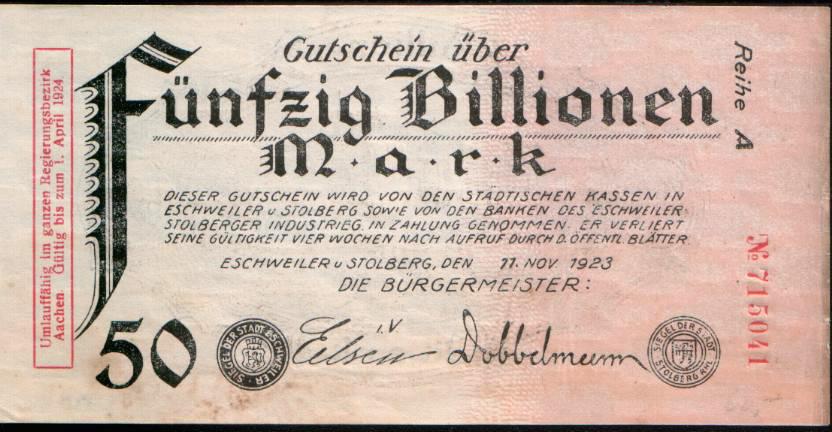
But even these staggering rates of inflation seem insignificant beside those of Germany. Following the chaos of the war, the German government resorted to printing money, not only to meet its domestic spending requirements in rebuilding a war-ravaged economy, but also to finance the crippling war reparations imposed on it by the allies in the Treaty of Versailles.
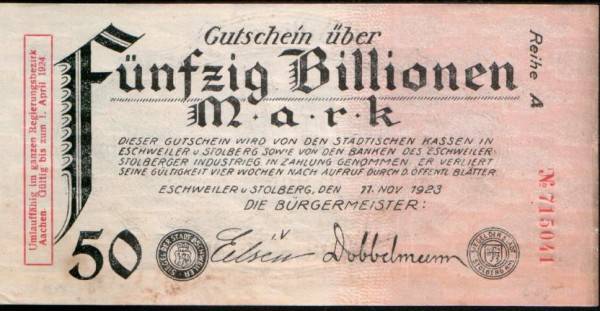 From mid 1921 the rate of monetary increase soared and inflation soared with it. By autumn 1923 the annual rate of inflation had reached a mind-boggling 7,000,000,000,000 per cent! As price increases accelerated, people became reluctant to accept money: before they knew it, the money would be worthless. People thus rushed to spend their money as quickly as possible. But this in turn further drove up prices. (The note shown above is in old billions, where a billion was a million million. So the note was for 50,000,000,000,000 marks.)
For many Germans the effect was devastating. People’s life savings were wiped out. Others whose wages were not quickly adjusted found their real incomes plummeting. Many were thrown out of work as businesses, especially those with money assets, went bankrupt. Poverty and destitution were widespread.
By the end of 1923 the German currency was literally worthless. In 1924, therefore, it was replaced by a new currency – one whose supply was kept tightly controlled by the government.
Serbia and Montenegro 1993–5
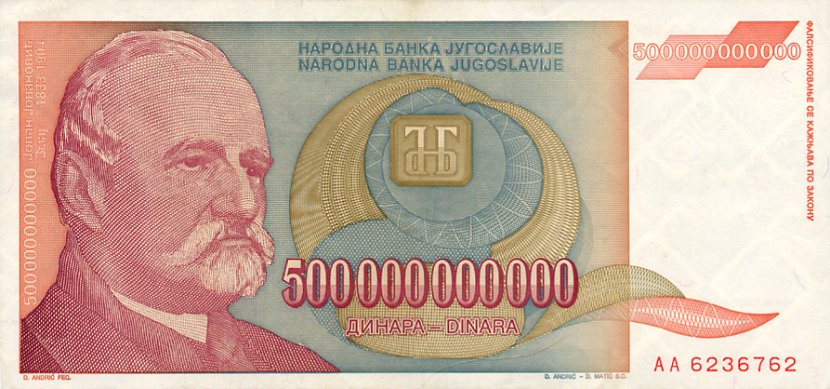
After the break-up of Yugoslavia in 1992, the economy of the remaining part of Yugoslavia (Serbia and Montenegro) collapsed. The government relied more and more on printing money to finance public expenditure. Prices soared.
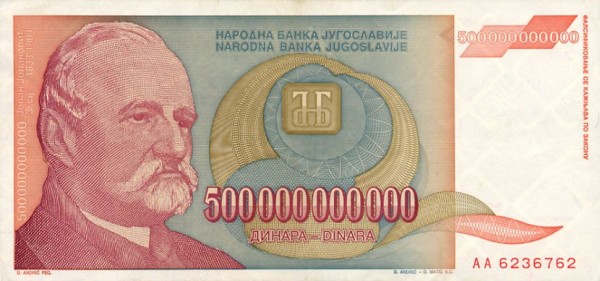 The government attempted to control the inflation by imposing price controls. But these simply made production unprofitable and output fell further. The economy nosedived. Unemployment exceeded 30 per cent.
In October 1993, the government created a new currency, the new dinar, worth one million old dinars. In other words, six zeros were knocked off the currency. But this did not solve the problem. Between October 1993 and January 1994, prices rose by 5 quadrillion per cent (5 and fifteen zeros). Normal life could not function. Shops ran out of produce; savings were wiped out; barter replaced normal market activity.
At the beginning of January 1994 a ‘new new dinar’ was introduced, worth 1 billion new dinars. On 24 January this was replaced by a ‘novi dinar’ pegged 1 to 1 against the Deutsche Mark. This was worth approximately 13 million new new dinars. The novi dinar remained pegged to the Deutsche Mark and inflation was quickly eliminated.
Articles
Zimbabweans get chance to swap ‘quadrillions’ for a few US dollars The Guardian (13/6/15)
175 Quadrillion Zimbabwean Dollars Are Now Worth $5 Bloomberg, Godfrey Marawanyika and Paul Wallace (11/6/15)
Zimbabwe is paying people $5 for 175 quadrillion Zimbabwe dollars Washington Post, Matt O’Brien (12/6/15)
Zimbabwe dollars phased out BBC News Africa (12/6/15)
Zimbabwe ditches its all but worthless currency Financial Times (12/6/15)
Zeroing in Thomson Reuters, Breaking News, Edward Hadas (12/6/15)
Old articles
Could inflation fell Mugabe? BBC News (28/7/08)
ZIMBABWE: Inflation at 6.5 quindecillion novemdecillion percent IRIN (21/1/09)
The Worst Episode of Hyperinflation in History: Yugoslavia 1993-94 Roger Sherman Society, Thayer Watkins (31/7/08)
Questions
- Why have several governments in the past been prepared to allow hyperinflation to develop?
- Itemise the types of cost imposed on people by hyperinflation.
- Does anyone gain from hyperinflation?
- What are the solutions to hyperinflation?
- What difficulties are there in eliminating hyperinflation? What costs are imposed on people in the process?
- Why might the causes of hyperinflation be described as always political?
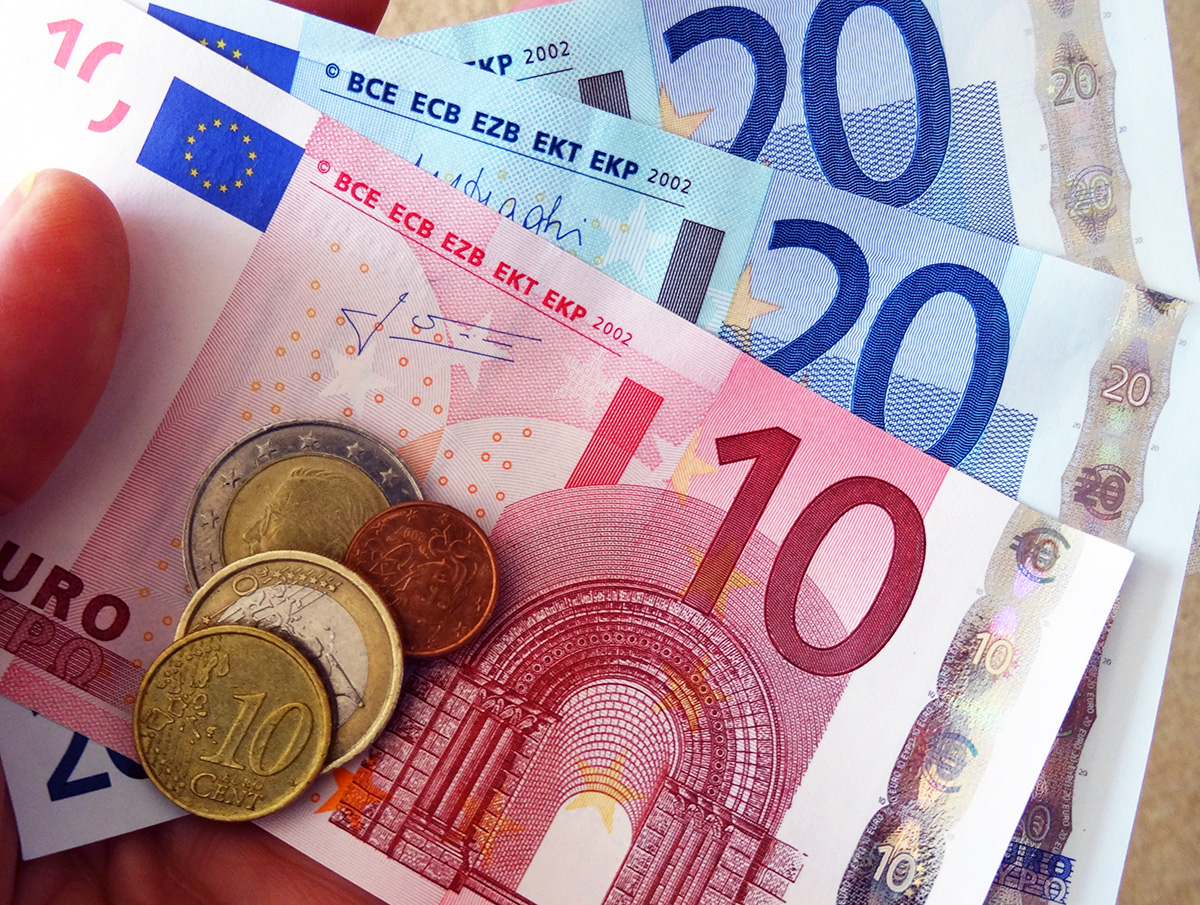
 The eurozone has been suffering from deflation: that is, negative inflation. But, the latest data show an increase in the rate of inflation in April from 0% to 0.3%. This is still a very low rate, with a return to deflation remaining a possibility (though perhaps unlikely); but certainly an improvement.
The eurozone economy has been stagnant for some time but the actions of the European Central Bank (ECB) finally appear to be working. Prices across the eurozone have risen, including services up by 1.3%, food and drink up by 1.2% and energy prices, albeit still falling, but at a slower rate. All of this has helped to push the annual inflation rate above 0%. For many, this increase was bigger than expected. Howard Archer, Chief European Economist at HIS Global Insight said:
“Renewed dips into deflation for the eurozone are looking increasingly unlikely with the risks diluted by a firming in oil prices from their January lows, the weakness of the euro and improved eurozone economic activity.”
Economic policy in the eurozone has focused on stimulating the economy, with interest rates remaining low and a €1.1 trillion bond-buying programme by the ECB. But, why is deflation such a concern? We know that one of the main macroeconomic objectives of a nation is low and stable inflation. If prices are low (or even falling) is it really as bad as economists and policy-makers suggest?
The problem of deflation occurs when people expect prices to continue falling and thus delay spending on durables, hoping to get the products cheaper later on. As such, consumption falls and this puts downward pressure on aggregate demand. This decision by consumers to put off spending will cause aggregate demand to shift to the left, thus pushing national income down, creating higher unemployment and adding to problems of economic stagnation. If this expectation continues, then so will the inward shifts in AD. In the eurozone, this has been a key problem, but it now appears that aggregate demand has stopped falling and is now slowly recovering, together with the economy.
 It is important to note how interdependent all aspects of an economy are. The euro responded as news of better inflation data emerged, together with expectations of a Greek deal being reached. Enrique Diaz-Alvarez, chief risk officer at Ebury said:
“The move [rise in euro] got going with the big upside surprise in eurozone inflation data — especially core inflation, which bounced up from 0.6 per cent to 0.9 per cent. This is exactly what the ECB wants to see, as it is proof that QE is having the desired effect and removes the threat of deflation in the eurozone from the foreseeable future.”
One of the key factors that has kept inflation down in the eurozone (and also the UK) is falling oil prices. It is for this reason that many have been suggesting that this type of deflation is not bad deflation. With oil prices recovering, the general price level will also recover and so economies will follow suit. The following articles consider the fortunes of the eurozone.
Eurozone inflation shouldn’t shift ECB’s QE focus Wall Street Journal, Richard Barley (2/6/15)
Eurozone deflation threat recedes Financial Times, Claire Jones (2/6/15)
Eurozone inflation rate rises to 0.3% in May BBC News (2/6/15)
Eurozone back to inflation as May prices beat forecast Reuters, Jan Strupczewski (2/6/15)
Boost for ECB as Eurozone prices turn positive in May Guardian, Phillip Inman (2/6/15)
Eurozone inflation higher than expected due to quantitative easing International Business Times, Bauke Schram (2/6/15)
Euro lifted by Greek deal hopes and firmer inflation data Financial Times, Roger Blitz and Michael Hunter (2/6/15)
Questions
- What is the difference between the 0.3% and 0.9% figures quoted for inflation in the eurozone?
- What is deflation and why is it such a concern?
- Illustrate the impact of falling consumer demand in an AD/AS diagram.
- How has the ECB’s QE policy helped to tackle the problem of deflation? Do you think that this programme needs to continue or now the economy has begun to improve, should the programme end?
- To what extent is the economic stagnation in the eurozone a cause for concern to countries such as the UK and USA? Explain your answer.
- Why has the euro risen, following news of this positive inflation data?
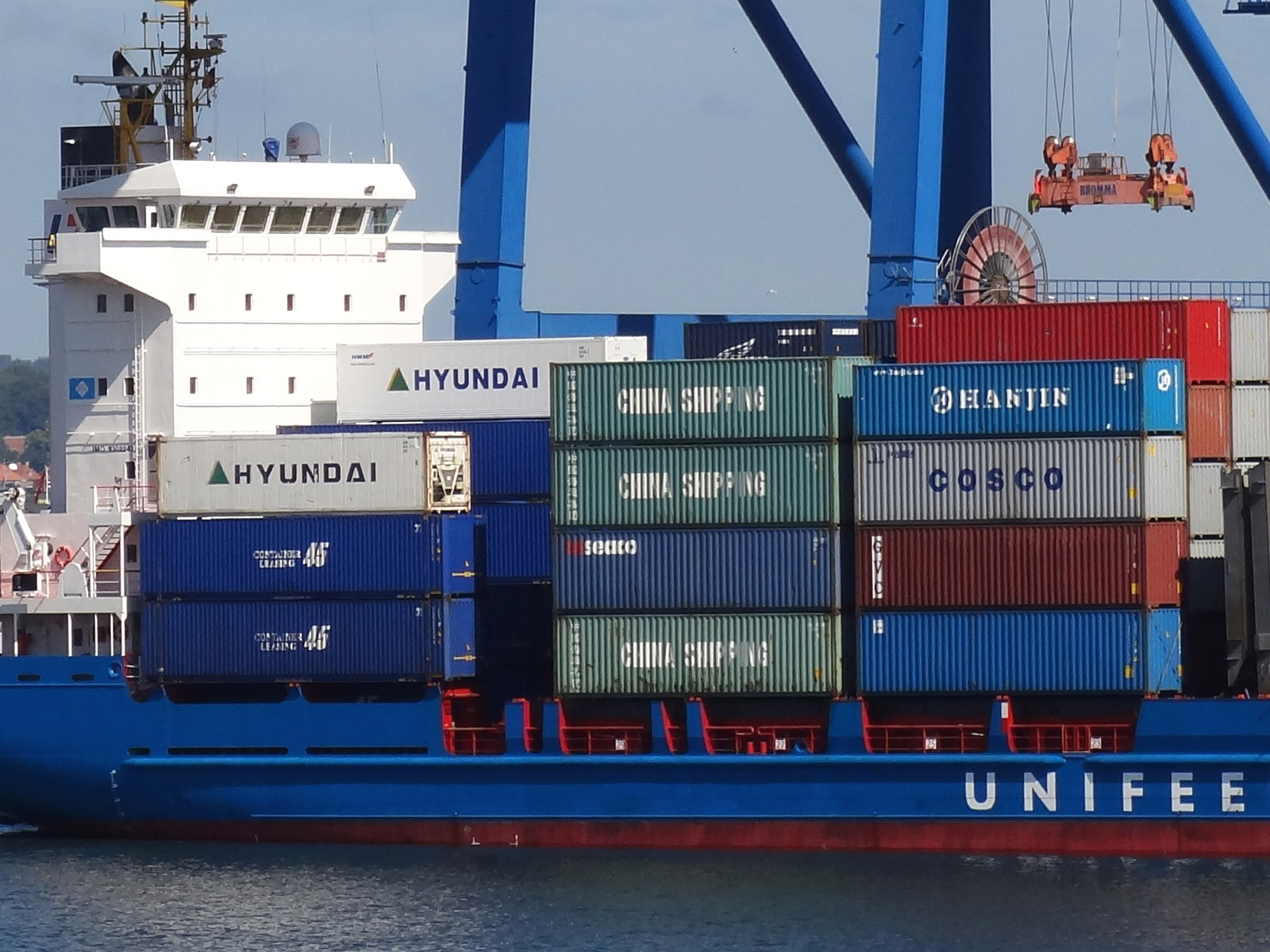 The UK’s balance on trade continues to be sharply in deficit. At the same time, both manufacturing and overall production are still well below their pre-crisis levels. What is more, with a sterling exchange rate that has appreciated substantially over recent months, UK exports are at an increasing price disadvantage. The hoped-for re-balancing of the economy from debt-financed consumption to investment and exports has not occurred. Investment in the UK remains low relative to that in other major economies (see).
 Finally with a higher exchange rate, the UK’s terms of trade have been improving. The downside is that it makes UK exports more expensive in foreign currency terms, but it also makes commodity prices cheaper, which have already fallen in dollar terms, and also the prices of imported component parts. This helps offset the effect of the appreciation of the exchange rate on exports.