 In a recent blog post on this site about the Microsoft/ Activision Blizzard merger, the European Commission had just reached a decision to approve the merger subject to remedies, but the investigations in the USA and UK were still ongoing. Since then, the merger has been approved by competition authorities around the world, including in the USA and UK, and thus the merger has gone through.
However, there were some differences in the way the case unfolded under the regulation of these three competition authorities.
The European Commission’s (EC) decision
The European Commission (EC) was the first to give the merger the green light. The EC’s in-depth investigation revealed concerns about the market for the distribution of games via cloud game streaming services. In particular, the concern was related to the possibility that Microsoft might make Activision’s games exclusive to its own cloud game streaming service (Game Pass Ultimate) and restrict access from competing cloud game streaming providers.
The EC argued that this in turn could strengthen Microsoft’s position in the market for PC operating systems, as Microsoft may have an incentive to limit or reduce the quality of the streaming of Activision’s games on PC’s which do not use the Windows operating system.
Thus, while the merger was approved, this was subject to remedies. These remedies included 10-year licensing commitments from Microsoft, as outlined in the EC’s press release:
These licenses will ensure that gamers that have purchased one or more Activision games on a PC or console store, or that have subscribed to a multi-game subscription service that includes Activision games, have the right to stream those games with any cloud game streaming service of their choice and play them on any device using any operating system.
This type of remedy is called a behavioural remedy and often requires the merging firms to commit to taking particular actions post-merger. Unlike structural remedies (which may for example, require the merging firms to sell off an entire business unit), behavioural remedies often require monitoring and enforcement by competition authorities. The EC argued that the deal, with these behavioural remedies, could strengthen competition in the market for cloud gaming.
The Federal Trade Commission’s (FTC) decision
 The FTC, in the USA, had similar concerns to those of the EC related to the cloud gaming market. These were outlined in the FTC’s press release:
[The deal] would enable Microsoft to suppress competitors to its Xbox gaming consoles and its rapidly growing subscription content and cloud-gaming business.
The FTC also argued that when Microsoft had previously acquired gaming content, it had made this content exclusive to Microsoft consoles. This could result in higher prices, and reduced quality, choice and innovation. To this end, the FTC appealed in an attempt to block the deal, but the Court ruled in favour of the deal going ahead.
During this time, Microsoft announced that it had committed to keeping Call of Duty on Sony’s PlayStation after the merger, and this likely contributed towards the court’s decision. Hence, the FTC was unsuccessful in its attempt to halt the merger.
The Competition and Markets Authority’s (CMA) decision
 The final hurdle remaining for Microsoft, was the CMA’s approval. As outlined in a previous blog post on this site, the CMA’s phase 2 investigation revealed similar concerns about the supply of cloud gaming services (amongst concerns related to the market for the supply of console gaming services, which were later dispelled), and whilst Microsoft offered some commitments similar to those accepted by the EC, the CMA did not deem these to be sufficient to address its concerns and thus prohibited the merger.
The CMA’s published remedies guidance suggests that the regulator has a preference for structural remedies over behavioural remedies. One of the reasons for this is because of the requirement to monitor and enforce the commitments, and this therefore formed part of the CMA’s reasons for not accepting the remedies. Unsurprisingly, Microsoft appealed this decision to the UK’s Competition Appeals Tribunal (CAT), probably partly driven by the fact that the EC accepted similar remedies to those rejected by the CMA. However, Microsoft and the CMA agreed that if the appeal was paused, Microsoft could propose a new deal.
The new deal: did the CMA make a U-turn?
 In August 2023, Microsoft submitted a new restructured deal for the CMA to review. As described by the Chief Executive of the CMA, this deal was “substantially different from what was put on the table previously” and was therefore investigated as a separate merger case under the CMA’s phase 1 processes.
The new deal meant that Microsoft would no longer be purchasing the cloud streaming rights held by Activision. Instead, the cloud streaming rights would be sold to an independent third-party game publisher – Ubisoft. This means that Microsoft will not be in control of the cloud gaming rights for Activision’s gaming content (outside of the EEA), and therefore will not be able to restrict its competitors’ access to Activision’s games, which was one of the main concerns outlined by the CMA based on the initial merger proposal. The new deal also opens up the possibility that Activision’s games will be made available on cloud gaming services that run on a non-Windows operating system.
On 13 October, the CMA approved this deal, subject to the cloud gaming rights being sold to Ubisoft, and some subsequent commitments from Microsoft in relation to its relationship with Ubisoft post-merger, as outlined in the CMA’s final report. However, the Chief Executive of the CMA has emphasised that they are unhappy with the way that Microsoft dealt with negotiating the approval of the merger:
But businesses and their advisors should be in no doubt that the tactics employed by Microsoft are no way to engage with the CMA. Microsoft had the chance to restructure during our initial investigation but instead continued to insist on a package of measures that we told them simply wouldn’t work. Dragging out proceedings in this way only wastes time and money.
What’s next in big tech?
While the merger deal has now gone through, the FTC has recently re-opened its case against Microsoft, which will continue to unfold over the next couple of months until December when the case will appear in Court. This means it is possible that the FTC could attempt to undo the merger, though this would be challenging.
In the tech market more broadly, the CMA has recently launched a market investigation into cloud services. While the focus of this blog post was on cloud gaming, cloud services are now increasingly being used by many businesses. The CMA’s issues statement suggests that a key focus of its investigation will be on the ability for customers to switch between cloud service providers. Microsoft is one of the largest providers of cloud services in the UK, and therefore it is inevitable that it will be under scrutiny. Given all three regulators’ recent efforts to ‘crackdown’ on big tech, this is just one of a series of cases that will be interesting to see unfold.
Articles
Competition authorities documentation
Questions
- Discuss the effectiveness of behavioural remedies vs structural remedies for a merger.
- Why might the competition authorities have been concerned about the possibility of Microsoft making Activision’s games exclusive to its own cloud game streaming service? Is exclusive dealing always anti-competitive?
- Why was the transfer of the cloud game streaming rights to Ubisoft seen as a suitable remedy?
 Policy makers have become increasingly concerned about what the US Federal Trade Commission (FTC) describe as ‘negative option marketing’. These are marketing deals that contain the following feature:
a term or condition that allows a seller to interpret a customer’s silence, or failure to take affirmative action, as an acceptance of an offer.
For example, companies such as Amazon, Apple, Spotify and Netflix may offer students a 3-month free trial or 3-month introductory offer (at a special lower price) for movie and music streaming services. However, many of these subscription contracts contain an example of negative option marketing – auto renewal clauses.
Problems with auto-renewal contracts
The inclusion of an auto-renewal clause means that if a customer fails to cancel the subscription at the end of the three-month period, the subscription automatically reverts to its full price. The full-price contract then continues to roll-over indefinitely unless the customer takes a pre-specified action to terminate the deal. Inattentive consumers could end up paying subscription prices that far exceed their willingness to pay.
 Auto-renewal contracts are not just an issue with free trials/introductory offers. Some people may purchase subscription contracts at the full price and then forget about them. These consumers could end up paying fees for months after they have effectively stopped using the service.
Another potential problem with the use of auto-renewal contracts, is businesses deliberately making the cancellation process more complex than it needs to be. In many cases it takes just one click to sign up for the subscription, but multiple clicks through a series of menus to cancel. Some businesses do not provide consumers with the option to cancel online and, instead, they are forced to phone a number that is often very busy.
Effects on consumer welfare
To what extent do these problems caused by auto-renewal reduce consumer welfare? What evidence do we have?
 Research by Citizens Advice found that just over one in four people (26 per cent) had signed up to a subscription by accident. 58 per cent of this group forgot to cancel a free trial, while 21 per cent did not realise that the free trial would automatically roll-over to a full-price subscription. This seems to be a particular issue for those on low incomes with 46 per cent of people on Universal Credit signing up to a subscription by accident.
Analysis by the Department for Business and Trade (DBT) has tried to estimate the value of these unwanted subscriptions. The study found that consumers spent £602 million on unwanted subscriptions where a free or reduced-price trial had been rolled over to the full price. The same study also found that £573 million was spent on subscriptions that people had forgotten about.
One in five people in the Citizens Advice study who tried to cancel a subscription found the process difficult. The DBT estimates that cancellation difficulties led to £382 million being spent on unwanted subscriptions.
UK Government response
 In response to these findings, the government introduced the Digital Markets, Competition and Consumers Bill into Parliament in April 2023.
Provisions in the Bill seek to standardise the information that businesses must provide consumers before they sign up for subscription contracts. For example, in the future, firms will have to display prominently (a) any auto-renewal provisions, (b) whether the price increases after a specified period, (c) details about how consumers can terminate the contract and (d) cooling-off periods.
The Bill also stipulates that businesses will have to provide consumers with reminders when a free/reduced-price trial period is about to end and/or a subscription is about to renew automatically. They must also make it easy to exit contracts and remove any unnecessary steps.
The government initially considered an additional measure that would force businesses to provide consumers with the option to take out any subscription without auto-renewal.
Citizens Advice strongly supported this policy. They argued that not only should consumers be given the choice, but that auto-renewal should not be the default i.e. people would have to opt-in to auto-renewal subscriptions.
However, after the consultation process for the Bill, the government decided against introducing this additional measure. Businesses have also argued that the other elements of the policy are too prescriptive.
Articles
Government documents
Questions
- Outline some theories from behavioural economics that might help to explain why people sometimes end up with unwanted subscriptions.
- Discuss some of the potential benefits of auto-renewal subscriptions for both consumers and firms.
- Using behavioural economic theory, explain some of the potential disadvantages for businesses of using auto-renewal subscriptions.
- When businesses deliberately make the cancellation process more complex than it needs to be, it is referred to as an example of ‘sludge’. Explain the meaning of ‘sludge’ in more detail, referring to some different examples in your answer.
- What difference do you think it would make to the number of people signing up for auto-renewal subscriptions if you had to opt-in as opposed to opting out? Explain your answer.
- Another policy would be to force firms to cancel subscription contracts if there is evidence that consumers have not used the service for a long period of time. Discuss some of the advantages and disadvantages of this measure.
- Explain what are meant by ‘dark patterns’. How may the choice architecture on some sites actually hinder consumer choice?
Effects on competition in the console and cloud gaming markets
Many people in the games industry expected the Competition and Markets Authority (CMA) to approve Microsoft’s proposed takeover of the games business, Activision Blizzard. However, in its final report published on 26 April, the CMA stated that the takeover would result in a substantial lessening of competition (SLC) in the supply of cloud gaming services in the UK. It rejected a behavioural remedy proposed by Microsoft and concluded that the merger should be prohibited.
When analysing the potential impact of this merger, the CMA focused on the following three issues:
- How important is the availability of Activision Blizzard’s games for the competitiveness of Microsoft’s rivals in the console and cloud gaming market? If, following the merger, Microsoft used its control over Activision Blizzard to restrict the availability of the games, would this significantly harm the competitiveness of their rivals?
- If restricting the availability of the games did harm its rivals, would it be profitable for Microsoft to do so? Do the benefits outweigh the costs? The major benefit for Microsoft is the additional sales this generates as consumers switch to its products to gain access to Activision’s games. The major cost is the forgone sales of the games to their rivals in the console and cloud gaming market.
- If it is profitable for Microsoft to limit the availability of the games, would this policy lead to a substantial lessening of competition (SLC) in the console and cloud gaming market? To answer this question the CMA compared the level of competition that would be most likely to occur if the merger were to proceed with the level if the deal were prohibited? In other words, it needed to identify the counterfactual.
In response to the first issue, the CMA judged that restricting access to Activision Blizzard’s games post-merger would significantly harm the competitiveness of Microsoft’s rivals in both the console and cloud gaming markets. However, its judgment on the second issue differed between the two markets. Why was this? One key issue was the difference in the relative market power of Microsoft in cloud vs console gaming.
One common indicator used to analyse the market position of a business relative to its rivals is market share. Using data on revenues generated from the sales of hardware, associated games and subscription services, console gaming market shares in the UK for 2021 were as follows:
- Sony (PlayStation): 40% – 50%
- Microsoft (xBox): 30% – 40%
- Nintendo (Switch): 10% – 20%
Given the important market position of the PlayStation, limiting the ability of its users to purchase Activision games would result in Microsoft forgoing significant sales and revenue. Detailed analysis of the data by the CMA, indicated that the costs outweighed the benefits and so Microsoft did not have a commercial incentive to limit the availability of the games in this market. Therefore, the CMA concluded that the merger would not result in a SLC in the console gaming market. This finding was discussed in more detail in a blog on this website in March 2023.
The CMA judged that Microsoft had a much stronger position in the market for cloud gaming.
Cloud gaming services
 Cloud gaming offers consumers a new way of playing graphically complex games. In this sector of the market, the games run on remote servers/data centres and then stream over the internet to the user’s device. The great advantage with this approach is that it enables consumers to play games on less powerful hardware devices such as smartphones, tablets, smart televisions, and standard PCs. Although the market is currently quite small it, has grown significantly over the past couple of years. Some people argue that it has the potential to make a dramatic change to the gaming market in the same way that businesses such as Netflix and Spotify have transformed the film, TV, and music industries.
It is more difficult to judge the relative market position of firms in a new and dynamic market, where things can change very quickly. The use of market share data is less informative but can still offer some insights. To estimate market shares in cloud gaming, the CMA used data on the number of monthly active users (MAUs). The figures for paid services in the UK for 2022 were as follows:
- xCloud (Microsoft): 70% – 80%
- PlayStation Cloud Gaming (Sony): 20% – 30%
- Boosteroid: 0 – 5%
- Nvidia GFN: 0 – 5%
Data suggest that Microsoft has a much stronger position in this market than in console gaming. There is also evidence that its market position is becoming more dominant. The same market shares for xCloud and PlayStation Gaming in 2021 were 40% – 50% and 50% – 60% respectively.
Given some of the limitations of using market-share data in a new and dynamic market, the CMA analysed other information about the sector to assess Microsoft’s market position. The investigation identified three key factors that could give Microsoft a significant cost advantage over its rivals: cloud infrastructure, the Windows operating system and access to a wide variety of games.
- Infrastructure: Microsoft’s ownership of Azure, a major cloud computing platform, could give it a significant cost advantage over its rivals in the future. A rival firm would need to develop it own cloud infrastructure or purchase these services from a third-party supplier.
- The Windows operating system: Given that far more games are developed for Windows as opposed to other operating systems, using Windows on a cloud infrastructure system gives a supplier access to large number of games. As it already owns Windows, Microsoft will be able to supply the operating system to its own cloud gaming service at little additional cost whereas its rivals will have to pay a license fee.
- Access to a wide range of games: Microsoft already owns twenty-four development studios that produce some very successful games such as Minecraft and Halo. It also has commercial relationships with other third-party developers who produce games for the Xbox console. This gives Microsoft another advantage over many of its rivals.
Given this evidence on Microsoft’s strong market position, the CMA concluded that the benefits to the company of restricting the availability of the games in the cloud gaming market outweighed the costs.
If Microsoft has commercial incentives to restrict the availability of Activision’s games, would this strategy lead to a SLC in the market for cloud gaming? To answer this question, the CMA had to identify the counterfactual: i.e. the most likely outcome in the market if the merger did not proceed. Following detailed analysis of the evidence, the competition authority concluded that Activision was likely to make its games available to different cloud gaming services if the deal did not take place.
Given Microsoft’s (a) strong market position and (b) limited number of relatively small competitors in cloud gaming, the CMA concluded that Microsoft’s commercial incentive to restrict the availability games would lead to a SLC compared to the counterfactual.
Martin Coleman, the chair of the independent panel of experts who conducted the CMA’s investigation, stated that:
Microsoft already enjoys a powerful position and head start over other competitors in cloud gaming and this deal would strengthen that advantage giving it the ability to undermine new and innovative competitors.
In response to these competition concerns, Microsoft offered to supply Activision games to certain cloud gaming services for a 10-year period. However, the CMA concluded that this behavioural remedy was not enough to address the competition issues raised by the merger and recommended that the deal be prohibited.
Microsoft’s immediate response was to appeal the decision to the Competition Appeal Tribunal.
The Federal Trade Commission is currently investigating the impact of the deal in the USA while the European Commission has just completed its investigation in the European Union. On 15 May, the EC announced that Microsoft’s behavioural remedy did fully address the competition concerns identified during its investigation. Therefore, the merger was approved on condition that Microsoft fully implemented the actions outlined in the remedy.
It will be interesting to read the recommendations of the FTC when the final results of its investigation are published later this year.
Articles
CMA and EC press releases
Questions
- Discuss the barriers to entry that exist in both the console and cloud gaming markets.
- Outline some of the issues when trying to calculate market shares in cloud gaming.
- What is meaning of the term ‘input foreclosure’? How is this relevant to the Microsoft/Activision case?
- What is the difference between a behavioural and a structural remedy? In what circumstances is a behavioural remedy most likely to be effective?
- Discuss some of the potential limitations with the behavioural remedy proposed by Microsoft.
- Explain why Microsoft’s position in the downstream market for cloud gaming is likely to influence incentives it faces to restrict the availability of Activision’s games post-merger.
Why did a competition authority change its mind on one aspect of this merger?
In January 2022, Microsoft announced its plan to acquire Activision Blizzard for $68.7 billion. Activision Blizzard is one of the largest games publishers in the world and famous for titles such as Call of Duty and World of Warcraft. Sales revenue from Call of Duty: Modern Warfare II was over $10 billion within ten days of its release in 2022. Given Microsoft’s ownership of the Xbox, one of the three devices that dominate the market for gaming consoles, the deal was always likely to raise competition concerns.
Potential competition issues
Following Phase 1 and 2 merger investigations by the Competition and Markets Authority (CMA) a number of competition issues were raised. One particular concern was in the market for gaming consoles and the potential impact of the merger on the future availability of Call of Duty (CoD). Some of the key findings of the initial research undertaken by the CMA were that:
- Sony’s PlayStation was a much closer rival for the Xbox than the Nintendo Switch, which tends to offer more family-orientated games.
- PlayStation users spend significant amounts of gametime playing CoD.
- Game availability is a key factor that influences console purchase decisions.
- Twenty-four percent of PlayStation users who play CoD stated that they would not purchase future versions of the console if CoD was unavailable on the platform.
These findings suggest that there are commercial incentives for Microsoft to limit the availability of CoD on the PlayStation. For example, the newly merged business could make future versions of the game exclusive to the Xbox – total exclusivity. Alternatively, it could adopt a policy of partial exclusivity. For example, it could only make versions of CoD available on the PlayStation that exclude some of its more popular features.
There are costs to Microsoft of implementing a policy of total or partial exclusivity. For example, 76% per cent of PlayStation users who play CoD stated that they would not switch consoles if future versions of the game were made unavailable. By making CoD exclusive to Xbox users, Microsoft would lose revenue from forgoing potential sales of the game to this group of users. The firm may also suffer reputational damage if there was a social media backlash against an exclusivity decision.
However, these costs of implementing a policy of exclusivity could be outweighed by the potential benefits. These include:
- The additional sales of consoles as some users switch from the PlayStation to the Xbox to gain access to CoD.
- the sale of CoD and other games to these additional Xbox users.
To quantify these costs and benefits, the CMA used a financial model that includes information on the amounts of money users typically spend on the Xbox platform and CoD over a five-year period. This ‘lifetime value of customers’ model found that it would be profitable for Microsoft to implement a policy of exclusivity post-merger.
The CMA also noted that in the majority of cases where Microsoft had previously acquired gaming studios, the subsequent release of games had been made exclusive to the Xbox.
CMA findings
Following its analysis of the case, the CMA published its provisional findings on the 8th February 2023. One key finding was that the merger would harm consumers, as it would lead to a substantial lessening of competition in the supply of console gaming services. The CMA argued that the acquisition should proceed only if Activision Blizzard sold off the parts of its business responsible for producing CoD. This is a structural remedy.
Microsoft rejected these findings and argued that the financial modelling used by the CMA was based on inaccurate data. In its formal written response to the competition authority the company argued that:
- The potential gains from a policy of exclusivity had been calculated over a five-year period whereas the costs (i.e. the forgone sales of CoD) had only been calculated over a one-year period. More accurate analysis should compare both the potential gains and losses over a five-year period.
- When more recent data are used to calculate the amounts of money users typically spend on the Xbox platform and CoD over a five-year period, the figure is lower than in the original work by the CMA.
Revised CMA findings
Having adjusted its analysis to take account of these criticisms, the CMA published an update to its Provisional Findings on 24th March 2023. In this update the competition authority stated that:
The analysis now shows that it would not be commercially beneficial to Microsoft to make CoD exclusive to Xbox following the deal, but that Microsoft will instead still have the incentive to continue to make the game available on PlayStation.
Therefore, just six weeks after publishing its Provisional Findings the CMA changed its conclusion and stated that the merger would not result in a substantial lessening of competition in the market for the supply of console gaming services in the UK.
In response to these changes an ex-CMA lawyer stated that:
This is extremely unusual. Restating your provisional findings is something ‘you would rather die than do’.
It is important to remember that the investigation by the CMA also raised concerns about the impact of the acquisition on competition in the cloud gaming market. These concerns remain unaffected by these updated findings and a final report will be published by the CMA at the end of April.
Competition authorities from 16 different countries/regions are also investigating the deal, including the Federal Trade Commission in the USA and the European Commission. It will be interesting to see if these authorities agree on the potential impact of the merger on competition.
Articles
CMA documentation
Questions
- Under what circumstances could a merger result in a substantial lessening of competition?
- Summarise the thresholds that have to be met by a potential merger before it is investigated by the Competition and Markets Authority.
- Explain the direct and indirect network effects that exist in the console gaming market. To what extent do they create barriers to entry?
- Outline some different ways that Microsoft could introduce a policy of partial exclusivity for the Call of Duty franchise of games.
- What would be the impact of a policy of exclusivity on the cross price elasticity of demand between Xbox and PlayStation consoles?
- Outline the difference between behavioural and structural remedies for merger.
- Discuss why the acquisition of Activision by Microsoft might reduce competition in the cloud gaming market.
 In two previous posts, one at the end of 2019 and one in July 2021, we looked at moves around the world to introduce a four-day working week, with no increase in hours on the days worked and no reduction in weekly pay. Firms would gain if increased worker energy and motivation resulted in a gain in output. They would also gain if fewer hours resulted in lower costs.
Workers would be likely to gain from less stress and burnout and a better work–life balance. What is more, firms’ and workers’ carbon footprint could be reduced as less time was spent at work and in commuting.
If the same output could be produced with fewer hours worked, this would represent an increase in labour productivity measured in output per hour.
The UK’s poor productivity record since 2008
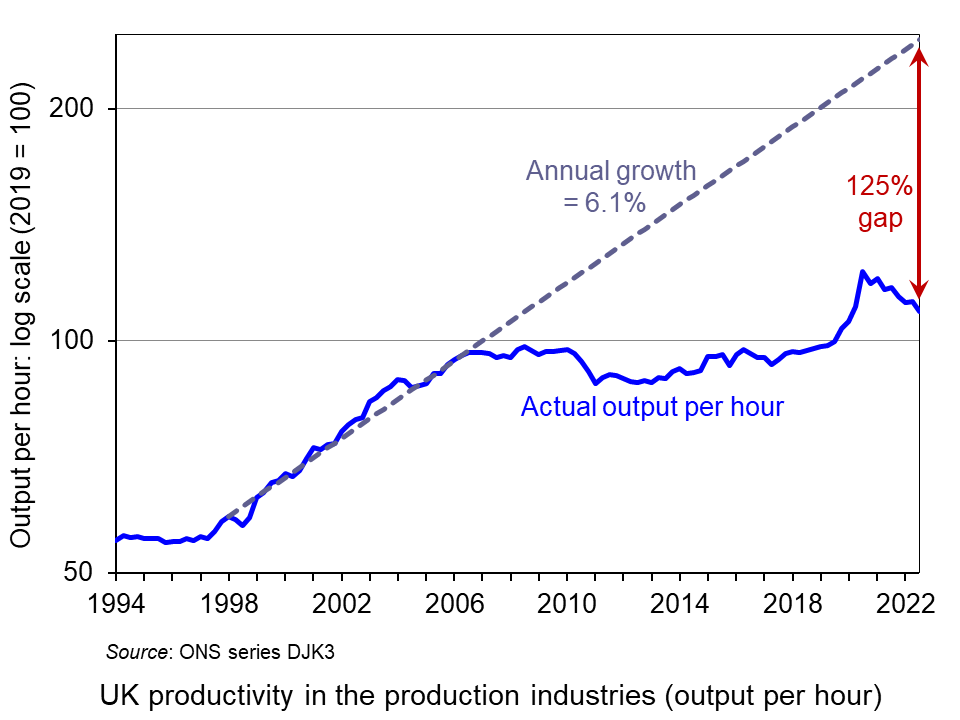 Since the financial crisis of 2007–8, the growth in UK productivity has been sluggish. This is illustrated in the chart, which looks at the production industries: i.e. it excludes services, where average productivity growth tends to be slower. (Click here for a PowerPoint of the chart.)
Prior to the crisis, from 1998 to 2007, UK productivity in the production industries grew at an annual rate of 6.1%. From 2007 to the start of the pandemic in 2020, the average annual productivity growth rate in these industries was a mere 0.5%.
It grew rapidly for a short time at the start of the pandemic, but this was because many businesses temporarily shut down or went to part-time working, and many of these temporary job cuts were low-wage/low productivity jobs. If you take services, the effect was even stronger as sectors such as hospitality, leisure and retail were particularly affected and labour productivity in these sectors tends to be low. As industries opened up and took on more workers, so average productivity fell back. In the four quarters to 2022 Q3 (the latest data available), productivity in the production industries fell by 6.8%.
If you project the average productivity growth rate from 1998 to 2007 of 6.1% forwards (see grey dashed line), then by 2022 Q3, output per hour in the production industries would have been 21/4 times (125%) higher than it actually was. This is a huge productivity gap.
 Productivity in the UK is lower than in many other competitor countries. According to the ONS, output per hour in the UK in 2021 was $59.14 in the UK. This compares with an average of $64.93 for the G7 countries, $66.75 in France, £68.30 in Germany, $74.84 in the USA, $84.46 in Norway and $128.21 in Ireland. It is lower, however, in Italy ($54.59), Canada ($53.97) and Japan ($47.28).
As we saw in the blog, The UK’s poor productivity record, low UK productivity is caused by a number of factors, not least the lack of investment in physical capital, both by private companies and in public infrastructure, and the lack of investment in training. Other factors include short-termist attitudes of both politicians and management and generally poor management practices. But one cause is the poor motivation of many workers and the feeling of being overworked. One solution to this is the four-day week.
Latest evidence on the four-day week
Results have just been released of a pilot programme involving 61 companies and non-profit organisations in the UK and nearly 3000 workers. They took part in a six-month trial of a four-day week, with no increase in hours on the days worked and no loss in pay for employees – in other words, 100% of the pay for 80% of the time. The trial was a success, with 91% of organisations planning to continue with the four-day week and a further 4% leaning towards doing so.
 The model adopted varied across companies, depending on what was seen as most suitable for them. Some gave everyone Friday off; others let staff choose which day to have off; others let staff work 80% of the hours on a flexible basis.
There was little difference in outcomes across different types of businesses. Compared with the same period last year, revenues rose by an average of 35%; sick days fell by two-thirds and 57% fewer staff left the firms. There were significant increases in well-being, with 39% saying they were less stressed, 40% that they were sleeping better; 75% that they had reduced levels of burnout and 54% that it was easier to achieve a good work–life balance. There were also positive environmental outcomes, with average commuting time falling by half an hour per week.
There is growing pressure around the world for employers to move to a four-day week and this pilot provides evidence that it significantly increases productivity and well-being.
Articles
- Results from world’s largest 4 day week trial bring good news for the future of work
4 Day Week Global, Charlotte Lockhart (21/2/23)
- Four-day week: ‘major breakthrough’ as most UK firms in trial extend changes
The Guardian, Heather Stewart (21/2/23)
- Senedd committee backs four-day working week trial in Wales
The Guardian, Steven Morris (24/1/23)
- ‘Major breakthrough’: Most firms say they’ll stick with a four-day working week after successful trial
Sky News, Alice Porter (21/2/23)
- Major four-day week trial shows most companies see massive staff mental health benefits and profit increase
Independent, Anna Wise (21/2/23)
- Four-day week: Which countries have embraced it and how’s it going so far?
euronews, Josephine Joly and Luke Hurst (23/2/23)
- Firms stick to four-day week after trial ends
BBC News, Simon Read, Lucy Hooker & Emma Simpson (21/2/23)
- The climate benefits of a four-day workweek
BBC Future Planet, Giada Ferraglioni and Sergio Colombo (21/2/23)
- Four-day working week: why UK businesses and workers will continue with new work pattern, plus pros and cons
National World, Rochelle Barrand (22/2/23)
- Most companies in UK four-day week trial to continue with flexible working
Financial Times, Daniel Thomas and Emma Jacobs (21/2/23)
- The pros and cons of a four-day working week
Financial Times, Editorial (13/2/23)
- Explaining the UK’s productivity slowdown: Views of leading economists
VoxEU, Ethan Ilzetzki (11/3/20)
- Why the promised fourth industrial revolution hasn’t happened yet
The Conversation, Richard Markoff and Ralf Seifert (27/2/23)
Questions
- What are the possible advantages of moving to a four-day week?
- What are the possible disadvantages of moving to a four-day week?
- What types of companies or organisations are (a) most likely, (b) least likely to gain from a four-day week?
- Why has the UK’s productivity growth been lower than that of many of its major competitors?
- Why, if you use a log scale on the vertical axis, is a constant rate of growth shown as a straight line? What would a constant rate of growth line look like if you used a normal arithmetical scale for the vertical axis?
- Find out what is meant by the ‘fourth industrial revolution’. Does this hold out the hope of significant productivity improvements in the near future? (See, for example, last link above.)