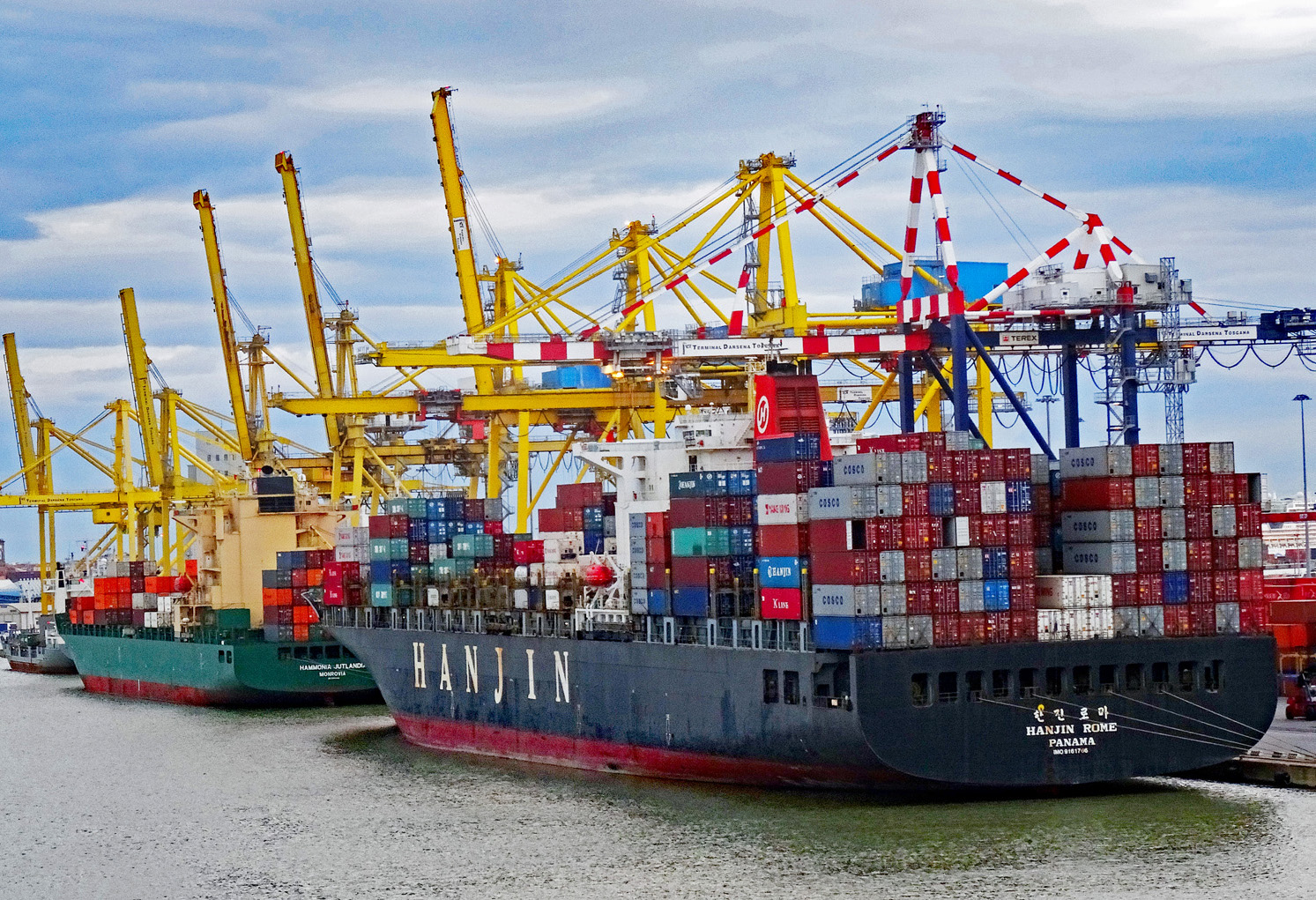
 Three recent reports (see links below) have suggested that US consumers and businesses pay most of the tariffs imposed by the second Trump administration. The percentage varies from around 86% to 96%. US customs revenue surged by approximately $200 billion in 2025, but this was a tax paid almost entirely by US consumers and businesses. Foreign suppliers largely maintained their (pre-tariff) prices. They took a hit in terms of reduced volumes rather than reduced pre-tariff prices.
The incidence of a tariff between consumers, domestic importers and overseas producers will depend on price elasticities of demand and supply. The following diagram shows a product where the importing country is large enough to have a degree of market power, which will normally be the case with the USA. The greater its buying power, the flatter will be its demand curve, showing that the foreign supplier will have little influence on the price. With no tariff, the equilibrium price paid by importers will be at point a, where demand equals supply. Q1 would be imported at a price of P1.
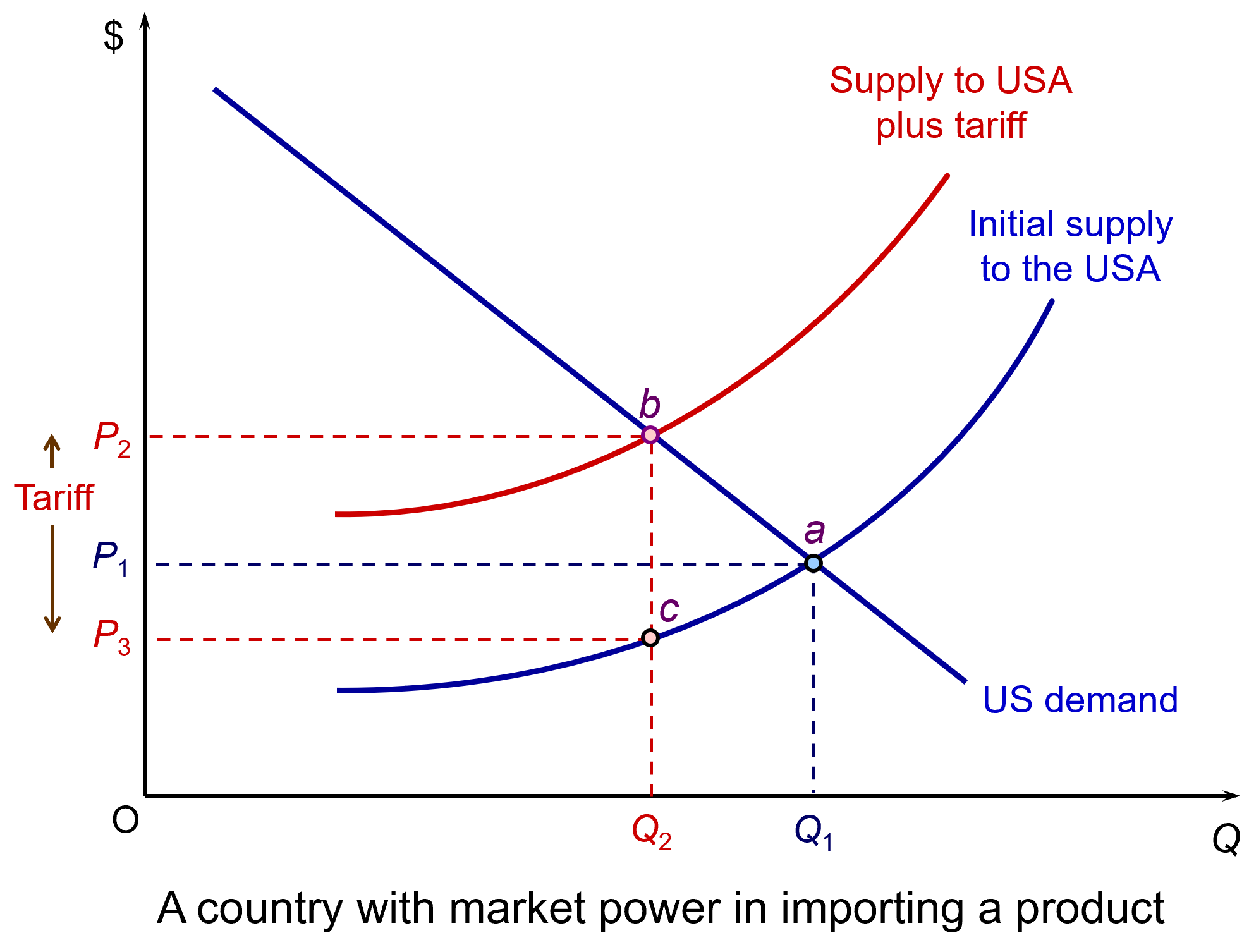 Imposition of a tariff will shift the supply curve upwards by the amount of the tariff. The new equilibrium price paid by importers will be at point b, where the new supply curve crosses the demand curve. Importers thus now pay a post-tariff price of P2: an effective rise in price of P2 minus P1. Foreign exporters receive P3, which is what they are paid by importers after the tariff has been paid.
The consumer price will be above P2 as that includes a mark-up by US businesses on top of the price they pay to import the product. Importers may bear some of the increase in price and not pass the full amount onto consumers, depending on competition and their ability to absorb cost increases.
President Trump argued that there would be very little rise in price from the tariffs and that overseas suppliers would bear the brunt of the tariffs. Indeed, recently he has argued that this must be the case as US inflation has been falling. In response, critics maintain that the rate of inflation would have fallen more without the tariffs and that current prices would be lower than they are. Also, if US importing firms or retailers bear some of the increased cost, even though this helps to dampen the price rise, their lower profits could damage investment and employment.

The Reports
The first report is from the New York Fed (one of the regional branches of the Federal Reserve Bank). It examines the effect of tariffs imposed in 2025, over three periods: (i) January to August, (ii) September to October, and (iii) November. In the first period, 94% of the tariffs were paid by US importers and 6% by foreign exports; in the second period, the figures were 92% and 8% and in the third period, 86% and 14%.
The second report is The Budget and Economic Outlook: 2026 to 2036 from the Congressional Budget Office. Box 2-1 notes that, as of November 2025, ‘the effective tariff rate was about 13 percentage points higher than the roughly 2 percent rate on imports in 2024’. Its analysis suggests that 95% of the tariffs will be borne by importers. Of these higher import prices, 30% will be borne by US businesses, largely through reduced profit margins, and 70% by consumers through higher prices. This will also allow many businesses which produce goods that compete with foreign imports to ‘increase their prices because of the decline in competition from abroad and the increased demand for tariff-free domestic goods’.
The third report is from the Kiel Insitut. In its Policy Brief, Americaʼs Own Goal: Who Pays the Tariffs?, it finds that US importers and consumers bear 96% of the cost of the 2025 tariffs, with foreign exporters absorbing only about 4%. It bases it findings on shipment-level data covering over 25 million transactions valued at nearly $4 trillion. This also shows that exports to the USA declined as foreign exporters preferred to reduce volumes rather than absorbing the tariffs.
The tariffs raised some $200 billion in 2025, around 3.8% of Federal tax receipts. But, as we have seen, this was paid largely by US consumers and business. It goes some way to offsetting the annual cut in tax revenues of around $450 to $520 billion per year from the tax cuts, largely to the better off, in Trump’s ‘One Big Beautiful Bill’.
Reports
Aricles
- NY Fed report says Americans pay for almost all of Trump’s tariffs
Reuters, Michael S. Derby (12/2/25)
- A year in, it’s official: Americans, not foreigners, are paying for Trump’s tariffs
CNN, Allison Morrow (12/2/26)
- Costs from Trump’s tariffs paid mainly by US firms and consumers, NY Fed says
BBC News, Kali Hays (13/2/26)
- Consumers and businesses paid nearly 90% of Trump tariffs in 2025, new analysis found
CBS News, Megan Cerullo (12/2/26)
- New Studies Challenge Who Really Pays for Tariffs
Investopedia, Diccon Hyatt (12/2/26)
- Trump Tariffs: Tracking the Economic Impact of the Trump Trade War
Tax Foundation, Erica York and Alex Durante (6/2/26)
- Who Is Paying the Trump Tariffs?
Paul Krugman (15/2/26)
Questions
- Summarise the findings of the three reports (but just Box 2-1 of the Congressional Budget Office one).
- Assess the argument that protectionism leads to inefficiency in the protected industries.
- Under what circumstances would exporters to the USA absorb a high percentage of tariff increases? Consider questions of elasticity.
- Can tariffs ever be justified on efficiency grounds?
- Can tariffs be justified as a bargaining ploy? Can they be used as a means of achieving freer and fairer trade?
- Read the blog, President Reagan on tariffs and summarise President Reagan’s arguments. Are they still relevant today?
- Consider the arguments for and against the EU raising tariffs on US goods.
 In a 1987 address to the US nation, Republican President Ronald Reagan discussed the question of tariffs. His message was clear.
You see, at first, when someone says, ‘Let’s impose tariffs on foreign imports,’ it looks like they’re doing the patriotic thing by protecting American products and jobs. And sometimes for a short while it works – but only for a short time. What eventually occurs is:
First, homegrown industries start relying on government protection in the form of high tariffs. They stop competing and stop making the innovative management and technological changes they need to succeed in world markets.
And then, while all this is going on, something even worse occurs: high tariffs inevitably lead to retaliation by foreign countries and the triggering of fierce trade wars. The result is more and more tariffs, higher and higher trade barriers, and less and less competition. So, soon, because of the prices made artificially high by tariffs that subsidise inefficiency and poor management, people stop buying.
Then the worst happens: markets shrink and collapse; businesses and industries shut down; and millions of people lose their jobs.
The memory of all this occurring back in the thirties made me determined when I came to Washington to spare the American people the protectionist legislation that destroys prosperity.
Now, it hasn’t always been easy. There are those in this Congress, just as there were back in the ’30s, who want to go for the quick political advantage, who will risk America’s prosperity for the sake of a short-term appeal to some special interest group, who forget that more than five million American jobs are directly tied to the foreign export business and additional millions are tied to imports.
For those of us who lived through the Great Depression, the memory of the suffering it caused is deep and searing. And today, many economic analysts and historians argue that high tariff legislation, passed back in that period called the Smoot-Hawley Tariff, greatly deepened the Depression and prevented economic recovery.
 He returned to the topic of tariffs in November 1988, when he reflected on the benefits of free and fair trade and the dangers of protectionism.
Here in America, as we reflect on the many things we have to be grateful for, we should take a moment to recognize that one of the key factors behind our nation’s great prosperity is the open trade policy that allows the American people to freely exchange goods and services with free people around the world. The freedom to trade is not a new issue for America.
In 1776 our Founding Fathers signed the Declaration of Independence, charging the British with a number of offenses, among them, and I quote, ‘cutting off our trade with all parts of the world’.
And that same year, a Scottish economist named Adam Smith launched another revolution with a book entitled ‘The Wealth of Nations’, which exposed for all time the folly of protectionism. Over the past 200 years, not only has the argument against tariffs and trade barriers won nearly universal agreement among economists but it has also proven itself in the real world, where we have seen free-trading nations prosper while protectionist countries fall behind.
America’s most recent experiment with protectionism was a disaster for the working men and women of this country. When Congress passed the Smoot-Hawley tariff in 1930, we were told that it would protect America from foreign competition and save jobs in this country – the same line we hear today. The actual result was the Great Depression, the worst economic catastrophe in our history; one out of four Americans were thrown out of work. Two years later, when I cast my first ballot for President, I voted for Franklin Delano Roosevelt, who opposed protectionism and called for the repeal of that disastrous tariff.
Ever since that time, the American people have stayed true to our heritage by rejecting the siren song of protectionism. In recent years, the trade deficit led some misguided politicians to call for protectionism, warning that otherwise we would lose jobs. But they were wrong again. In fact, the United States not only didn’t lose jobs, we created more jobs than all the countries of Western Europe, Canada, and Japan combined. The record is clear that when America’s total trade has increased, American jobs have also increased. And when our total trade has declined, so have the number of jobs.
Part of the difficulty in accepting the good news about trade is in our words. We too often talk about trade while using the vocabulary of war. In war, for one side to win, the other must lose. But commerce is not warfare. Trade is an economic alliance that benefits both countries. There are no losers, only winners. And trade helps strengthen the free world.
Yet today protectionism is being used by some American politicians as a cheap form of nationalism, a fig leaf for those unwilling to maintain America’s military strength and who lack the resolve to stand up to real enemies – countries that would use violence against us or our allies. Our peaceful trading partners are not our enemies; they are our allies.
We should beware of the demagogs who are ready to declare a trade war against our friends – weakening our economy, our national security, and the entire free world – all while cynically waving the American flag. The expansion of the international economy is not a foreign invasion; it is an American triumph, one we worked hard to achieve, and something central to our vision of a peaceful and prosperous world of freedom.
After the Second World War, America led the way to dismantle trade barriers and create a world trading system that set the stage for decades of unparalleled economic growth. And in one week, when important multilateral trade talks are held in Montreal, we will be in the forefront of efforts to improve this system. We want to open more markets for our products, to see to it that all nations play by the rules, and to seek improvement in such areas as dispute resolution and agriculture. We also want to bring the benefits of free trade to new areas, including services, investment, and the protection of intellectual property. Our negotiators will be working hard for all of us.
Yes, back in 1776, our Founding Fathers believed that free trade was worth fighting for. And we can celebrate their victory because today trade is at the core of the alliance that secure the peace and guarantee our freedom; it is the source of our prosperity and the path to an even brighter future for America.
The questions below address whether these radio addresses by President Reagan are relevant in today’s context of the imposition of tariffs by President Trump.
Videos of Radio Addresses
Articles and postings
Questions
- Summarise Ronald Reagan’s arguments.
- How would Donald Trump reply to these arguments?
- Can tariffs ever be justified on efficiency grounds?
- Can tariffs be justified as a bargaining ploy? Can they be used as a means of achieving freer and fairer trade?
- Find out why the Smoot-Hawley Tariff Act was introduced in 1930 and what were its consequences.
- How does the World Trade Organization seek to promote freer and fairer trade? How does it resolve trade disputes?
