 As Leicester City celebrated promotion to the English Premier League (EPL) last Saturday (5th April) it also became the first club in England that will probably have to pay a new Financial Fair Play (FFP) Tax. This tax is not paid to the government, but is effectively a fine imposed by the English Football League (EFL) on teams who break FFP regulations.
On Tuesday 8th April 2014 representatives from all the Championship clubs met with officials from the English Football League (EFL) in order to discuss the implementation of FFP. It had been reported in February that a number of teams were unhappy about the implementation of the FFP rules and were threatening to take legal action against the league. Unsurprisingly, one of these clubs was rumoured to be Leicester City.
In April 2012, 21 out of the 24 clubs in the Championship agreed on a set of new FFP regulations. These rules place a limit on the size of any financial losses that a team can incur in a given season before punishments, such as a tax, are imposed on them. The English Football League (EFL) stated that the aim of the FFP regulations was to
reduce the levels of losses being incurred at some clubs and, over time, establish a league of financially self-sustaining professional football clubs.
Under the agreed set of rules, all teams in the Championship have to provide a set of annual accounts by 1st December for the previous season: i.e. the first reporting period was in December 2012, when clubs had to submit accounts for 2011–12. No penalties were applied for the first two reporting periods as teams were given time to adjust to the new FFP framework. However sanctions come into effect for the 2013–14 season.
For the 2013–14 season the FFP rules set a threshold of £3 million as the size of the pre-tax financial losses that a team can incur before having to face any sanctions. If a team incurs a pre-tax loss of greater than £3 million but less than £8 million then punishments from the league can be avoided if the team’s owner invests enough money into the club so that the loss is effectively limited to £3 million: i.e. if the club reports a loss of £7 million then the owner would have to invest a minimum of £4 million of his/her own cash to avoid any sanctions.
The club is not allowed to finance the loss by borrowing or adding to the level of the team’s debt. If the owner cannot/refuses to make the investment or the pre-tax loss is greater than £8 million then the team is subject to one of two possible sanctions depending on whether it is promoted or not.
First, if the club is not promoted to the EPL, then it is subject to a transfer ban from the 1st January 2015: i.e. it will be unable to sign new players at the start of the transfer window. The ban remains in place until the club is able to submit financial information that clearly shows that it is meeting the FFP guidelines.
Second, if the club is promoted to the EPL then instead of a transfer embargo it has to pay the FFP Tax. The amount of tax the firm has to pay to the league depends on the size of the financial loss it has incurred. The larger the loss, the greater the tax it has to pay. The marginal rate of tax also increases with the size of the loss.
 In order to help illustrate how the tax works it is useful to take a simple example. Leicester city reported a pre-tax loss of £34 million in 2012–13. If the club managed to reduce its pre-tax losses to £15 million in 2013–14 then, given its promotion, it would be subject to the tax. If we also assume that the owners are willing and able to invest £5 million of their own money into the club then the rate of tax the team would have to pay is based on the size of its losses over £8 million in the following way:
1% on losses between £8,000,001 and £8,100,000
20% on losses between £8,100,001 and £8,500,000
40% on losses between £8,500,001 and £9,000,000
60% on losses between £9,000,001 and £13,000,000
80% on losses between £13,000,001 and £18,000,000
100% on any losses over £18,000,000
Therefore with a loss of £15 million the FFP tax that Leicester would have to pay is £4,281,000 (£1,000 + £80,000 + £200,000 + £2.4million + £1.6million). If the club instead made a pre-tax financial loss of £30,000 in the 2013–14 season, then the FFP tax it would have to pay increases to £18,681,000 (£1,000 + £80,000 + £200,000 + £2.4million + £4 million + £12 million).
It was originally agreed that the revenue generated from the FFP tax would be shared equally by the teams in the Championship who managed to meet the FFP regulations. However the EPL objected to this provision and the money will now be donated to charity by the EFL.
Based on the financial results reported in 2012–13, about half the clubs in the Championship would be subject to either a transfer ban or FFP tax in January 2015. It was reported in the press in February that a number of clubs had instructed the solicitors, Brabners, to write to the EFL threatening legal action.
One particular concern was the ability of the clubs in the Championship subject to FFP rules to compete with teams relegated from the EPL. When the original FFP regulations were agreed, the teams relegated from the EPL received parachute payments of £48 million over a 4-year period. Following the record-breaking TV deal to broadcast EPL games, the payments were increased to £59 million for the 2013–14 season.
Following the meeting on Tuesday 8th April a spokesman from the EFL said
Considerable progress was achieved on potential improvements to the current regulations following a constructive debate between the clubs.
It will be interesting to see what changes are finally agreed and the implications they will have for the competitive balance of the league.
Articles
Why Championship clubs are crying foul over financial fair play The Guardian (26/2/14)
Wage bills result in big losses at Leicester City and Nottingham Forest The Guardian (5/3/14)
Financial fair play: Championship clubs make progress on talks BBC Sport (10/4/14)
Financial Fair Play in the Football League The Football League (25/4/12)
Loss leaders – Financial Fair Play Rules When Saturday Comes (25/4/12)
Richard Scudamore: financial fair play rules unsustainable in present form The Guardian (14/3/14)
Questions
- To what extent do you think that the implementation of the FFP regulations will either increase or decrease the competitive balance of the Championship?
- An article in the magazine ‘When Saturday Comes’ made the following statement “Last season’s champions, QPR, lost £25.4m and would have been handed a ‘tax’ of at least £17.4m based on 2013-14 thresholds”. Explain why this statement is not accurate. What mistake has the author made when trying to calculate the level of FFP tax payable?
- Nottingham Forest reported pre-tax financial losses of £17 million in 2012-13. If they made the same losses in 2013-14 and were promoted to the EPL, calculate how much FFP tax they would have to pay under current regulations.
- To what extent do you think that the money generated by the FFP tax should be equally distributed between the teams in the Championship who meet the FFP regulations.
- Why do you think team owners might need regulations to restrict the level of losses that they can make. Why might sport be different from other sectors?
 In his Budget on March 19, the Chancellor of the Exchequer, George Osborne, announced fundamental changes to the way people access their pensions. Previously, many people with pension savings were forced to buy an annuity. These pay a set amount of income per month from retirement for the remainder of a person’s life.
But, with annuity rates (along with other interest rates) being at historically low levels, many pensioners have struggled to make ends meet. Even those whose pension pots did not require them to buy an annuity were limited in the amount they could withdraw each year unless they had other guaranteed income of over £20,000.
Now pensioners will no longer be required to buy an annuity and they will have much greater flexibility in accessing their pensions. As the Treasury website states:
This means that people can choose how they access their defined contribution pension savings; for example they could take all their pension savings as a lump sum, draw them down over time, or buy an annuity.
While many have greeted the news as a liberation of the pensions market, there is also the worry that this has created a moral hazard.  When people retire, will they be tempted to blow their savings on foreign travel, a new car or other luxuries? And then, when their pension pot has dwindled and their health is failing, will they then be forced to rely on the state to fund their care?
But even if pensioners resist the urge to go on an immediate spending spree, there are still large risks in giving people the freedom to spend their pension savings as they choose. As the Scotsman article below states:
The risks are all too obvious. Behaviour will change. People who no longer have to buy an annuity will not do so but will then be left with a pile of cash. What to do with it? Spend it? Invest it? There are many new risky choices. But the biggest of all can be summed up in one fact: when we retire our life expectancy continues to grow. For every day we live after 65 it increases by six and a half hours. That’s right – an extra two-and-a-half years every decade.
The glory of an annuity is it pays you an income for every year you live – no matter how long. The problem with cash is that it runs out. Already the respected Institute for Fiscal Studies (IFS) has said that the reform ‘depends on highly uncertain behavioural assumptions about when people take the money’. And that ‘there is a market failure here. There will be losers from this policy’.
We do not have perfect knowledge about how long we will live or even how long we can be expected to live given our circumstances. Many people are likely to suffer from a form of myopia that makes them blind to the future: “We’re likely to be dead before the money has run out”; or “Let’s enjoy ourselves now while we still can”; or “We’ll worry about the future when it comes”.
The point is that there are various market failings in the market for pensions and savings. Will the decisions of the Chancellor have made them better or worse?
Articles
Pension shakeup in budget leaves £14bn annuities industry reeling The Guardian, Patrick Collinson (20/3/14)
Chancellor vows to scrap compulsory annuities in pensions overhaul The Guardian, Patrick Collinson and Harriet Meyer (19/3/14)
Labour backs principle of George Osborne’s pension shakeup The Guardian, Rowena Mason (23/3/14)
Osborne’s pensions overhaul may mean there is little left for future rainy days The Guardian, Phillip Inman (24/3/14)
Let’s celebrate the Chancellor’s bravery on pensions – now perhaps the Government can tackle other mighty vested interests Independent on Sunday, Mary Dejevsky (23/3/14)
A vote-buying Budget The Scotsman, John McTernan (21/3/14)
L&G warns on mis-selling risks of pension changes The Telegraph, Alistair Osborne (26/3/14)
Budget 2014: Pension firms stabilise after £5 billion sell off Interactive Investor, Ceri Jones (20/3/14)
Budget publications
Budget 2014: pensions and saving policies Institute for Fiscal Studies, Carl Emmerson (20/3/14)
Budget 2014: documents HM Treasury (March 2014)
Freedom and choice in pensions HM Treasury (March 2014)
Questions
- What market failures are there in the market for pensions?
- To what extent will the new measures help to tackle the existing market failures in the pension industry?
- Explain the concept of moral hazard. To what extent will the new pension arrangements create a moral hazard?
- Who will be the losers from the new arrangements?
- Assume that you have a choice of how much to pay into a pension scheme. What is likely to determine how much you will choose to pay?
 Footballers in the English Premier League are some of the most highly paid workers in the world. With unique talents and skills and hence a limited supply of labour, together with an insatiable appetite from the British public for football, we would expect to see high wages and a market ripe for investment, with high returns on offer. But, is this case?
The article below is by Linda Yueh, the Chief Business Correspondent for BBC News, and she has looked into the football, asking why on earth buy a football club? Despite the success of the English Premier League in drawing fans, TV and commercial revenues, many teams find it difficult to break even and investing in a team is unlikely to yield much of a return (if any!). Yet, we still see successful businesspeople, especially from abroad, purchasing English football teams.
Many club owners have hugely profitable ventures in other markets and historically only invest their money when they see an opportunity for a high return. But, not in the case of football. A return is unlikely and yet they still invest. So, with positive returns unlikely, what is it about this market that attracts investors? The article by Linda Yueh considers this question.
Article
Why on earth buy a football club? BBC News, Linda Yueh (27/2/14)
Report
Annual Review of Football Finance – Highlights Deloitte, Sports Business Group June 2013
Questions
- How can the returns to investment be measured?
- How can a company’s operating profit be calculated?
- Using a labour market diagram, explain why footballers are paid such a high wage.
- Is it monetary or non-monetary factors that seem to explain why businessmen invest in football clubs?
- Why are English football clubs typically unprofitable? Should they be?
- Which factors can explain the growing financial inequality between clubs in the Premier League and in the divisions below? Is there an argument for government involvement to regulate football?
 In the blog Effects of raising the minimum
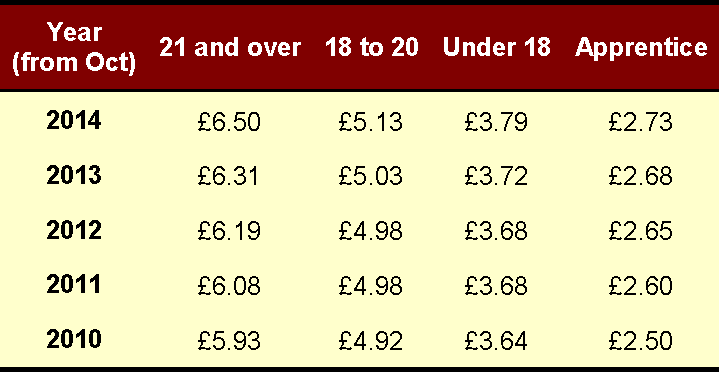
wage, the policy of an above-inflation rise in the minimum wage was discussed, as this had been advocated by political leaders. Over the past 5 years, the minimum wage has fallen in real terms, but from October 2014, the national minimum wage will increase 19p per hour and this rise will be the first time since 2008 when the increase will be higher than inflation.
The National Minimum Wage is a rate applied to most workers in the UK and is their minimum hourly entitlement. For adults over the age of 21, it will be increased by just over 3% to £6.50. Rises will also occur for 18-20 year olds, though their increase will be lower at 10p and will take the hourly wage to £5.13 an hour, representing a 2% rise. 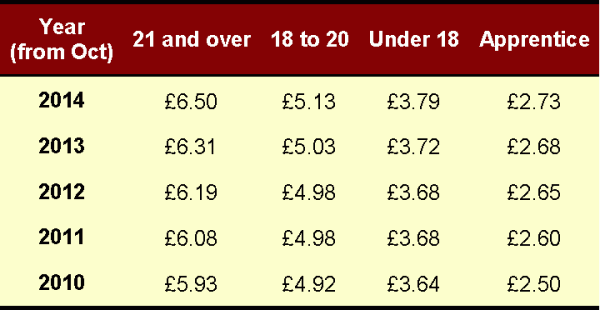 Those aged 16 and 17 will also see a 2% rise, taking their wage up by 7p to £3.79. With inflation currently at 1.9% (as measured by the CPI), these rises outstrip inflation, representing a real increase in the minimum wage. Undoubtedly this is good news for workers receiving the minimum wage, and it is thought that millions of workers will benefit.
Vince Cable said:
The recommendations I have accepted today mean that low-paid workers will enjoy the biggest cash increase in their take home pay since 2008…This will benefit over one million workers on national minimum wage and marks the start of a welcome new phase in minimum wage policy.
While this rise has been praised, there are still suggestions that this minimum wage is too low and does not represent a ‘living wage’. The General Secretary of Unison said:
Across the country people are struggling to make ends meet. The sooner we move to a Living Wage the better. The real winners today will again be payday loan sharks who prey on working people, unable to bridge the financial gap between what they earn and what their families need to survive.
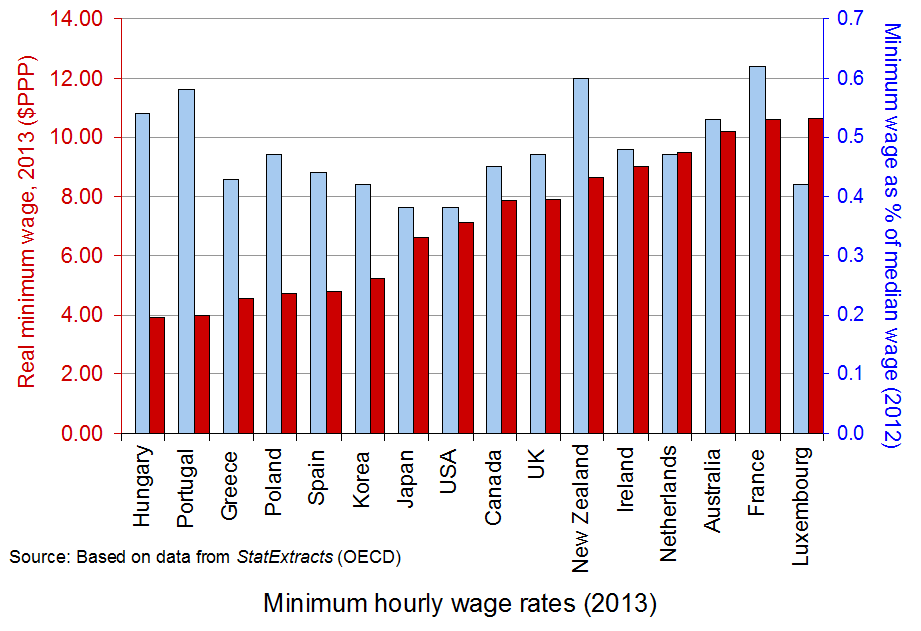
(Click here for a PowerPoint of the above chart.)
The Chancellor eventually wants to increase the minimum wage to £7 per hour, but there will undoubtedly be an impact on businesses of such a rise. Is it also possible that with the national minimum wage being pushed up, unemployment may become a problem once more?
Market wages are determined by the interaction of the demand and supply of labour and when they are in equilibrium, the only unemployment in the economy will be equilibrium unemployment, namely frictional or structural. However, when the wage rate is forced above the equilibrium wage rate, disequilibrium unemployment may develop. At a wage above the equilibrium the supply of labour will exceed the demand for labour and the excess is unemployment.
By increasing the national minimum wage, firms will face higher labour costs and this may discourage them from taking on new workers, but may also force them into laying off existing workers. The impact of the minimum wage on unemployment doesn’t seem to be as pronounced as labour market models suggest, so perhaps the increase in the minimum wage will help the lowest paid families and we won’t observe any adverse effect on businesses and employment. The following articles consider this story.
National minimum wage to rise to £6.50 The Guardian, Rowena Mason (12/3/14)
Minimum wage up to £6.50 an hour BBC News (12/3/14)
Minium wage to increase by 3% to £6.50 an hour Independent, Maria Tadeo (12/3/14)
Minimum wage rise confirmed Fresh Business Thinking, Daniel Hunter (12/3/14)
Ministers approve minimum wage rise London Evening Standard (12/3/14)
Government to accept proposed 3% minimum wage rise The Guardian, Rowena Mason (4/3/14)
Londoners do not believe minimum wage is enough to live on in the capital The Guardian, Press Association (9/3/14)
Minimum wage: The Low Pay Commission backs a 3% increase BBC News (26/2/14)
Questions
- Using a diagram, illustrate the impact of raising the national minimum wage in an otherwise perfectly competitive labour market.
- How does your answer to question 1 change, if the market is now a monopsony?
- To what extent is elasticity relevant when analysing the effects of the national minimum wage on unemployment?
- How might an increase in the national minimum wage affect public finances?
- Why is an above-inflation increase in the national minimum wage so important?
- What is meant by a Living Wage?
- What do you think the impact on business and the macroeconomy would be if the minimum wage were raised to a ‘Living Wage’?
Many people are attracted to work in the private sector, with expectations of greater opportunities for promotion, more variation in work and higher salaries. However, according to the Office for National Statistics, it may be that the oft-talked-of pay differential is actually in the opposite direction. Data from the ONS suggests that public sector workers are paid 14.5% more on average than those working in the private sector.
As is the case with the price of a good, the price of labour (that is, the wage rate) is determined by the forces of demand and supply. Many factors influence the wages that individuals are paid and traditional theory leads us to expect higher wages in sectors where there are many firms competing for labour. With the government acting as a monopsony employer, it has the power to force down wages below what we would expect to see in a perfectly competitive labour market. However, the ONS data suggests the opposite. What factors can explain this wage differential?
Jobs in the public sector, on average, require a higher degree of skills. There tend to be entry qualifications, such as possessing a university degree. While this is the case for many private-sector jobs as well, on average it is a greater requirement in the public sector. The skills required therefore help to push up the wages that public-sector workers can demand. Another explanation could be the size of public-sector employers, which allows them to offer higher wages. When the skills, location, job specifications etc. were taken into account, the 14.5% average hourly earnings differential declined to between just 2.2% and 3.1%, still in favour of public-sector workers. It then reversed to give private-sector workers the pay edge, once the size of the employer was taken out.
Further analysis of the data also showed that, while it may pay to be in the public sector when you’re starting out on your career, it pays to be in the private sector as you move up the career ladder. Workers in the bottom 5% of earners will do better in the public sector, while those in the top 5% of earners benefit from private-sector employment. The ONS said:
Looking at the top 5%, in the public sector earnings are greater than £31.49 per hour, while in the private sector, the top 5% earn more than £33.63 per hour… The top 1% of earners in the private sector, at more than £60.21 per hour, earns considerably more than the top 1% of earners in the public sector, at more than £49.65 per hour.
The data from the ONS thus suggest a reversal in the trend of average public-sector pay being higher than private sector pay, once all the relevant factors are taken into account.
This will naturally add to debates about living standards, which are likely to take on a stronger political slant as the next election approaches. It is obviously partly down to the public-sector pay freeze that we saw in 2010 and also to a reversal, at least in part, of the previous trend from 2008, where public-sector pay 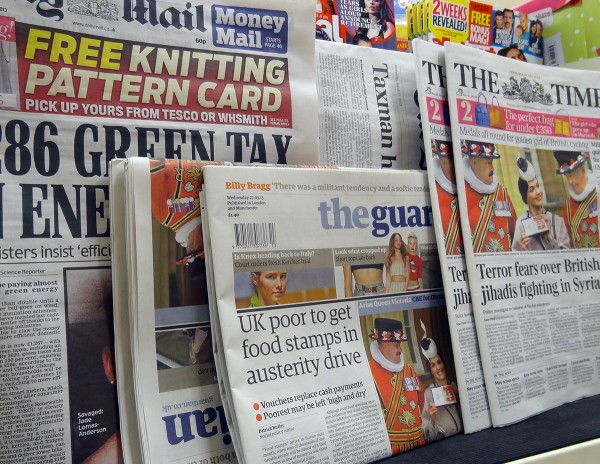 had been growing faster than private-sector pay. However, depending on the paper you read or the person you listen to, they will offer very different views as to who gets paid more. All you need to do in this case is look at the titles of the newspaper articles written by the Independent and The Telegraph! Whatever the explanation, these new data provide a wealth of information about relative prospects for pay for everyone.
Data
Public and Private Sector Earnings Office for National Statistics (March 2014)
Annual Survey of Hours and Earnings, 2013 Provisional Results Office for National Statistics (December 2013)
Articles
Austerity bites as private sector pay rises above the public sector for the first time since 2010 Independent, Ben Chu (10/3/14)
Public sector workers still better paid despite the cuts The Telegraph, John Bingham (10/3/14)
Public sector hourly pay outstrips private sector pay BBC News (10/3/14)
Public sector workers are biggest losers in UK’s post-recession earnings squeeze The Guardian, Larry Elliott (11/3/14)
New figures go against right-wing claims that public sector workers are grossly overpaid Independent, Ben Chu (10/3/14)
Public sector pay sees biggest shrink on 2010, figures suggest LocalGov, Thomas Bridge (11/3/14)
Public sector staff £2.12 an hour better off The Scotsman, David Maddox (11/3/14)
Questions
- Illustrate the way in which wages are determined in a perfectly competitive labour market.
- Why does monopsony power tend to push wages down?
- Why does working for a large company suggest that you will earn a higher wage on average?
- Using the concept of marginal revenue product of labour, explain the way in which higher skills help to push up wages.
- How significant are public-sector pay freezes in explaining the differential between public- and private-sector pay?
- Why is there a difference between the bottom and top 5% of earners? How does this impact on whether it is more profitable to work in the public or private sector?