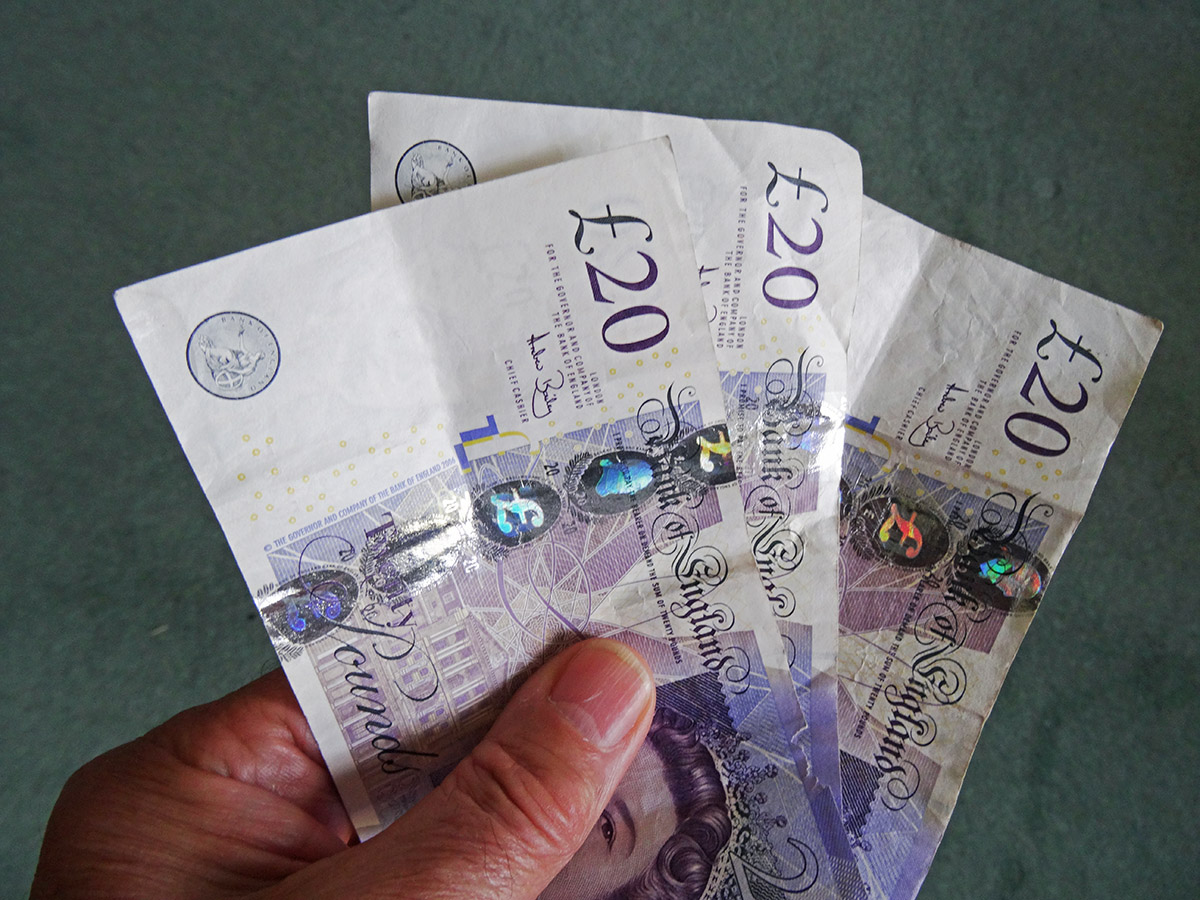
 Officials from Rugby Union’s Aviva Premiership recently announced that the salary cap used by the league would increase from £4.76 million to £5.1 million per team for the 2015-16 season. It is not the only professional sports league to use this type of regulation. The NFL currently has a salary cap of $133 million/team while in the NBA it is set at $63 million/team. What is the rationale for placing restrictions on the amount an organisation can pay its employees? How do these caps work in practice?
A salary cap is a regulation that limits the amount that an organisation can pay its employees. Sanctions are usually imposed if the ceiling is broken.
It is hard to imagine this type of policy being introduced in most industries. For example there may have been a number of calls for much greater regulation of the big six firms in the energy market with the Labour party suggesting that prices should be frozen for 20 months. However in amongst all the calls for more intervention, nobody has suggested that limits should be placed on the wages that these firms pay their staff.
One example where the authorities are thinking of intervening on pay is the proposal by the European Union to introduce a cap on the size of bonuses that can be paid by firms in the banking industry. However this is more of a constraint on the method of remuneration rather than an absolute limit on the level of pay. If the policy was introduced there would be nothing preventing firms from increasing basic salaries in order to make up for any shortfall caused by the reduction in bonuses.
There is one sector of the economy where salary caps are widely used – professional team sports. There are a number of different ways they have been implemented. For example the Football Association once placed a limit on the amount that a club could pay an individual player. This was originally set at £4/week in 1901 and increased to £20/week before it was finally abolished in 1961.
In recent times it has been far more common for salary caps in professional sports leagues to place limits on the size of a team’s total wage bill rather than the amount that can be paid to an individual player. This is the case in the Aviva Premiership, the NFL and the NBA. Perhaps it would be more accurate to refer to these policies as a cap on payrolls rather than on salaries.
The Aviva Premiership gives the following 4 reasons for having the payroll cap that it first introduced in 1999:
|
|
| • |
To ensure the financial viability of the clubs; |
| • |
To ensure a competitive Aviva Premiership Rugby competition; |
| • |
To control inflationary pressures on clubs’ costs; |
| • |
To provide a level playing field for the clubs. |
It is claimed that the policy has helped the league to achieve these objectives as (a) more clubs are now breaking even and (b) compared with other rugby competitions it has the greatest number of games that finish with less than one score between the teams.
There are a number of different ways that a payroll cap can be implemented. With an absolute payroll scheme all the teams in the league, no matter what their size, face the same constraint. This is the policy adopted by the NFL, NBA and the Aviva Premiership. An alternative is to implement a percentage payroll cap. Examples of these can be found in League 1 and League 2 of the English Football League. League 1 teams can spend up to 60% of their turnover on wages while League 2 teams can spend up to 55% of their turnover on wages. Obviously this means that well supported clubs with a larger turnover can spend more on players’ wages than less well supported clubs with a smaller turnover.
Another way that payroll caps differ is whether they are ‘hard’ caps or ‘soft’ caps. With a ‘hard’ cap there are no exceptions to the scheme. All the teams’ payrolls must remain within the same limit set by the league officials. With a ‘soft’ cap the authorities identify some exceptions that enable clubs to exceed the limit. The payroll cap used in rugby union is an example of a soft cap and works in the following way.
There are a number of elements to the scheme:
|
|
| • |
The senior salary cap; |
| • |
Excluded players; |
| • |
The academy credits. |
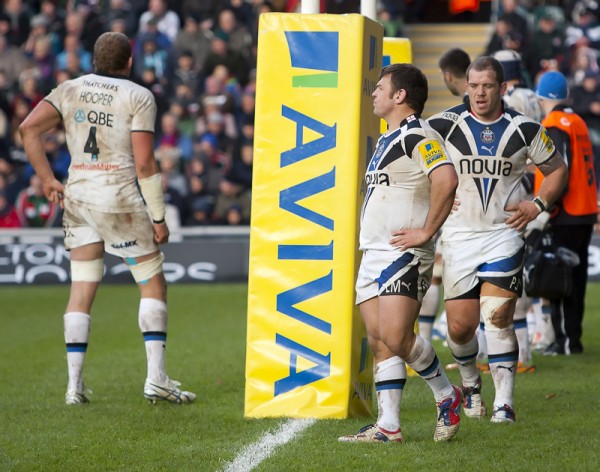 The senior salary cap is the major part of the regulation and the Aviva Premiership announced that this would increase from £4.76 million per team in the current season to £5.1 million per team for 2015-16. The Academy credits enable teams to exceed this £5.1 million limit if they train and develop younger players. The teams have to prove that they have young players that meet the following criteria:
|
|
| • |
They are under the age of 24 before the season started; |
| • |
They joined the youth academy before their eighteenth birthday; |
| • |
They earn more than £30,000 per year. |
For a player who meets these conditions it is only their salary in excess of £30,000/year that is considered. For example if a young player was paid £50,000/year then only £20,000 of his wages would count towards the team’s payroll cap. The first £30,000 would not count. The Aviva Premiership recently announced that a home grown player credit would replace the academy credits. Under the new scheme the upper age limit will be removed and clubs can claim up to £400,000 in allowances. This means that teams could spend up to £5.5 million a year on wages if they train and develop younger players.
However other exceptions means that teams can exceed even this figure. The payroll cap arrangements allow teams to identify one player whose wages are not included when the payroll cap is calculated. In order to be nominated the exempted player has to meet certain criteria. In the 2015-16 season teams will be allowed to have two excluded players.
Sir Iain McGeechan has suggested that these changes will increase the effective salary cap to £7 million/year with some star players earning £1 million/season. However this would still be below the level of the basic salary cap in the French Rugby Union Super 14 League which is €10 million per season (approximately £8.5 million)
Premiership salary cap will leave small clubs playing catch-up The Telegraph (20/9/14)
Bath line up move for Australian Will Genia as new salary cap regulations come into effectThe Telegraph (15/9/14)
The salary cap in Rugby Union Law in Sport (15/4/14)
Barwell blasts salary cap ‘cheats’ ESPN (1/3/13)
Salary Cap changes confirmed Premiership Rugby (17/9/14)
What is meant by a salary cap in Sport and would this ever be used in English football? In Brief (accessed on 22/9/14)
Questions
- Draw a diagram to illustrate the impact of a salary cap on a perfectly competitive market and explain your answer.
- Which teams in the Aviva Premiership would be in favour of the increase in the salary cap and which teams would be opposed? Explain your answer.
- Do you think that an absolute or percentage salary cap would be more effective at maintaining competitive balance in a league? Which teams would be more in favour of an absolute salary cap?
- Why do think some leagues have introduced a ‘soft’ rather than a ‘hard’ salary caps?
- To what extent do you think that salary/payroll caps are consistent with European single market principles about the free movement of people?
- Officials from the Aviva Premiership provide the clubs with a long list of payments which must be counted as part of a player’s salary. These include holiday costs, school fees, payment for off-field activities on behalf of the club, payments in kind and signing on fees. Why do you think that the authorities provide such a large list?
- Find out the criteria that must be met in order for a player to be exempted from the team’s payroll calculations. Provide some reasons why you think these criteria were used.
 The instability of the economy was clearly demonstrated by the events of the late 2000s. Economists have devoted considerable energies to understanding the determinants of the business cycle. Increasing attention is focused on the role that credit cycles play in contributing to or exacerbating cycles. Therefore, data on lending by banks is followed keenly by policymakers who wish to avoid the repeat of the pace of growth in credit seen in the period preceding the financial crisis. Interestingly, the latest data from the Bank of England show that lending by financial institutions to households (net of repayments) rose in July to its highest level since November 2009.
The idea of credit cycles is not new. But, the financial crisis of the late 2000s has helped to reignite analysis and interest. Many economists have revisited the work of Hyman Minsky (1919–1996), an American economist, who argued that financial cycles are an inherent part of the economic cycle and contribute to fluctuations in real GDP. Notably, he argued that credit extended to households and businesses is pro-cyclical so that flows of credit extended by banks are larger when the growth of the economy’s output is stronger. Since credit flows are dependent on the phase of the business cycle, they are said to be endogenous to the path of output. The key point here is that there is an inherent mechanism within the economy which is potentially destabilising.
Banks, it is argued, may use the growth of the economy’s output as an indicator of the riskiness of its lending. Households and businesses may undertake a similar assessment. After a period of sustained growth banks and investors become more confident about the future path of the economy and, consequently, in the returns of assets. This means that there is a role for psychology in understanding the business cycle.
 If we look at the chart, this period of heightened confidence may correspond with the period starting from the late 1990s. Between 1998 and 2007 the average monthly net flow of credit to private non-financial corporations and households was £9.4 billion. In other words, households and businesses were acquiring a staggering £9.4 billion of additional debt from banks each month. But, this was as high as £14.0 billion per month in 2007. (Click here for a PowerPoint of the chart.)
What helped to fuel the impact of heightened confidence on credit provision was financial innovation. In particular, the bundling of assets, such as mortgages, to form financial instruments which could then be purchased by investors helped to provide financial institutions with further funds for lending. This is the process of securitisation. The result was that during the 2000s as households and businesses began to acquire larger debts their financial well-being became increasingly stretched. This was hastened by central banks raising interest rates. The intention was to dampen the rising rate of inflation, partly attributable to rising global commodity prices, such as oil. Suddenly, euphoria was replaced with pessimism.
Some argue that a Minsky moment had occurred. Many countries then witnessed a balance sheet recession. As individual households and businesses try and improve their own financial well-being they collectively contribute to its worsening. For instance, large-scale attempts to sell assets, such as shares or property, only help to cause their value to decline.
A global response to the events of the financial crisis has been for policy-makers to pay more attention to the aggregate level of credit provision. The chart shows that lending in 2014 is more robust than it has been form some time. Across the first seven months of 2014 the average monthly net flow of credit extended by banks to households and businesses (private non-financial corporations) has been £2.2 billion.
However, the 2014-rebound of credit is wholly attributable to lending to households. Net lending to households has averaged £2.7 billion per month while businesses have been repaying credit to banks to the tune of £437 million per month – something that businesses have collectively done in each year from 2009. While net lending to households remains considerably lower than pre-financial crisis levels, it will be something that policymakers will be watching very closely. This, in turn, means that they will be paying particular interest to the housing and mortgage markets.
Articles
Appetite for loans picks up again, say major banks BBC News (23/9/14)
Business lending by UK banks is down by £941m Herald Scotland, Ian McConnell (27/8/14)
How bank lending fell by £365 BILLION in five years… much to the delight of controversial payday loan firms Mail, Louise Eccles (7/09/14)
U.K.’s Big Banks Cut Lending by $595 Billion, KPMG Says Bloomberg, Richard Partington (8/9/14)
UK banks’ home loan approvals fall to 12-month low – BBA Reuters, Andy Bruce and Tom Heneghan (23/9/14)
Data
Bankstats (Monetary and Financial Statistics) – Latest Tables Bank of England
Statistical Interactive Database Bank of England
Questions
- What is meant by the term the business cycle?
- What does it mean for the determinants of the business cycle to be endogenous? What about if they are exogenous?
- Outline the ways in which the financial system can impact on the spending behaviour of households. Repeat the exercise for businesses.
- How might uncertainty affect spending and saving by households and businesses?
- What does it mean if bank lending is pro-cyclical?
- Why might lending be pro-cyclical?
- How might the differential between borrowing and saving interest rates vary over the business cycle?
- Explain what you understand by net lending to households or firms. How does net lending affect their stock of debt?
 The draw for the lucrative group stages of the Champions League was made on Thursday 28th August. The 32 remaining clubs in the competition were allocated into eight groups of four teams. 74% percent of the respondents to a BBC survey thought that Manchester City had the toughest draw, while only 3.7% thought that Chelsea had the hardest draw. How did the Premier League champions end up in a much tougher group than the teams that finished in 3rd and 4th place? Was it purely by chance?
The unpredictability of a sporting contest depends not only on differences in the talent/motivation of the participants involved, but also on how the contest is designed and structured. The Champions League is an interesting case. The title of the competition would suggest that the participating clubs are all league champions from the 54 football associations spread across Europe. However, out of the 32 clubs which made it to the group stage, only 18 were actually the champions of their own domestic league.
22 teams automatically qualify for the group stages, while the other ten qualify via a knock-out stage of the competition. Of the 22 teams which gain automatic qualification only thirteen are league champions. The other nine places are allocated to teams which finished either 2nd or 3rd in their domestic leagues.
The inclusion of teams which did not win their domestic league occurs because UEFA allocates places in the Champions League by ranking the sporting performance of the 54 different football associations in Europe. This measure of performance, known as a Country’s Coefficient, is based on the results of the teams from each football association in both the Champions League and Europa League over the previous five years. If UEFA ranks a football association in one of the top three positions, then the teams that finish 1st , 2nd and 3rd in those leagues automatically qualify for the group stage of the Champions League. England is currently ranked in 2nd place behind Spain, which explains why Chelsea, which finished 3rd in the Premier League, obtained automatic qualification. The teams that finished 4th in these three top ranked leagues also gain entry to the final knock-out round of the competition. This is how Arsenal gained qualification for the group stage by narrowly defeating Besiktas from the Turkish League.
Teams from the lower ranked football associations have to win through more knock-out games in order to reach the lucrative group stage. For example the league champions from the bottom six countries (Faroe Islands, Wales, Armenia, Andorra, San Marino and Gibraltar) would have to win through four two-leg knock-out games. The league champions from Scotland would have to win through three as their football association is ranked in 24th place.
A draw takes place in order to allocate the remaining 32 teams to the leagues in the group stages. It is interesting how this allocation occurs because it is not a completely random process. UEFA ranks individual teams as well as countries. Real Madrid is currently ranked in 1st place while Port Talbot Town from the Welsh league is in 449th place. The top eight ranked teams still left in the competition are placed in pot 1, the 9th to 16th ranked clubs are placed in pot 2 and so on. One team from each pot is then drawn out at random and placed in a group. Therefore each group contains one club from pot 1, 1 club from pot 2, 1 club from pot 3 and 1 from pot 4.
The problem for Manchester City is that the seeding of each team is predominately determined by its performance in the Champions and Europa league over the previous five years. Once a team has made it to the group stages, its performance in its own domestic league has no impact on how it is seeded. This means that although Arsenal only finished 4th in the Premier League, it is placed in pot 1 for the draw because of its results in the Champions League over the previous five years. It therefore avoids the other top seeded clubs such as Real Madrid, Barcelona and Bayern Munich. Chelsea is also in pot 1, so was also more likely to get a favourable draw. Manchester City was seeded in pot 2 because it had only been in the Champions League for the last three years, so had not accumulated as many points as the teams who have been in the competition for longer.
Unfortunately for Manchester City, it was drawn in the same group as one of the strongest pot 1 teams – Bayern Munich. It was also unlucky to end up with one of the strongest teams in pot 4. Roma was runners up in the Italian league so was given an automatic place in the group stage. However it received a relatively low seeding as it is the first time it has been in the Champions league since 2010–11.
How much does the seeding matter? Since 1999–2000, when the group stage was expanded to 32 clubs, 86% of the top seeded teams have successfully qualified from the group stage into the last 16. Eleven of the last 16 winners were also from pot 1.
Articles
UEFA Rankings – Club coefficients 2014/15 UEFA (29/8/14)
UEFA Rankings – Country coefficients 2014/15 UEFA (29/8/14)
UEFA Rankings – Coefficients Overview UEFA (29/8/14)
Explained: The UEFA Champions League draw The Indian Empress (28/8/14)
Questions
- Uefa awards ranking points to teams based on their sporting performance. For example teams receive two ranking points for a victory against any team. This is different from the system used to rank national teams where the quality of the team defeated also influences the number of points awarded. What impact would it have if more ranking points were awarded in the Champions League for victories against higher ranked clubs?
- The Uefa system for ranking countries and teams is based on performance in European competitions over the previous 5 years. The performance in each year is weighted equally. What impact might it have if victories from the previous year were more heavily weighted than those from 4 or 5 years ago?
- The draw for the group stages of the Champions League could be made using a completely random process without any seeding. What impact might this have on the amount of money that firms in England, Spain and Italy would be willing to pay to secure the media rights?
- Can you think of any other elements of the design of the tournament that might have an impact on the predictability of the outcome?
The linked article below from The Guardian paints a disturbing picture of the long-term problem of servicing both private-sector and public-sector debts.
With interest rates at historical lows, the problem has been masked for the time being. But with interest rates set to rise within a few months, and significantly over the coming years, the burden of debt servicing is likely to become severe. This could have profound effects both on long-term economic growth and on the distribution of income.
As the author, Phillip Inman states:
The funding gap is growing and with deficits on so many fronts, it is hard to see how promises to pensioners and health service users can be met without a dash for growth that is unsustainable, a switch to dramatic cost-cutting in other areas or higher taxes on those who came through the recession relatively unscathed.
You are probably facing the problem of growing debt yourself. How long, if ever, will it take you to repay your student loans? What impact will this have on your ability to spend and to have a ‘decent’ standard of living? Will you be able to afford a mortgage large enough to buy a reasonable house or flat? Will you be able to afford to do a masters degree or PhD without support from your parents or relatives or without a scholarship? And even if you manage to secure a well-paid job, will you be able to afford a reasonable pension for when you eventually retire?
The article looks at the nature of the problem and its causes. It concludes by saying:
Britain has become expert at putting off decisions and hoping for something to turn up. Without a return to ultra-cheap commodities, another technological/productivity revolution, or a return to more modest living and delayed gratification, it’s a plan that is running out of time.
Article
Trouble in store: the grave future of British public and private debt The Guardian, Phillip Inman (20/7/14)
Report
Fiscal sustainability report Office for Budget Responsibility (10/7/14)
Fiscal sustainability report – Executive summary Office for Budget Responsibility (10/7/14)
Fiscal sustainability report – Supplementary data series Office for Budget Responsibility (10/7/14)
Questions
- Why is public-sector debt likely to continue rising significantly over the coming years unless there is a concerted policy to make cuts in public expenditure?
- What factors are likely to lead to a rise in private-sector debt over the coming years?
- What factors have caused a redistribution from the younger to the older generation?
- How have ultra low interest rates affected the distribution of income?
- What is likely to happen to the gap in wages between ‘graduate’ jobs and ‘non-graduate’ jobs? Identify the factors likely to influence this gap?
- What is meant by ‘hire purchase’? Are leasing schemes for car purchase a form of ‘hire purchase? Are there similar schemes in the housing market?
- Does it matter if a country’s debts rise (either public or private) if the creditors are in the same country? Explain.
 The ONS has just released its annual publication, The Effects of Taxes and Benefits on Household Income. The report gives data for the financial year 2012/13 and historical data from 1977 to 2012/13.
The publication looks at the distribution of income both before and after taxes and benefits. It divides the population into five and ten equal-sized groups by household income (quintiles and deciles) and shows the distribution of income between these groups. It also looks at distribution within specific categories of the population, such as non-retired and retired households and different types of household composition.
The data show that the richest fifth of households had an average pre-tax-and-benefit income of £81,284 in 2012/13, 14.7 times greater than average of £5536 for the poorest fifth. The richest tenth had an average pre-tax-and-benefit income of £104,940, 27.1 times greater than the average of £3875 for the poorest tenth.
 After the receipt of cash benefits, these gaps narrow to 6.6 and 11.0 times respectively. When the effect of direct taxes are included (giving ‘disposable income’), the gaps narrow further to 5.6 and 9.3 times respectively. However, when indirect taxes are also included, the gaps widen again to 6.9 and 13.6 times.
This shows that although direct taxes are progressive between bottom and top quintiles and deciles, indirect taxes are so regressive that the overall effect of taxes is regressive. In fact, the richest fifth paid 35.1% of their income in tax, whereas the poorest fifth paid 37.4%.
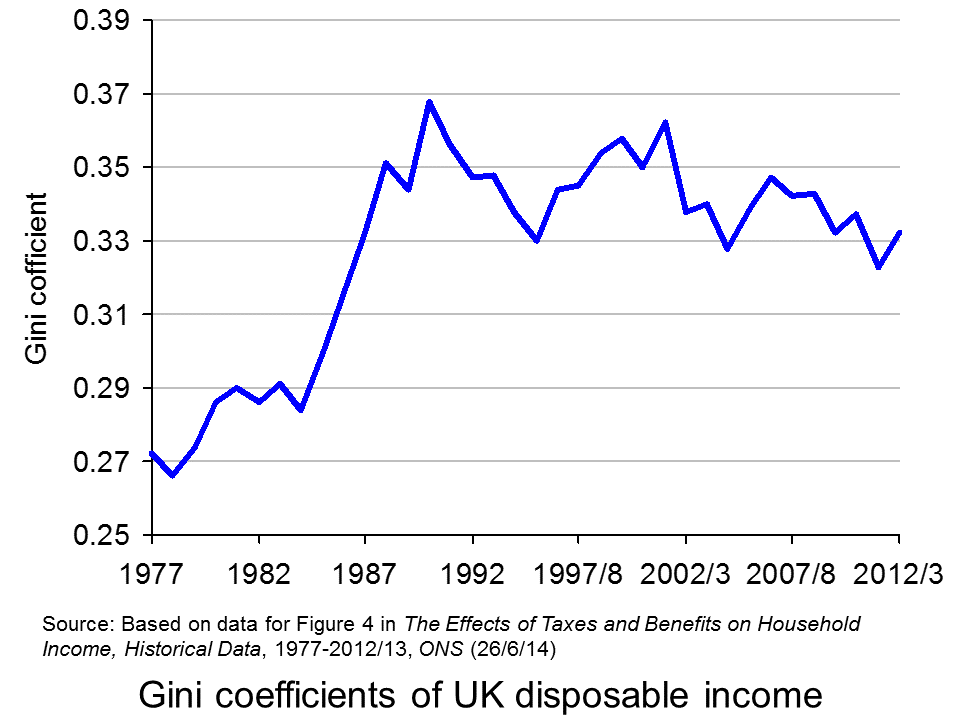 Taking the period from 1977 to 2012/13, inequality of disposable income (i.e. income after direct taxes and cash benefits) increased from 1977 to 1988, especially during the second two Thatcher governments (1983 to 1990) (see chart opposite). But then in the first part of the 1990s inequality fell, only to rise again in the late 1990s and early 2000s. However, with the Labour government giving greater cash benefits for the poor, inequality reduced once more, only to widen again in the boom running up to the banking crisis of 2007/8. But then, with recession taking hold, the incomes of many top earners fell and automatic stabilisers helped protect the incomes of the poor. Inequality consequently fell. But with the capping of benefit increases and a rise in incomes of many top earners as the economy recovers, so inequality is beginning to rise once more – in 2012/13, the Gini coefficient rose to 0.332 from 0.323 the previous year.
As far as income after cash benefits and both direct and indirect taxes is concerned, the average income of the richest quintile relative to that of the poorest quintile rose from 7.2 in 2002/3 to 7.6 in 2007/8 and then fell to 6.9 in 2012/13.
Other headlines in the report include:
Since the start of the economic downturn in 2007/08, the average disposable income has decreased for the richest fifth of households but increased for the poorest fifth.
Cash benefits made up over half (56.4%) of the gross income of the poorest fifth of households, compared with 3.2% of the richest fifth, in 2012/13.
The average disposable income in 2012/13 was unchanged from 2011/12, but it remains lower than at the start of the economic downturn, with equivalised disposable income falling by £1200 since 2007/08 in real terms. The fall in income has been largest for the richest fifth of households (5.2%). In contrast, after accounting for inflation and household composition, the average income for the poorest fifth has grown over this period (3.5%).
This is clearly a mixed picture in terms of whether the UK is becoming more or less equal. Politicians will, no doubt, ‘cherry pick’ the data that suit their political position. In general, the government will present a good news story and the opposition a bad news one. As economists, it is hoped that you can take a dispassionate look at the data and attempt to relate the figures to policies and events.
Report
The Effects of Taxes and Benefits on Household Income, 2012/13 ONS (26/6/14)
Data
Reference tables in The Effects of Taxes and Benefits on Household Income, 2012/13 ONS (26/6/14)
The Effects of Taxes and Benefits on Household Income, Historical Data, 1977-2012/13 ONS (26/6/14)
Rates of Income Tax: 1990-91 to 2014-15 HMRC
Articles
Inequality is on the up again – Osborne’s boast is over New Statesman, George Eaton (26/6/14)
Disposable incomes rise for richest fifth households only Money.com, Lucinda Beeman (26/6/14)
Half of families receive more from the state than they pay in taxes but income equality widens as rich get richer Mail Online, Matt Chorley (26/6/14)
Rich getting richer as everyone else is getting poorer, Government’s own figures reveal Mirror, Mark Ellis (26/6/14)
The Richest Households Got Richer Last Year, While Everyone Else Got Poorer The Economic Voice (27/6/14)
Questions
- Define the following terms: original income, gross income, disposable income, post-tax income, final income.
- How does the receipt of benefits in kind vary across the quintile groups? Explain.
- What are meant by the Lorenz curve and the Gini coefficient and how is the Gini coefficient measured? Is it a good way of measuring inequality?
- Paint a picture of how income distribution has changed over the past 35 years.
- Can changes in tax be a means of helping the poorest in society?
- What types of income tax cuts are progressive and what are regressive?
- Why are taxes in the UK regressive?
- Why has the fall in income been largest for the richest fifth of households since 2007/8? Does this mean that, as the economy recovers, the richest fifth of households are likely to experience the fastest increase in disposable incomes?
 Officials from Rugby Union’s Aviva Premiership recently announced that the salary cap used by the league would increase from £4.76 million to £5.1 million per team for the 2015-16 season. It is not the only professional sports league to use this type of regulation. The NFL currently has a salary cap of $133 million/team while in the NBA it is set at $63 million/team. What is the rationale for placing restrictions on the amount an organisation can pay its employees? How do these caps work in practice?
  The senior salary cap is the major part of the regulation and the Aviva Premiership announced that this would increase from £4.76 million per team in the current season to £5.1 million per team for 2015-16. The Academy credits enable teams to exceed this £5.1 million limit if they train and develop younger players. The teams have to prove that they have young players that meet the following criteria: